The Long and Short
Surplus notes return to the primary market
This material is a Marketing Communication and does not constitute Independent Investment Research.
The first two launches of surplus notes in 2026 came in recent weeks. Insurance companies have been mostly raising debt through alternative debt structures. Nevertheless, surplus notes still offer an attractive way to target higher ratings while adding spread over notes issued at the senior unsecured level. They have traditionally traded at a wider spread to their senior, publicly issued counterparts. While that spread has compressed with increased risk appetite and price discovery in this niche, conservative investors can still gain exposure to higher-rated credits in the long-end of the curve, without conceding much spread or yield.
Pre-capitalized securities (P-CAPs) and funding agreement (FA) backed notes have been far more prevalent among insurance company issuers seeking to raise capital while keeping borrowing costs at a minimum, and demand for high quality paper has facilitated these trends. Still, surplus notes remain a viable option to investment grade issuers and have recently returned to the new issue market after a long hiatus dating back to September of last year (PACLIF 5.95% ’55) and previously to last summer with SYA’s 30-year note offering. Issuance has been relatively dormant over the past couple of years, but the two new deals demonstrate the opportunity for the primary market to pick up again, and new surplus issuers often come in waves.
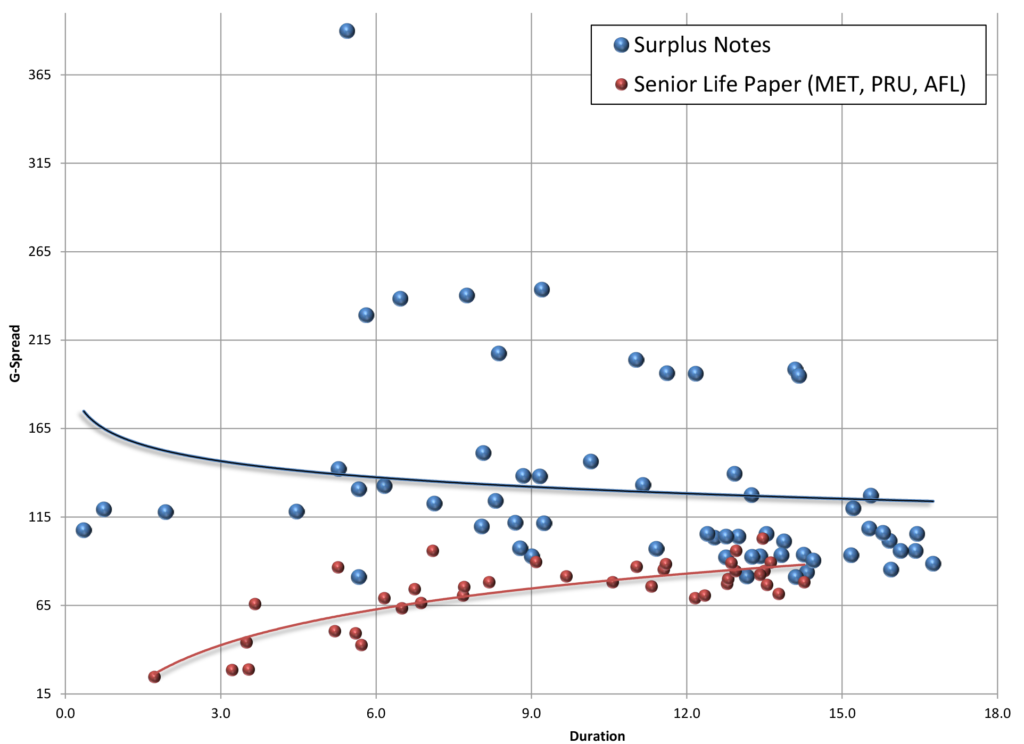
Northwestern Mutual Life Insurance (NWMLIC: Aa3/AA-) brought $1.25 billion of 30-year surplus notes on May 18, roughly a year after their last deal in this segment. The subordinated operating company level debt came at a spread of 93 bp over the 30-year, or a yield of 6.05% at the time, after initial price talk of 120 bp. Earlier this week, Massachusetts Mutual (MASSMU: A2/AA-) followed up by pricing $1 billion of similarly structured paper at spread of 100 bp over the 30-year, after initial price talk in the 130 bp area. The latter debt launch comes as MASSMU is still facing uncertainties regarding an SEC probe into their accounting practices that was announced in late 2025. As is always the case, the subordinated bonds for both new issues were rated one notch below each insurance operating company’s respective financial strength ratings. In both cases, the new notes appear attractively valued at just under 6% total yield to similarly rated senior unsecured life insurance company notes currently outstanding (Exhibit 1). With 30-year US treasury rates back below 5% and investment grade credit spreads back near historically tight levels, yield-based buy programs have adjusted accordingly.
Exhibit 1. Surplus notes credit curve versus life insurance seniors
Source: Santander US Capital Markets LLC, Bloomberg/TRACE YAS G-Spread indications only
Life insurance senior issues include MET, PRU and AFL
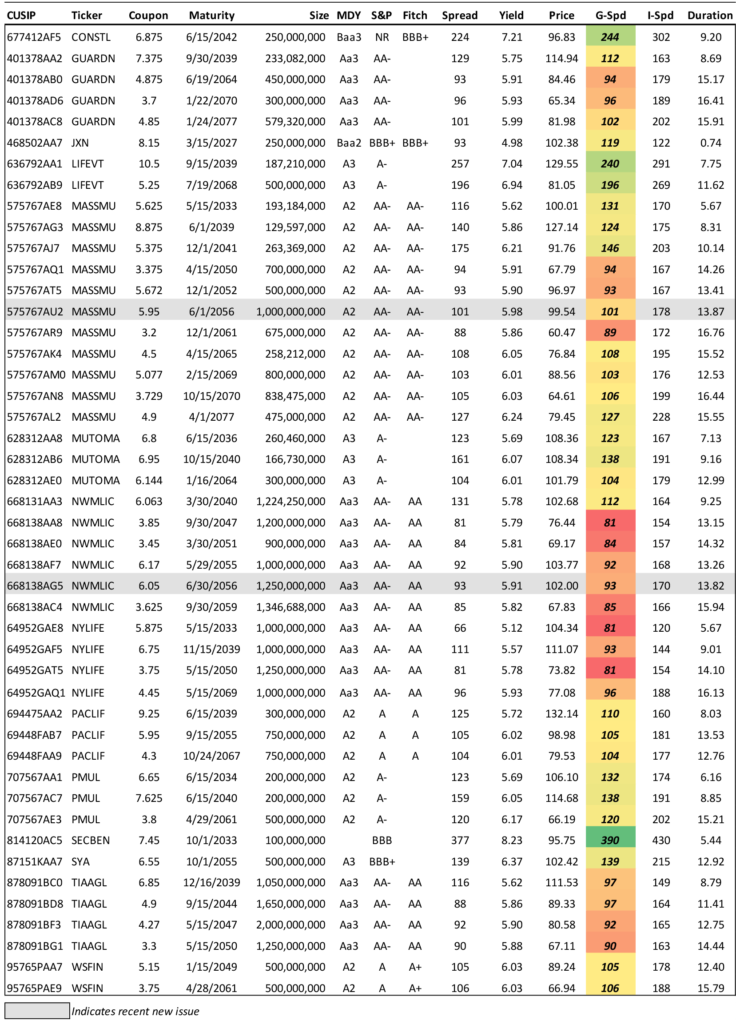
There are now roughly 60 bonds total with $100 million or more par value and classified as investment grade insurance surplus notes currently outstanding, making it still a relatively niche segment of the broader insurance sector (exhibits 2 and 3 below). With few exceptions, these bonds are typically issued through 144a private placement, therefore they are mostly outside of the investment grade index. Secondary market liquidity in surplus notes typically ebbs and flows, mostly in conjunction with 30-year US Treasury rates. When 30-year Treasuries get close to 5%, as has been the case lately, it traditionally to draw long-end buyers into the market looking for very high-quality paper that can potentially yield over 6%.
From 2017 through 2021 there were waves of issuance that saw as many five to six borrowers in a given year access this unique corner of the corporate bond market. Again, given the attractiveness to total yield buyers, index eligibility is by no means mandatory. That could potentially broaden the field of borrowers to those wishing to issue in sizes below $300 million as primary liquidity picks back up again. The primer below provides additional background on the structure as well as the motivations for issuers.
Exhibit 2. Universe of life insurance surplus notes
Source: Santander US Capital Markets LLC, Bloomberg/TRACE YAS price indications only
Primer: Background on surplus notes
Public and mutual insurance companies utilize surplus notes offerings to diversify capital and attract different types of investors within the public debt markets. Despite their subordinated classifications within the capital structure, in many cases surplus notes are among the only outstanding debt issues for mutual companies. Therefore, they are often only subordinated to the insurance company’s policyholders from a priority of payment standpoint. Interestingly for the public insurance companies, since the debt is issued directly out of the insurance operating company, it typically maintains structural seniority to most of the senior unsecured debt issued at the parent company level, though remain subordinated to funding agreement-backed (FA-backed) or guaranteed investment contract (GIC) structures at the operating company. Furthermore, since large mutual insurance companies are conservatively managed, and typically well-capitalized, these subordinated issues frequently maintain higher ratings than even the senior debt levels of some of the largest and higher-rated public insurance companies.
Surplus notes are technically hybrid capital – but with limitations
Surplus notes are subordinated to policyholders and all other senior debt instruments outstanding at the operating subsidiary. They are classified as hybrid capital since they technically provide for temporary loss absorption to issuers. While the deals are mostly issued as cumulative, both principal and interest payments must be approved by the insurance company’s state regulators. At the regulator’s discretion, those payments can be delayed without triggering an event of default or cross-default provisions. In the event of a delay in interest payment, interest accrues until regulatory approval is reinstated to the issuer to resume the payments. Since the structures first became prominent roughly 30 to 35 years ago, there are very few instances where a delay in payment was ever implemented among investment grade issuers.
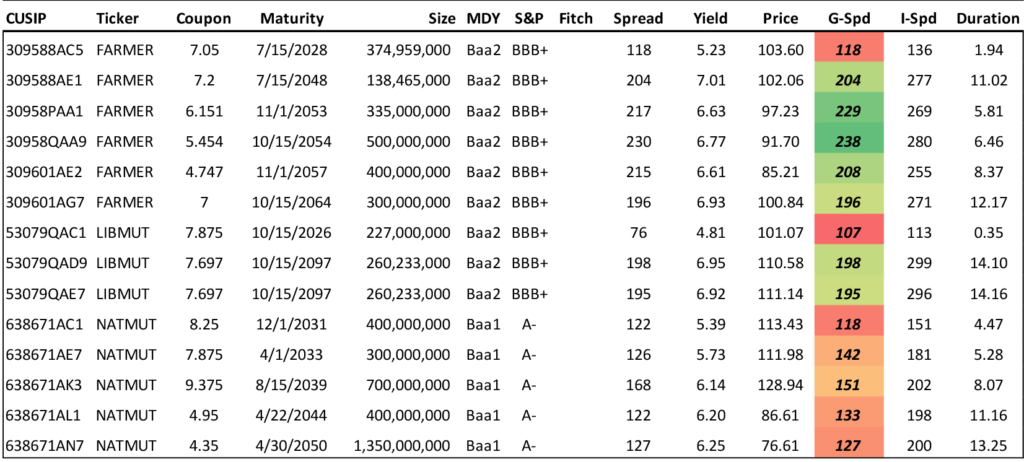
Exhibit 3. Universe of P&C insurance surplus notes
Source: Santander US Capital Markets LLC, Bloomberg/TRACE YAS price indications only
Why surplus notes were originally conceived
Mutual insurance companies are mostly owned by the policyholders themselves. As a result, access to public capital markets was traditionally more limited. This new structure gave non-traditional issuers the opportunity to bolster capital levels and enhance financial flexibility. As with principal and interest payments, the actual issuance must also be approved by the state regulator. The structure was largely dormant for some time but re-emerged after the financial crisis in 2009 as insurance companies looked to bolster capital ratio levels and instill confidence in the markets. Issuance has since been sporadic, with several prominent deals coming over the past few years.
Rating agencies’ approach to surplus notes
Moody’s typically rates surplus notes two notches lower than the operating company’s insurance financial strength (IFS) rating for life insurers, and three notches for property & casualty insurers. S&P also rates two and three notches below the operating company financial strength rating as well. For hybrid treatment, the rating agencies will determine the level of equity credit to the issuer based on the maturity and whether or not the issue is cumulative. However, once the issue is within 20 years to maturity—which is true for many of the older, original structures—Moody’s will automatically treat the issue as 100% debt.
This material is intended only for institutional investors and does not carry all of the independence and disclosure standards of retail debt research reports. In the preparation of this material, the author may have consulted or otherwise discussed the matters referenced herein with one or more of SCM’s trading desks, any of which may have accumulated or otherwise taken a position, long or short, in any of the financial instruments discussed in or related to this material. Further, SCM may act as a market maker or principal dealer and may have proprietary interests that differ or conflict with the recipient hereof, in connection with any financial instrument discussed in or related to this material.
This message, including any attachments or links contained herein, is subject to important disclaimers, conditions, and disclosures regarding Electronic Communications, which you can find at https://portfolio-strategy.apsec.com/sancap-disclaimers-and-disclosures.
Important Disclaimers
Copyright © 2026 Santander US Capital Markets LLC and its affiliates (“SCM”). All rights reserved. SCM is a member of FINRA and SIPC. This material is intended for limited distribution to institutions only and is not publicly available. Any unauthorized use or disclosure is prohibited.
In making this material available, SCM (i) is not providing any advice to the recipient, including, without limitation, any advice as to investment, legal, accounting, tax and financial matters, (ii) is not acting as an advisor or fiduciary in respect of the recipient, (iii) is not making any predictions or projections and (iv) intends that any recipient to which SCM has provided this material is an “institutional investor” (as defined under applicable law and regulation, including FINRA Rule 4512 and that this material will not be disseminated, in whole or part, to any third party by the recipient.
The author of this material is an economist, desk strategist or trader. In the preparation of this material, the author may have consulted or otherwise discussed the matters referenced herein with one or more of SCM’s trading desks, any of which may have accumulated or otherwise taken a position, long or short, in any of the financial instruments discussed in or related to this material. Further, SCM or any of its affiliates may act as a market maker or principal dealer and may have proprietary interests that differ or conflict with the recipient hereof, in connection with any financial instrument discussed in or related to this material.
This material (i) has been prepared for information purposes only and does not constitute a solicitation or an offer to buy or sell any securities, related investments or other financial instruments, (ii) is neither research, a “research report” as commonly understood under the securities laws and regulations promulgated thereunder nor the product of a research department, (iii) or parts thereof may have been obtained from various sources, the reliability of which has not been verified and cannot be guaranteed by SCM, (iv) should not be reproduced or disclosed to any other person, without SCM’s prior consent and (v) is not intended for distribution in any jurisdiction in which its distribution would be prohibited.
In connection with this material, SCM (i) makes no representation or warranties as to the appropriateness or reliance for use in any transaction or as to the permissibility or legality of any financial instrument in any jurisdiction, (ii) believes the information in this material to be reliable, has not independently verified such information and makes no representation, express or implied, with regard to the accuracy or completeness of such information, (iii) accepts no responsibility or liability as to any reliance placed, or investment decision made, on the basis of such information by the recipient and (iv) does not undertake, and disclaims any duty to undertake, to update or to revise the information contained in this material.
Unless otherwise stated, the views, opinions, forecasts, valuations, or estimates contained in this material are those solely of the author, as of the date of publication of this material, and are subject to change without notice. The recipient of this material should make an independent evaluation of this information and make such other investigations as the recipient considers necessary (including obtaining independent financial advice), before transacting in any financial market or instrument discussed in or related to this material.
Important disclaimers for clients in the EU and UK
This publication has been prepared by Trading Desk Strategists within the Sales and Trading functions of Santander US Capital Markets LLC (“SanCap”), the US registered broker-dealer of Santander Corporate & Investment Banking. This communication is distributed in the EEA by Banco Santander S.A., a credit institution registered in Spain and authorised and regulated by the Bank of Spain and the CNMV. Any EEA recipient of this communication that would like to affect any transaction in any security or issuer discussed herein should do so with Banco Santander S.A. or any of its affiliates (together “Santander”). This communication has been distributed in the UK by Banco Santander, S.A.’s London branch, authorised by the Bank of Spain and subject to regulatory oversight on certain matters by the Financial Conduct Authority (FCA) and the Prudential Regulation Authority (PRA).
The publication is intended for exclusive use for Professional Clients and Eligible Counterparties as defined by MiFID II and is not intended for use by retail customers or for any persons or entities in any jurisdictions or country where such distribution or use would be contrary to local law or regulation.
This material is not a product of Santander´s Research Team and does not constitute independent investment research. This is a marketing communication and may contain ¨investment recommendations¨ as defined by the Market Abuse Regulation 596/2014 ("MAR"). This publication has not been prepared in accordance with legal requirements designed to promote the independence of research and is not subject to any prohibition on dealing ahead of the dissemination of investment research. The author, date and time of the production of this publication are as indicated herein.
This publication does not constitute investment advice and may not be relied upon to form an investment decision, nor should it be construed as any offer to sell or issue or invitation to purchase, acquire or subscribe for any instruments referred herein. The publication has been prepared in good faith and based on information Santander considers reliable as of the date of publication, but Santander does not guarantee or represent, express or implied, that such information is accurate or complete. All estimates, forecasts and opinions are current as at the date of this publication and are subject to change without notice. Unless otherwise indicated, Santander does not intend to update this publication. The views and commentary in this publication may not be objective or independent of the interests of the Trading and Sales functions of Santander, who may be active participants in the markets, investments or strategies referred to herein and/or may receive compensation from investment banking and non-investment banking services from entities mentioned herein. Santander may trade as principal, make a market or hold positions in instruments (or related derivatives) and/or hold financial interest in entities discussed herein. Santander may provide market commentary or trading strategies to other clients or engage in transactions which may differ from views expressed herein. Santander may have acted upon the contents of this publication prior to you having received it.
This publication is intended for the exclusive use of the recipient and must not be reproduced, redistributed or transmitted, in whole or in part, without Santander’s consent. The recipient agrees to keep confidential at all times information contained herein.