The Long and Short
Humana brings the first health insurance P-CAP
This material is a Marketing Communication and does not constitute Independent Investment Research.
Humana Inc (HUM: Baa2/BBB/BBB-) recently issued a first of its kind pre-capitalized security (P-CAP) for the health insurance sector this week. The structure had previously been mostly exclusive to the life and P&C insurance segments. The new notes could serve as a springboard for other health issuers to follow. The timing of HUM’s launch follows a sharp recovery in the issuer’s credit spreads, providing a window for issuance. The P-CAP market continues to mature with increased awareness and acceptance by institutional investors. Spread opportunity has gotten more technical. But the prospect of seeing the structure grow beyond the life and P&C industries is getting better.
It makes sense that HUM management used the recent tightening in credit spreads as an opportunity to access debt markets. P-CAPs enable them to do so without putting debt directly on their balance sheet – an attractive feature of the security structure. HUM has been under pressure in credit markets since January, when reports surfaced that the increase in Medicare Advantage reimbursement rates could be near zero in 2027. The initial reaction in spreads appeared overdone but persisted into the broader credit selloff in March. Last month, the Centers for Medicare & Medicaid Services (CMS) ruled that Medicare payment rates would increase 2.48% next year, providing an estimated $13 billion in relief to the industry. Medicare makes up over 70% of HUM’s total membership with the vast majority of premiums earned with no group commercial or marketplace members. That compares with Medicare membership in the range of zero to mid-teens for peers such as UNH, CVS, ELV and CI.
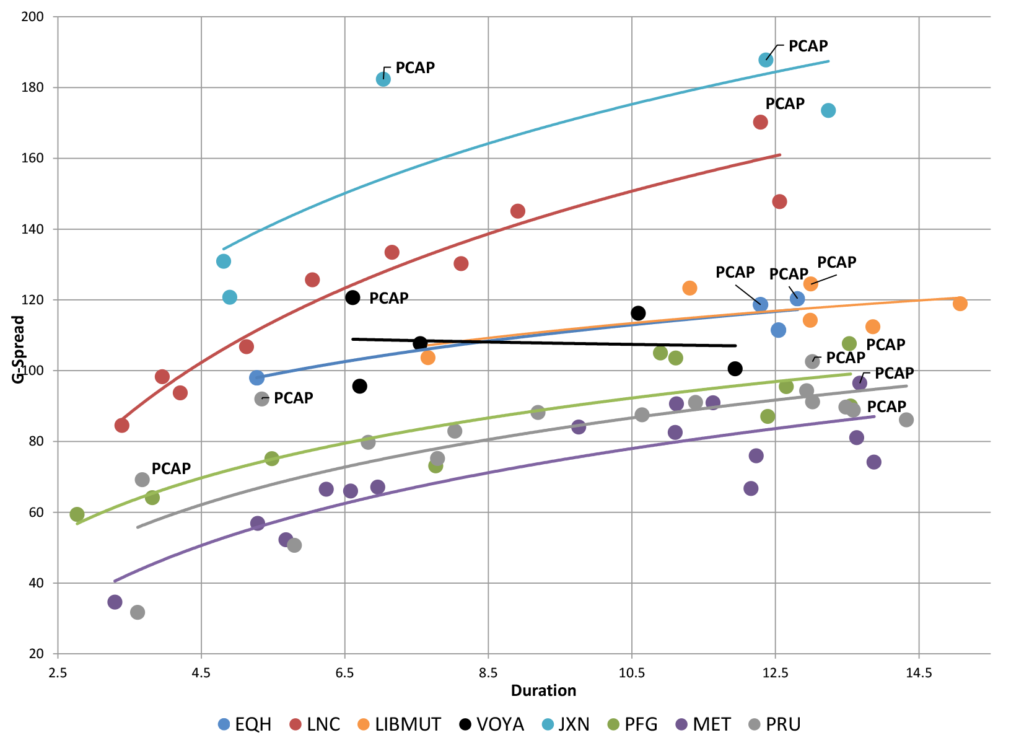
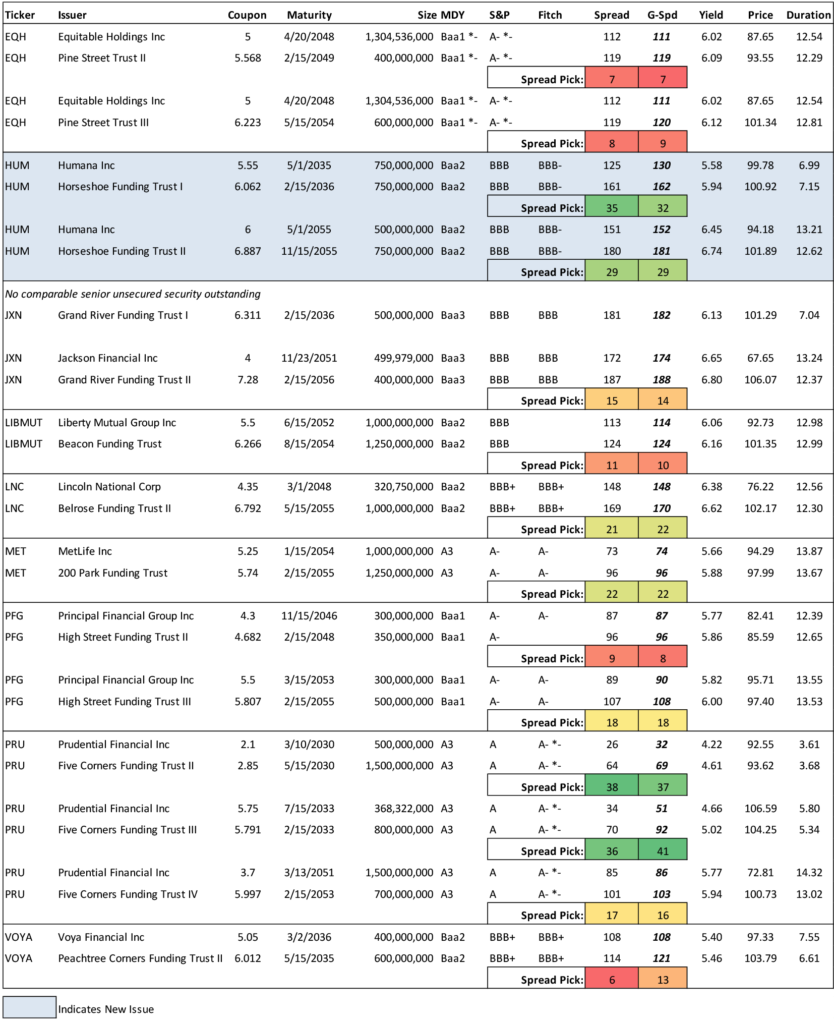
HUM launched a two-tranche P-CAP with a 10- and 30-year maturity, named the Horseshoe Funding Trust I and II. They priced $750 million in each tranche at spread levels of 195 bp over the 10-year Treasury and 220 bp over the 30-year, respectively. At those prices, bonds offered roughly 35 bp discounts to secondary senior unsecured securities of similar maturities. Comparatively, the discount among life and P&C P-CAPs has gotten closer to the 15 to 20 bp range for longer-dated securities in the secondary market (Exhibit 1). The HUM deal performed extremely well on the first day of trading with spreads tightening about 5 bp after launch. Current discounts are around 30 bp for the long bond and 32-33 bp for the 10-year notes relative to secondaries (Exhibit 2). These bonds still appear attractively priced relative to rest of the P-CAP segment with the potential for spread tightening relative to seniors.
The applications of the P-CAP structure have long appeared to have broader potential outside of the insurance industry. In 2023, power generation company Vistra Corp (VST: Baa3/BBB- secured rating) issued a P-CAP structure, entitled Palomino Funding Trust I. With time, it seems possible that other utility credits and additional industries might see the benefits of holding liquidity in reserve. P-CAPs are a unique trust structure to raise funds while keeping leverage off the balance sheet until the funds are eventually needed. The market appears to increasingly acknowledge that P-CAPs are rated in-line with their respective senior unsecured notes. The rating agencies consider the trust structures pari passu with comparable senior debt, since the issuers are required to issue senior debt into the trust if they ever take ownership of the Treasury securities that are held. This fact was demonstrated in recent real-world examples including Unum (see below) and LNC, where trusts were dissolved and/or debt was exchanged for comparable senior unsecured bonds.
Exhibit 1. Selected insurance P-CAPs and their senior unsecured credit curves – P-CAP discounts have gotten tighter and more technical over the past two years
Source: Santander US Capital Markets LLC, Bloomberg/TRACE – G-spread indications only
Exhibit 2. Spread opportunity in insurance P-CAPs is increasingly technical relative to comparable senior unsecured debt
Source: Santander US Capital Markets LLC, Bloomberg/TRACE pricing
Primer: Pre-capitalized securities (P-CAPs)
Pre-capitalized securities or P-CAPs are a unique trust structure that have been mostly utilized by insurance companies seeking to issue debt, but also wanting to keep leverage off the balance sheet until or if the funds are eventually needed. The bonds trade in the secondary market at a discount to comparable senior unsecured debt issued by the same insurance companies.
The motivational concept behind a P-CAP is fairly simple. The issuer creates a trust that accesses the public debt market, but that debt is held off balance sheet of the insurance company and does not contribute to financial leverage. The proceeds of the securities issued by the trust are used to purchase Treasuries (principal or interest strips), from which the trust will pay a coupon plus a locked in spread rate that is paid/provided by the underlying insurance company. In effect, it is a means for an insurance issuer to essentially lock in or create an option on interest rates at a time when they view rates as attractive but might not necessarily need to issue debt. The company effectively has a put option to issue senior unsecured debt into the trust at any time and take ownership of the treasury securities that are held (typically at increments of $50 or $100 million depending on the terms of the deal). Only at that point does the debt count toward financial leverage and the issuer have access to the funds.
All outstanding P-CAPs are rated in-line with the senior unsecured debt of the issuer, as the rating agencies view the credit quality as being closely linked to that of underlying insurance company. The notes issued into the trust upon exercise would be pari passu with all senior unsecured debt obligations of the underlying insurance company. An issuer would choose to execute voluntarily in the event that it could no longer access the public debt markets or simply views current rates as less attractive to issue new debt. Debt issuance to the trust can also occur as a result of a mandatory exercise event, which is described below. So far, no insurance company that has issued P-CAPs has ever exercised either voluntarily or through automatic/mandatory action.
An automatic exercise event occurs if either a bankruptcy event occurs at the underlying insurance company, or if the company fails to make scheduled payments to the trust. A mandatory exercise event would occur if consolidated net worth of the company falls below a certain threshold, or if the company defaults on other payments or violates debt covenants. In either case, the senior debt then issued to the trust puts holders of the P-CAPs in a pari passu position with other senior debtholders of the insurance company.
In 2024, Unum Group (UNM: Baa2/BBB/BBB) dissolved their outstanding Hill City Funding Trust (UNM 4.046% ‘41%). Since the P-CAP structure was conceived, no other issuer had actually executed an exercise event before, which helped demonstrate the fallback nature of these liquidity reserves. As the first dissolution, the UNM bonds served as a case study for execution, and proof of concept, particularly for investors that might still be reluctant about the structure itself. UNM took ownership of the Treasury securities previously held in the trust by issuing senior unsecured debt with identical coupon, principal and maturity into the trust. Therefore, the holders of the notes will continue receive the same coupon payments unabated, while the ratings and seniority of the bonds will remain the same.
This material is intended only for institutional investors and does not carry all of the independence and disclosure standards of retail debt research reports. In the preparation of this material, the author may have consulted or otherwise discussed the matters referenced herein with one or more of SCM’s trading desks, any of which may have accumulated or otherwise taken a position, long or short, in any of the financial instruments discussed in or related to this material. Further, SCM may act as a market maker or principal dealer and may have proprietary interests that differ or conflict with the recipient hereof, in connection with any financial instrument discussed in or related to this material.
This message, including any attachments or links contained herein, is subject to important disclaimers, conditions, and disclosures regarding Electronic Communications, which you can find at https://portfolio-strategy.apsec.com/sancap-disclaimers-and-disclosures.
Important Disclaimers
Copyright © 2026 Santander US Capital Markets LLC and its affiliates (“SCM”). All rights reserved. SCM is a member of FINRA and SIPC. This material is intended for limited distribution to institutions only and is not publicly available. Any unauthorized use or disclosure is prohibited.
In making this material available, SCM (i) is not providing any advice to the recipient, including, without limitation, any advice as to investment, legal, accounting, tax and financial matters, (ii) is not acting as an advisor or fiduciary in respect of the recipient, (iii) is not making any predictions or projections and (iv) intends that any recipient to which SCM has provided this material is an “institutional investor” (as defined under applicable law and regulation, including FINRA Rule 4512 and that this material will not be disseminated, in whole or part, to any third party by the recipient.
The author of this material is an economist, desk strategist or trader. In the preparation of this material, the author may have consulted or otherwise discussed the matters referenced herein with one or more of SCM’s trading desks, any of which may have accumulated or otherwise taken a position, long or short, in any of the financial instruments discussed in or related to this material. Further, SCM or any of its affiliates may act as a market maker or principal dealer and may have proprietary interests that differ or conflict with the recipient hereof, in connection with any financial instrument discussed in or related to this material.
This material (i) has been prepared for information purposes only and does not constitute a solicitation or an offer to buy or sell any securities, related investments or other financial instruments, (ii) is neither research, a “research report” as commonly understood under the securities laws and regulations promulgated thereunder nor the product of a research department, (iii) or parts thereof may have been obtained from various sources, the reliability of which has not been verified and cannot be guaranteed by SCM, (iv) should not be reproduced or disclosed to any other person, without SCM’s prior consent and (v) is not intended for distribution in any jurisdiction in which its distribution would be prohibited.
In connection with this material, SCM (i) makes no representation or warranties as to the appropriateness or reliance for use in any transaction or as to the permissibility or legality of any financial instrument in any jurisdiction, (ii) believes the information in this material to be reliable, has not independently verified such information and makes no representation, express or implied, with regard to the accuracy or completeness of such information, (iii) accepts no responsibility or liability as to any reliance placed, or investment decision made, on the basis of such information by the recipient and (iv) does not undertake, and disclaims any duty to undertake, to update or to revise the information contained in this material.
Unless otherwise stated, the views, opinions, forecasts, valuations, or estimates contained in this material are those solely of the author, as of the date of publication of this material, and are subject to change without notice. The recipient of this material should make an independent evaluation of this information and make such other investigations as the recipient considers necessary (including obtaining independent financial advice), before transacting in any financial market or instrument discussed in or related to this material.
Important disclaimers for clients in the EU and UK
This publication has been prepared by Trading Desk Strategists within the Sales and Trading functions of Santander US Capital Markets LLC (“SanCap”), the US registered broker-dealer of Santander Corporate & Investment Banking. This communication is distributed in the EEA by Banco Santander S.A., a credit institution registered in Spain and authorised and regulated by the Bank of Spain and the CNMV. Any EEA recipient of this communication that would like to affect any transaction in any security or issuer discussed herein should do so with Banco Santander S.A. or any of its affiliates (together “Santander”). This communication has been distributed in the UK by Banco Santander, S.A.’s London branch, authorised by the Bank of Spain and subject to regulatory oversight on certain matters by the Financial Conduct Authority (FCA) and the Prudential Regulation Authority (PRA).
The publication is intended for exclusive use for Professional Clients and Eligible Counterparties as defined by MiFID II and is not intended for use by retail customers or for any persons or entities in any jurisdictions or country where such distribution or use would be contrary to local law or regulation.
This material is not a product of Santander´s Research Team and does not constitute independent investment research. This is a marketing communication and may contain ¨investment recommendations¨ as defined by the Market Abuse Regulation 596/2014 ("MAR"). This publication has not been prepared in accordance with legal requirements designed to promote the independence of research and is not subject to any prohibition on dealing ahead of the dissemination of investment research. The author, date and time of the production of this publication are as indicated herein.
This publication does not constitute investment advice and may not be relied upon to form an investment decision, nor should it be construed as any offer to sell or issue or invitation to purchase, acquire or subscribe for any instruments referred herein. The publication has been prepared in good faith and based on information Santander considers reliable as of the date of publication, but Santander does not guarantee or represent, express or implied, that such information is accurate or complete. All estimates, forecasts and opinions are current as at the date of this publication and are subject to change without notice. Unless otherwise indicated, Santander does not intend to update this publication. The views and commentary in this publication may not be objective or independent of the interests of the Trading and Sales functions of Santander, who may be active participants in the markets, investments or strategies referred to herein and/or may receive compensation from investment banking and non-investment banking services from entities mentioned herein. Santander may trade as principal, make a market or hold positions in instruments (or related derivatives) and/or hold financial interest in entities discussed herein. Santander may provide market commentary or trading strategies to other clients or engage in transactions which may differ from views expressed herein. Santander may have acted upon the contents of this publication prior to you having received it.
This publication is intended for the exclusive use of the recipient and must not be reproduced, redistributed or transmitted, in whole or in part, without Santander’s consent. The recipient agrees to keep confidential at all times information contained herein.