


The Big Idea
Subtle, small shifts on the horizon in MBS
Steven Abrahams | May 15, 2026
This material is a Marketing Communication and does not constitute Independent Investment Research.
Recent changes to insurer capital and proposed changes to bank capital for mortgage loans promise to pull in more buyers from those corners of the market and indirectly bid up other mortgage assets. And the bank rules along with some changes to credit scoring for Fannie Mae and Freddie Mac loans may also reshape pricing of loan guarantees and some subtleties of prepayment risk.
Change in insurer capital could lift mortgage loan demand
Insurers at the end of April won some valuable capital relief on mortgage loan holdings that should encourage more loan investment, especially from smaller insurers. My colleague, Chris Helwig, covers the details of the development elsewhere in this issue. But more demand for loans is likely to increase demand for that part of the mortgage market and push some current buyers into private and agency MBS.
Guidelines from the National Association of Insurance Commissioners until April 30 had penalized mortgage loans owned by insurers through unaffiliated funds. Insurers could hold performing residential loans directly and use only 68 bp of capital, but the same loans in an unaffiliated vehicle required 175 bp of capital. Guidelines issued last month dropped the capital required for an unaffiliated vehicle to 68 bp.
The change looks likely to encourage asset managers to set up vehicles where smaller insurers can participate and share the significant costs of due diligence and servicing mortgage loans. Mortgage loans, especially non-QM, have become favorite investments for larger insurers with the expertise and scale to hold them on balance sheet or through affiliated funds. The NAIC guidance should open the gates to a wider set of insurers.
New bank capital rules may sway MBS prepayments
The raft of new bank capital rules proposed by regulators on March 19 included important incentives that could eventually change Fannie Mae and Freddie Mac pricing of loan guarantees. As guarantees go, so goes the cost of mortgage debt and MBS prepayment risks. The cost of debt for mortgages with high loan-to-value could go up, the prepayment risk down.
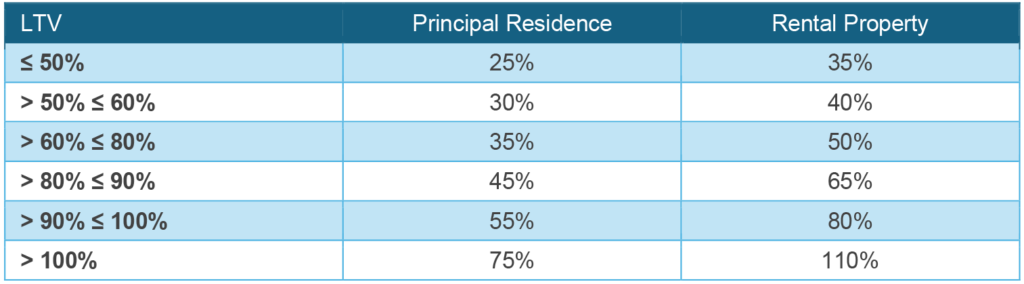
The proposed rules lower the amount of capital required for banks to hold mortgages with low loan-to-value ratios. Performing mortgages today get a 50% risk weight, regardless of LTV. Banks consequently hold $4 for every $100 in loan principal. Under the proposed rules, capital drops for every loan with an LTV of 90% or lower and rises for anything higher (Exhibit X). At the extreme, for loans with LTVs of 50% or lower, the risk weight drops to 25% and capital to $2 for every $100 in loan principal.
Exhibit 1: Bank risk weights would drop with LTV under proposed rules
Source: Federal Reserve https://www.federalregister.gov/documents/2026/03/27/2026-05960/regulatory-capital-rules-regulatory-capital-and-standardized-approach-for-risk-weighted-assets
The lower capital creates incentives for banks to hold onto loans with lower LTVs, possibly at the expense of otherwise selling the loans to Fannie Mae or Freddie Mac or into private securitizations. The higher capital for loans with LTV above 90% creates incentives to sell to the enterprises.
Today almost 80% of all loans sold to Fannie Mae and Freddie Mac come from nonbanks, suggesting the new rules might have little effect on flows to the enterprises. But that high nonbank share in part reflects capital treatment of mortgage loans and servicing implemented after the 2008 Global Financial Crisis. In 2013, for example, roughly 60% of Fannie Mae loans and 80% of Freddie Mac loans came from banks. The newly proposed rules try to draw banks back into mortgage origination and servicing.
For Fannie Mae and Freddie Mac, new capital rules could affect a significant amount of loan flow. In 2025, for instance, 76% of total 30-year guaranteed principal came with an LTV of 90% or less and 60% came with an LTV of 80% or less—all loans that will see required bank capital drop if the latest proposals go into effect (Exhibit 2).
Exhibit 2: Most Fannie Mae, Freddie Mac loans would see capital drop
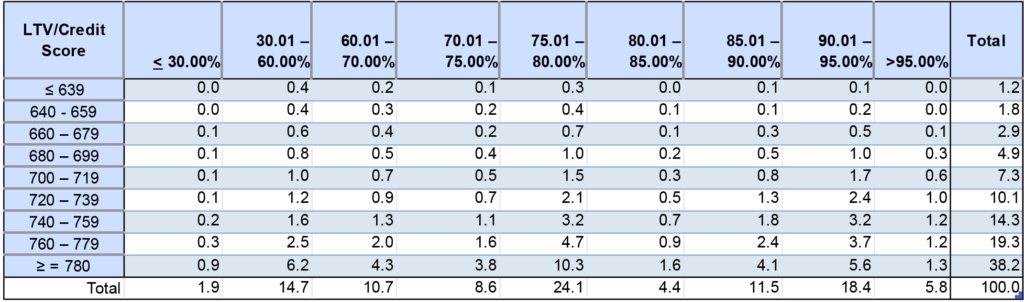
Note: All Fannie Mae and Freddie Mac 30-year mortgage principal guaranteed in calendar 2025.
Source: Fannie Mae, Freddie Mac, Santander US Capital Markets
The issue for Fannie Mae and Freddie Mac will be how a change in flow might affect guarantees, including the loan-level pricing adjustments charged at the initial delivery of the loan. Although the enterprises do not report the profitability of their guarantees by LTV and FICO, most analysts assume that relatively high expected profits on stronger loans subsidize lower expected profits or even outright losses on weaker loans. If the flow of stronger loans thins out, the enterprises will have to restrike that balance.
If the average Fannie Mae and Freddie Mac LTV goes up, the average guarantee fee will presumably have to follow. How that higher fee will apply across LTV and credit score will almost certainly depend on the loans’ alternative value either in lender portfolios or private securitizations. The better the valuation outside of agency MBS, the less leverage the enterprises will have to raise fees. Most of the extra cost may end up on the weakest loans.
A bias toward higher guarantee fees over the next few years as the proposed rules take effect and as the enterprises assess loan flows should dampen some of the prepayment risk in outstanding MBS. It could be that banks end up offering newly aggressive rates for stronger loans and counter some of the effect of higher agency fees. Of course, that would leave weaker loans subject to higher fees without competing alternatives. New bank capital rules could have the effect of raising the cost of debt for high LTV mortgages and initially dampening their prepayment risk.
VantageScore and the impact of lender choice on LLPAs
Fannie Mae and Freddie Mac have also recently started accepting either VantageScore 4.0 or Classic FICO credit scores for loan purchases, leading some analysts to predict that guarantee fees will need to rise in response to lenders’ ability to use the higher of the two. But a rise in the average fee seems unlikely. Instead, look for a flattening of LLPA fees across credit scores.
“Lender choice will result in higher credit scores being used for loan pricing on a material population of mortgage applications,” risk-advisor Milliman wrote in a February report, “which can bias loan-level price adjustments (LLPAs) and reduce the guarantee fees collected by Fannie Mae and Freddie Mac (the Enterprises).
“It is likely that LLPAs will be increased to offset this bias,” the report continued. “In addition to higher LLPAs, the introduction of lender choice increases uncertainty for investors and servicers, and both parties will adjust prices, resulting in higher mortgage interest rates.”
A rise in the average LLPA or guarantee fees seems unlikely, however, since a change in the method for choosing credit scores, all else equal, does not change the expected losses on the population of guaranteed loans or the losses likely at various levels of stress in the housing market.
What will change is the information carried by the credit score, which has always reflected both the borrowers’ credit record and the method used to pick the score. Even classic FICO scores vary for an individual across the three major credit bureaus, so Fannie Mae and Freddie Mac have always dictated a method for choosing from among them. Now the enterprises are introducing another choice between VantageScore and FICO.
The enterprises have probably already taken a sizable sample of past originations, run both VantageScore and FICO on each loan and looked at the predictive power of choosing just the higher of the two. This would allow the enterprises to price guarantee fees and LLPAs based on both score and method.
In all likelihood, lender choice provides slightly less predictive power than using a single source. For practical purposes, this would mean slightly less ability to make clear distinctions between different levels of credit score. Rather than raising average predicted losses, this simply flattens the landscape of predicted risks and, along with it, flattens the LLPA grid as a consequence.
* * *
The view in rates
The market is getting progressively more bearish about the prospects of resolution anytime soon to the US-Iran conflict. The longer it goes on, the lower oil reserves get worldwide and the longer it will take for production to return to pre-war levels, if it returns to those levels at all. That raises the risk of higher energy prices bleeding through as an input cost to other goods. That raises the risk of inflation worldwide and eventually threatens growth, although the US economy continues to prove resilient in part based on extraordinary levels of capital spending for technology. The risk of inflation and a resilient economy and labor market leave the Fed with little if any room to move rates lower this year. The very front end of the curve is probably stuck at a floor of 3.65% or higher depending on US-Iran and expected short-term inflation. The 10-year note continues to look like it will spend more time above 4.25% than below it for the balance of the year, although Friday’s mark of 4.59% looks a little high.
Key market levels:
- Setting on 3-month term SOFR traded Friday at 365 bp, unchanged for 10 weeks.
- Further out the curve, the 2-year note traded Friday at 4.07, up by 18 bp over two weeks. The 10-year note traded at 4.59%, up by 20 bp.
- The Treasury yield curve traded Friday with 2s10s at 52 bp, steeper by 2 bp over the last two weeks, with 5s30s at 86 bp, flatter by 8 bp
- Breakeven 10-year inflation traded Friday at 251 bp, up by 8 bp over the last two weeks, with 5-year forward 5-year breakeven at 227 bp, up by 2 bp but still signaling confidence that the Fed target still holds. The 10-year real rate finished the week at 207 bp, up 20 bp on the last two weeks.
The view in spreads
The supply and demand balance looks constructive for MBS and a little less so for corporate debt. MBS net supply continues to run very low while Fannie Mae and Freddie Mac continue to add to their mortgage portfolios. Insurers continue to issue annuities and buy corporate and structured credit, but credit is facing significant needs to finance the current AI buildout. MBS spreads should be able to hold their ground in most circumstances, but credit spreads look soft depending on the volume of net issuance.
The Bloomberg US investment grade corporate bond index OAS traded on Friday at 74 bp, tighter by 4 bp in the last two weeks. Nominal par 30-year MBS spreads to the blend of 5- and 10-year Treasury yields traded Friday at 115 bp, unchanged in the last two weeks. Par 30-year MBS TOAS closed Friday at 21 bp, wider by 2 bp in the last two weeks.
The view in credit
Haves and have nots continue. Big companies have healthier balance sheets than smaller companies. Consumers at the middle-to-higher end of the income distribution also have liquidity and wealth. Bank lending to non-bank financial institutions, including private debt funds and business development companies continues to expand. Bank regulators continue to focus on that category of lending, which could eventually tighten the private credit markets. But for now, credit metrics for NBFI lending are strong relative to traditional bank lending such as C&I.