By the Numbers
Deconstructing faster closed-end second lien speeds
This material is a Marketing Communication and does not constitute Independent Investment Research.
Prepayment speeds on closed-end second lien loans are on the rise and there are a few notable factors driving the increase. More aggressive refinancing of de-levered loans, migration patterns and turnover out of New York and a broad-based increase in speeds on larger second liens look to be the primary drivers. Faster prepayment assumptions look likely to flow through to residual valuations on these deals. And the combination of more conservative equity valuations coupled with higher rates and the drop in loan prices may impair securitization economics.
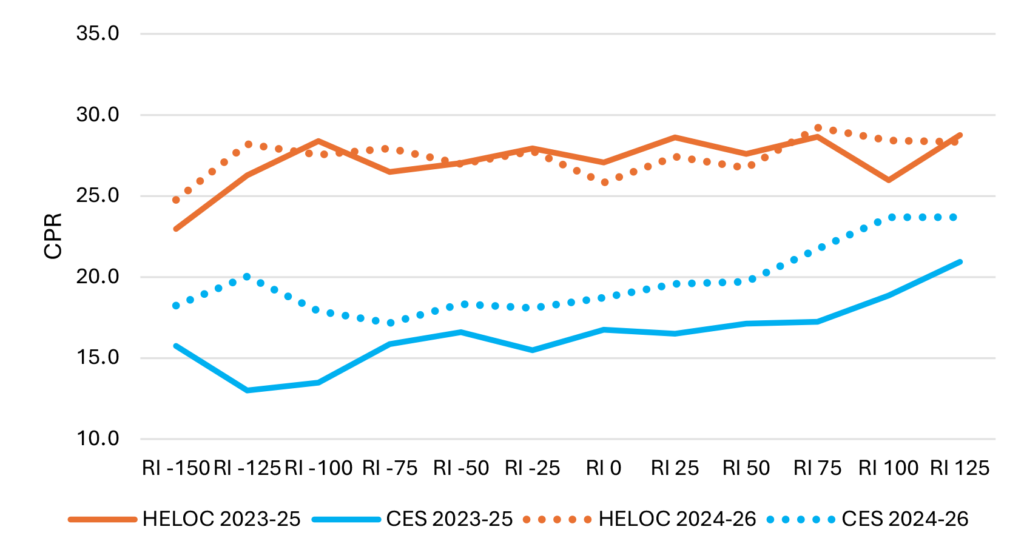
Prepayments across second liens, and more specifically closed-end second liens (CES), are notably faster than prior observations. Comparing prepayment S-curves constructed using two years of observations from 2023 through 2025 and 2024 through 2026 show that at-the-money speeds on closed-end second liens are roughly 3 CPR faster in the more recent observation (Exhibit 1).
Exhibit 1: At-the-money speeds on CES have increased
Source: Santander US Capital Markets, CoreLogic LP
Both in-and out-of-the-money observations have sped up too. Loans with 75 bp or more of incentive prepay 5 CPR faster in the latter observation. And loans with 100 bp of negative incentive have prepaid 5 CPR faster as well. So, while S-curves remain relatively flat for the cohort, investors should recalibrate baseline assumptions higher to account for the new normal in empirical speeds.
Digging in on the drivers of faster speeds…
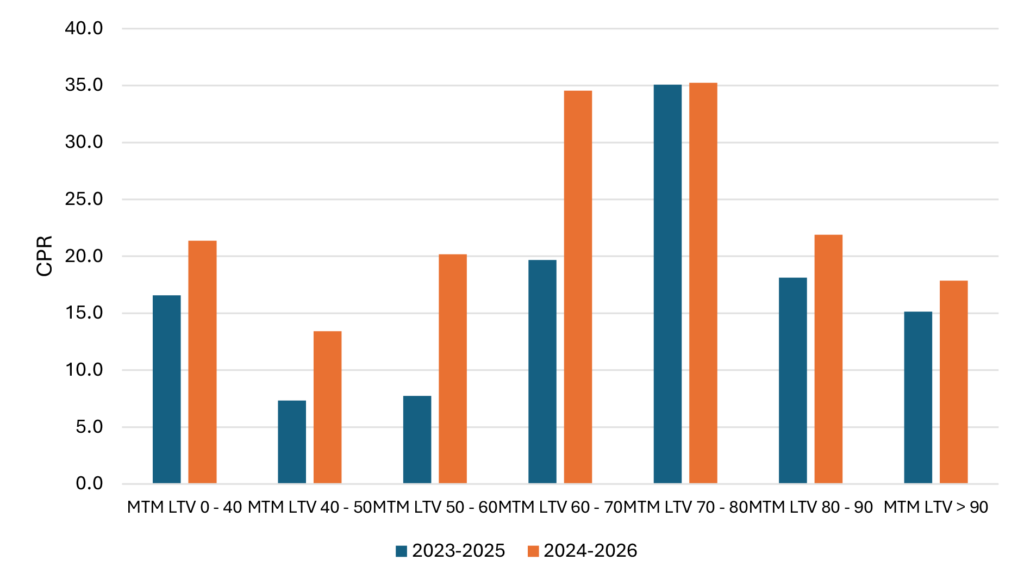
Comparing the sets of observations, one stark difference is the disparity in prepayment rates on loans that have seen substantial deleveraging since origination. Looking at a subset of closed-end second liens, whose combined LTVs were at least 80 at origination, prepayment speeds are notably faster in the latter observation on loans with lower mark-to-market cLTVs. Loans that have experienced 10 to 20 points of equity appreciation since origination have seen at-the-money prepayment rates rise from 20 CPR at-the-money to 35 CPR (Exhibit 2).
Based on indicative originator rate sheets, this deleveraging could create anywhere from 150 to 200 bp of rate incentive based on SATO alone, independent of any move in primary mortgage rates. And that type of incentive likely leaves these loans ripe for cross-servicer refinancing. As more large originators expand their second lien origination capacity against the backdrop of relatively moribund first lien originations, this type of SATO-based refinancing looks likely to remain elevated.
Exhibit 2: At-the-money speeds have increased on CES loans with substantial equity
Source: Santander US Capital Markets, CoreLogic LP
New York, New York?
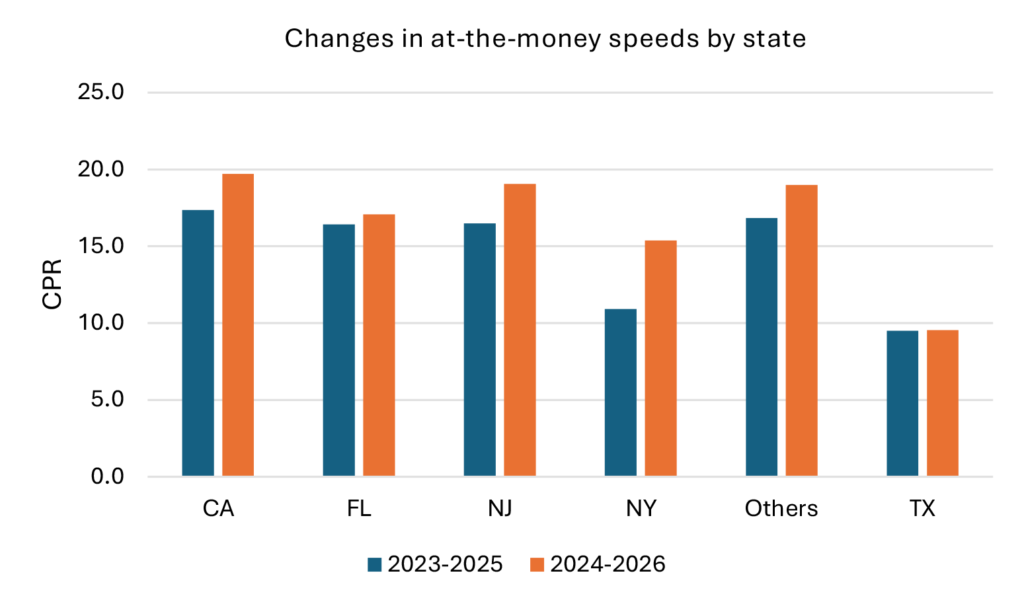
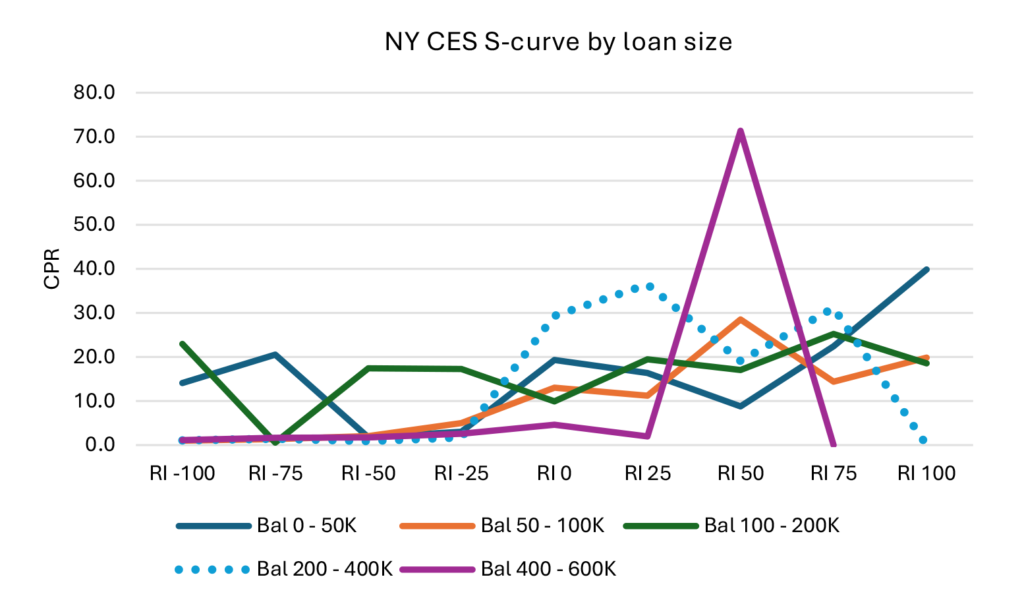
Another driver of faster speeds is a noticeable uptick in at-the-money prepayment rates on New York based loans. At-the-money speeds on NY-based second liens have risen by 5 CPR in more recent observations. While this rise may attributable to refinancing activity, another plausible explanation is the continued and growing migration trend out of New York, and subsequent rising rates of turnover. Higher rates of turnover may be intrastate, as borrowers move out of the city into the suburbs, or out of state to places like Florida and Texas where job opportunities in traditionally New York-centric industries are on the rise. Interestingly, the fastest at-the-money speeds are observed in higher balance second liens, ostensibly to more affluent borrowers with greater mobility (Exhibits 3&4).
Exhibit 3 & 4: At-the-money speeds rise on NY-based second liens
Source: Santander US Capital Markets, CoreLogic LP
These drivers, along with others, have pushed broad-based prepayments across the sector higher. Cutting the cohort by loan size, then looking at the delta in prepayment rates across the two observation datasets for each degree of moneyness shows that second liens with modestly larger balances are experiencing the biggest increase in prepayment rates (Exhibit 5). At-the-money speeds on second liens with original balances between $100,000 and $200,000 have risen by 3 CPR with even faster speeds when those loans are both 100 bp in- and out-of-the-money. The relative increase in prepayments on larger loans may be explained in part or whole by growing cross servicer refinancing activity, where fixed costs in re-underwriting the borrower are higher for a new originator, driving their focus to higher balance loans.
Exhibit 5: Comparing changes in prepayments by second lien balance

Source: Santander US Capital Markets, CoreLogic LP
Implications for valuation
Investors in the investment grade portion of the debt stack are likely fairly agnostic to these faster speeds given those bonds are par priced at issuance and faster speeds, to the positive, will build credit enhancement as the current pay ‘AAA’ bonds are paid down. Investors farther down the debt stack likely welcome these faster speeds as growing levels of credit enhancement should tighten spreads on these longer spread duration bonds as they become candidates for potential upgrades. The most meaningful impact to valuations will be felt by the equity or residual classes of these deals. The equity classes of these deals are comprised of the remaining interest cash flow generated by the net WAC of the collateral remaining after the interest on the debt has been paid. And this interest is subordinated at the bottom of the capital structure to insulate debt holders against future principal losses or interest shortfalls. As a result, these cash flows are effectively credit sensitive, interest-only instruments, and small changes to both assumed and empirical prepayments can have material impacts on their rates of return. As equity investors restrike their prepayment expectations on these cash flows higher, their values will decline, likely impairing economics for sponsors to some extent.
This material is intended only for institutional investors and does not carry all of the independence and disclosure standards of retail debt research reports. In the preparation of this material, the author may have consulted or otherwise discussed the matters referenced herein with one or more of SCM’s trading desks, any of which may have accumulated or otherwise taken a position, long or short, in any of the financial instruments discussed in or related to this material. Further, SCM may act as a market maker or principal dealer and may have proprietary interests that differ or conflict with the recipient hereof, in connection with any financial instrument discussed in or related to this material.
This message, including any attachments or links contained herein, is subject to important disclaimers, conditions, and disclosures regarding Electronic Communications, which you can find at https://portfolio-strategy.apsec.com/sancap-disclaimers-and-disclosures.
Important Disclaimers
Copyright © 2026 Santander US Capital Markets LLC and its affiliates (“SCM”). All rights reserved. SCM is a member of FINRA and SIPC. This material is intended for limited distribution to institutions only and is not publicly available. Any unauthorized use or disclosure is prohibited.
In making this material available, SCM (i) is not providing any advice to the recipient, including, without limitation, any advice as to investment, legal, accounting, tax and financial matters, (ii) is not acting as an advisor or fiduciary in respect of the recipient, (iii) is not making any predictions or projections and (iv) intends that any recipient to which SCM has provided this material is an “institutional investor” (as defined under applicable law and regulation, including FINRA Rule 4512 and that this material will not be disseminated, in whole or part, to any third party by the recipient.
The author of this material is an economist, desk strategist or trader. In the preparation of this material, the author may have consulted or otherwise discussed the matters referenced herein with one or more of SCM’s trading desks, any of which may have accumulated or otherwise taken a position, long or short, in any of the financial instruments discussed in or related to this material. Further, SCM or any of its affiliates may act as a market maker or principal dealer and may have proprietary interests that differ or conflict with the recipient hereof, in connection with any financial instrument discussed in or related to this material.
This material (i) has been prepared for information purposes only and does not constitute a solicitation or an offer to buy or sell any securities, related investments or other financial instruments, (ii) is neither research, a “research report” as commonly understood under the securities laws and regulations promulgated thereunder nor the product of a research department, (iii) or parts thereof may have been obtained from various sources, the reliability of which has not been verified and cannot be guaranteed by SCM, (iv) should not be reproduced or disclosed to any other person, without SCM’s prior consent and (v) is not intended for distribution in any jurisdiction in which its distribution would be prohibited.
In connection with this material, SCM (i) makes no representation or warranties as to the appropriateness or reliance for use in any transaction or as to the permissibility or legality of any financial instrument in any jurisdiction, (ii) believes the information in this material to be reliable, has not independently verified such information and makes no representation, express or implied, with regard to the accuracy or completeness of such information, (iii) accepts no responsibility or liability as to any reliance placed, or investment decision made, on the basis of such information by the recipient and (iv) does not undertake, and disclaims any duty to undertake, to update or to revise the information contained in this material.
Unless otherwise stated, the views, opinions, forecasts, valuations, or estimates contained in this material are those solely of the author, as of the date of publication of this material, and are subject to change without notice. The recipient of this material should make an independent evaluation of this information and make such other investigations as the recipient considers necessary (including obtaining independent financial advice), before transacting in any financial market or instrument discussed in or related to this material.
Important disclaimers for clients in the EU and UK
This publication has been prepared by Trading Desk Strategists within the Sales and Trading functions of Santander US Capital Markets LLC (“SanCap”), the US registered broker-dealer of Santander Corporate & Investment Banking. This communication is distributed in the EEA by Banco Santander S.A., a credit institution registered in Spain and authorised and regulated by the Bank of Spain and the CNMV. Any EEA recipient of this communication that would like to affect any transaction in any security or issuer discussed herein should do so with Banco Santander S.A. or any of its affiliates (together “Santander”). This communication has been distributed in the UK by Banco Santander, S.A.’s London branch, authorised by the Bank of Spain and subject to regulatory oversight on certain matters by the Financial Conduct Authority (FCA) and the Prudential Regulation Authority (PRA).
The publication is intended for exclusive use for Professional Clients and Eligible Counterparties as defined by MiFID II and is not intended for use by retail customers or for any persons or entities in any jurisdictions or country where such distribution or use would be contrary to local law or regulation.
This material is not a product of Santander´s Research Team and does not constitute independent investment research. This is a marketing communication and may contain ¨investment recommendations¨ as defined by the Market Abuse Regulation 596/2014 ("MAR"). This publication has not been prepared in accordance with legal requirements designed to promote the independence of research and is not subject to any prohibition on dealing ahead of the dissemination of investment research. The author, date and time of the production of this publication are as indicated herein.
This publication does not constitute investment advice and may not be relied upon to form an investment decision, nor should it be construed as any offer to sell or issue or invitation to purchase, acquire or subscribe for any instruments referred herein. The publication has been prepared in good faith and based on information Santander considers reliable as of the date of publication, but Santander does not guarantee or represent, express or implied, that such information is accurate or complete. All estimates, forecasts and opinions are current as at the date of this publication and are subject to change without notice. Unless otherwise indicated, Santander does not intend to update this publication. The views and commentary in this publication may not be objective or independent of the interests of the Trading and Sales functions of Santander, who may be active participants in the markets, investments or strategies referred to herein and/or may receive compensation from investment banking and non-investment banking services from entities mentioned herein. Santander may trade as principal, make a market or hold positions in instruments (or related derivatives) and/or hold financial interest in entities discussed herein. Santander may provide market commentary or trading strategies to other clients or engage in transactions which may differ from views expressed herein. Santander may have acted upon the contents of this publication prior to you having received it.
This publication is intended for the exclusive use of the recipient and must not be reproduced, redistributed or transmitted, in whole or in part, without Santander’s consent. The recipient agrees to keep confidential at all times information contained herein.