The Big Idea
The run on the bank of private credit starts another lap
This material is a Marketing Communication and does not constitute Independent Investment Research.
The slow run on the bank of private credit continues as expected, at least based on the latest rounds of redemptions. Cliffwater’s $31 billion private credit fund saw 17% of shares ask for money back in the second quarter this year, up from 14% in the first quarter. And Blackstone’s $79 billion fund saw 10% of shares ask to redeem, a record for the fund. It is bad news for private debt funds and business development companies. But it is likely worse news for companies that rely on private credit for funding.
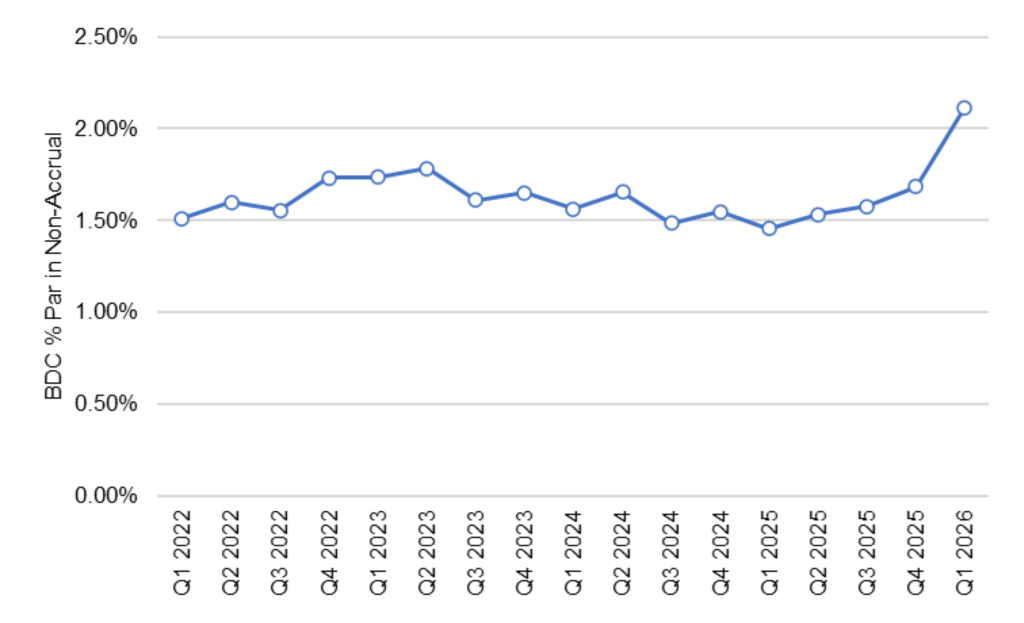
Private funds and BDCs only provide periodic information about portfolio performance, but some of the news lately shows performance slipping. Delinquencies in BDC loan portfolios jumped 43 bp in the first quarter to 2.12%, according to PitchBook, the largest quarterly jump and the highest delinquency rate in at least five years (Exhibit 1).
Exhibit 1: Loan delinquencies at business development companies rise
Source: PitchBook, Santander US Capital Markets
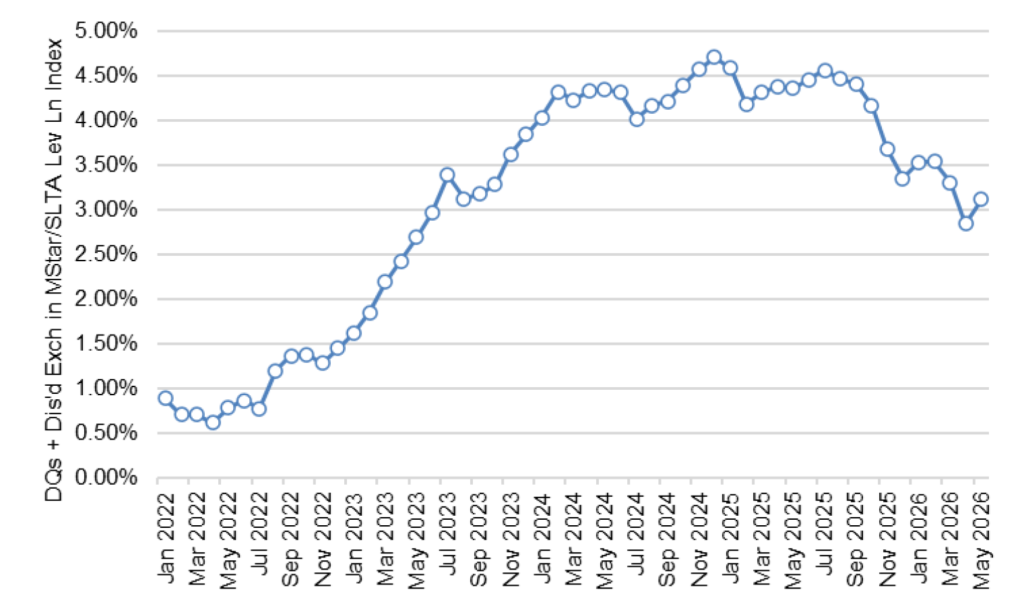
The state of private credit, nevertheless, is still fuzzy. The rates of delinquencies and distressed exchanges among loans in the Morningstar/LSTA leveraged loan index, for example, have been going down for most of the last year (Exhibit 2). Even though leveraged loans are not quite the same as private direct lending, both markets cater mainly to highly leveraged companies and the index numbers run counter to concerns that private credit is deteriorating. The signals are mixed.
Exhibit 2: But delinquencies and distressed exchanges in leveraged loans fall
Source: PitchBook, Santander US Capital Markets
That leaves shareholders in private debt funds and BDCs making decisions with conflicting signals and a relative lack of information. Confidentiality agreements often stop private debt funds from disclosing the financial condition of their borrowers and lack of independent secondary private loan trading precludes market signals . That leaves shareholders with the information conveyed by the action of their peers, who have started to run. Shareholders have incentives to run sooner rather than later to avoid getting stuck with only the loans the fund could not sell or borrow against.
Cliffwater and Blackstone and others have capped quarterly redemptions at 5% of NAV to avoid forced sales of assets. Other funds are adding to liquidity. Ares Strategic Income Fund on May 26, for example, boosted its $4.1 billion bank revolving credit facility by $850 million and extended maturity to May 2031. Fitch’s recent review of eight perpetually non-traded BDCs concluded they had enough liquidity to meet 5% quarterly redemptions through 2026.
Private debt funds and BDCs should have enough capital to survive a longer run. Recent work led by Gregor Matvos at Northwestern University reviewed most of the private debt fund industry. It found that most funds have equity equivalent to 65% to 80% of total assets. Debt is moderate and mainly reflects bank credit lines. And portfolios are spread across industries and geography. That does not mean limited partners get out without bumps and bruises. But private funds themselves do not look like systemic risks. They are far less leveraged than the average US bank.
Borrowers from private debt funds and BDCs look more vulnerable than the funds and BDCs themselves. If the run on funds and BDCs continues, which looks highly likely, then efforts to preserve liquidity should lead the funds and BDCs to pull back on direct lending. That could eventually leave their borrowers high and dry. Demand from existing BDC borrowers to roll their loans over looks set to ramp up into 2028, based on loan maturities (Exhibit 3). If the run continues that long, the drain on private debt market liquidity could leave some of those borrowers short. That’s when the slow run on the bank of private credit turns into a credit fundamental as more borrowers get forced to deleverage. The clock is slowly ticking.
Exhibit 3: BDC loan maturities suggest pressure to rollover ramps into 2028
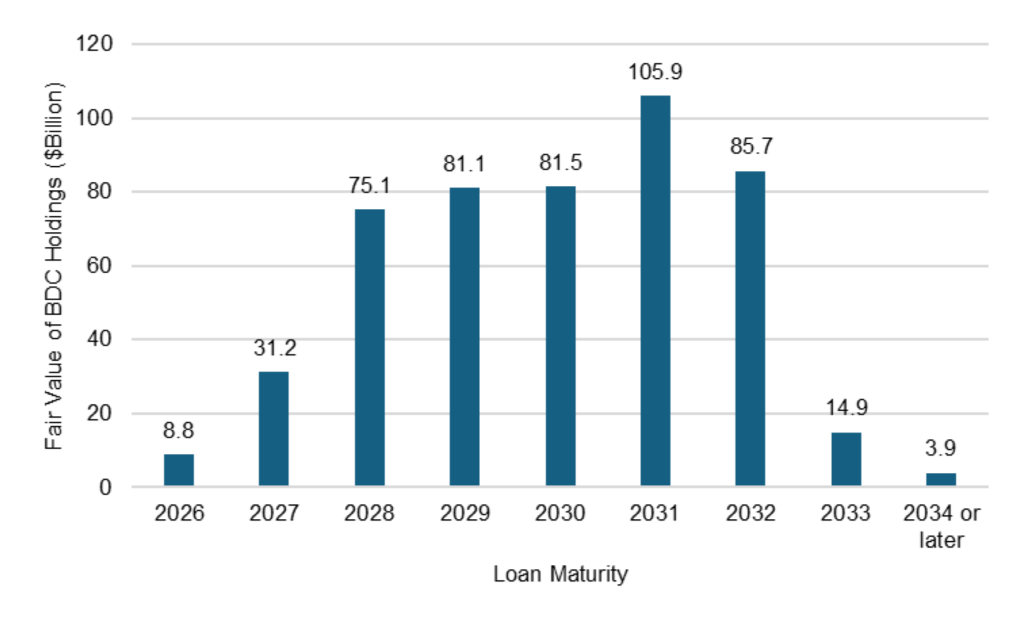
Note: Data shows BDC holdings excluding equities, CLOs, other structured finance holdings.
Source: PitchBook, Santander US Capital Markets.
* * *
The view in rates
The market for now has concluded that the Fed will start hiking within the next seven months, pushing rates up and flattening the yield curve. The very front end of the curve is probably stuck at a floor of 4.00% or higher through 2026 depending on US-Iran and expected short-term inflation. The 10-year note continues to look like it will spend more time above 4.40% than below it for the balance of the year. It would take a credible ceasefire in the Middle East and concrete steps toward a lasting agreement between the US and Iran for 10-year yields to drop below 4.40%.
Key market levels:
- Setting on 3-month term SOFR traded Friday at 365 bp
- Further out the curve, the 2-year note traded Friday at 4.16, up 16 bp over the week. The 10-year note traded at 4.55%, up 12 bp.
- The Treasury yield curve traded Friday with 2s10s at 38 bp, flatter by 5 bp over the last week, with 5s30s at 72 bp, flatter by 11 bp
- Breakeven 10-year inflation traded Friday at 236 bp, down 4 bp over the last week, with 5-year forward 5-year breakeven at 222 bp, down 1 bp and still signaling confidence that the Fed target still holds. The 10-year real rate finished the week at 218 bp, up 15 bp over the last week.
The view in spreads
The supply and demand balance looks constructive for MBS and a little less so for corporate debt. MBS net supply continues to run very low while Fannie Mae and Freddie Mac continue to add to their mortgage portfolios. Insurers continue to issue annuities and buy corporate and structured credit, but credit is facing significant needs to finance the current AI buildout. MBS spreads should be able to hold their ground in most circumstances, but credit spreads look soft depending on the volume of net issuance.
The Bloomberg US investment grade corporate bond index OAS traded on Friday at 72 bp, unchanged from last week. Nominal par 30-year MBS spreads to the blend of 5- and 10-year Treasury yields traded Friday at 111 bp, wider by 2 bp in the last week. Par 30-year MBS TOAS closed Friday at 23 bp, wider by 3 bp in the last week.
The view in credit
Haves and have nots continue. Big companies have healthier balance sheets than smaller companies. Consumers at the middle-to-higher end of the income distribution also have liquidity and wealth. Bank lending to non-bank financial institutions, including private debt funds and business development companies continues to expand. Bank regulators continue to focus on that category of lending, which could eventually tighten the private credit markets. But for now, credit metrics for NBFI lending are strong relative to traditional bank lending such as C&I.
This material is intended only for institutional investors and does not carry all of the independence and disclosure standards of retail debt research reports. In the preparation of this material, the author may have consulted or otherwise discussed the matters referenced herein with one or more of SCM’s trading desks, any of which may have accumulated or otherwise taken a position, long or short, in any of the financial instruments discussed in or related to this material. Further, SCM may act as a market maker or principal dealer and may have proprietary interests that differ or conflict with the recipient hereof, in connection with any financial instrument discussed in or related to this material.
This message, including any attachments or links contained herein, is subject to important disclaimers, conditions, and disclosures regarding Electronic Communications, which you can find at https://portfolio-strategy.apsec.com/sancap-disclaimers-and-disclosures.
Important Disclaimers
Copyright © 2026 Santander US Capital Markets LLC and its affiliates (“SCM”). All rights reserved. SCM is a member of FINRA and SIPC. This material is intended for limited distribution to institutions only and is not publicly available. Any unauthorized use or disclosure is prohibited.
In making this material available, SCM (i) is not providing any advice to the recipient, including, without limitation, any advice as to investment, legal, accounting, tax and financial matters, (ii) is not acting as an advisor or fiduciary in respect of the recipient, (iii) is not making any predictions or projections and (iv) intends that any recipient to which SCM has provided this material is an “institutional investor” (as defined under applicable law and regulation, including FINRA Rule 4512 and that this material will not be disseminated, in whole or part, to any third party by the recipient.
The author of this material is an economist, desk strategist or trader. In the preparation of this material, the author may have consulted or otherwise discussed the matters referenced herein with one or more of SCM’s trading desks, any of which may have accumulated or otherwise taken a position, long or short, in any of the financial instruments discussed in or related to this material. Further, SCM or any of its affiliates may act as a market maker or principal dealer and may have proprietary interests that differ or conflict with the recipient hereof, in connection with any financial instrument discussed in or related to this material.
This material (i) has been prepared for information purposes only and does not constitute a solicitation or an offer to buy or sell any securities, related investments or other financial instruments, (ii) is neither research, a “research report” as commonly understood under the securities laws and regulations promulgated thereunder nor the product of a research department, (iii) or parts thereof may have been obtained from various sources, the reliability of which has not been verified and cannot be guaranteed by SCM, (iv) should not be reproduced or disclosed to any other person, without SCM’s prior consent and (v) is not intended for distribution in any jurisdiction in which its distribution would be prohibited.
In connection with this material, SCM (i) makes no representation or warranties as to the appropriateness or reliance for use in any transaction or as to the permissibility or legality of any financial instrument in any jurisdiction, (ii) believes the information in this material to be reliable, has not independently verified such information and makes no representation, express or implied, with regard to the accuracy or completeness of such information, (iii) accepts no responsibility or liability as to any reliance placed, or investment decision made, on the basis of such information by the recipient and (iv) does not undertake, and disclaims any duty to undertake, to update or to revise the information contained in this material.
Unless otherwise stated, the views, opinions, forecasts, valuations, or estimates contained in this material are those solely of the author, as of the date of publication of this material, and are subject to change without notice. The recipient of this material should make an independent evaluation of this information and make such other investigations as the recipient considers necessary (including obtaining independent financial advice), before transacting in any financial market or instrument discussed in or related to this material.
Important disclaimers for clients in the EU and UK
This publication has been prepared by Trading Desk Strategists within the Sales and Trading functions of Santander US Capital Markets LLC (“SanCap”), the US registered broker-dealer of Santander Corporate & Investment Banking. This communication is distributed in the EEA by Banco Santander S.A., a credit institution registered in Spain and authorised and regulated by the Bank of Spain and the CNMV. Any EEA recipient of this communication that would like to affect any transaction in any security or issuer discussed herein should do so with Banco Santander S.A. or any of its affiliates (together “Santander”). This communication has been distributed in the UK by Banco Santander, S.A.’s London branch, authorised by the Bank of Spain and subject to regulatory oversight on certain matters by the Financial Conduct Authority (FCA) and the Prudential Regulation Authority (PRA).
The publication is intended for exclusive use for Professional Clients and Eligible Counterparties as defined by MiFID II and is not intended for use by retail customers or for any persons or entities in any jurisdictions or country where such distribution or use would be contrary to local law or regulation.
This material is not a product of Santander´s Research Team and does not constitute independent investment research. This is a marketing communication and may contain ¨investment recommendations¨ as defined by the Market Abuse Regulation 596/2014 ("MAR"). This publication has not been prepared in accordance with legal requirements designed to promote the independence of research and is not subject to any prohibition on dealing ahead of the dissemination of investment research. The author, date and time of the production of this publication are as indicated herein.
This publication does not constitute investment advice and may not be relied upon to form an investment decision, nor should it be construed as any offer to sell or issue or invitation to purchase, acquire or subscribe for any instruments referred herein. The publication has been prepared in good faith and based on information Santander considers reliable as of the date of publication, but Santander does not guarantee or represent, express or implied, that such information is accurate or complete. All estimates, forecasts and opinions are current as at the date of this publication and are subject to change without notice. Unless otherwise indicated, Santander does not intend to update this publication. The views and commentary in this publication may not be objective or independent of the interests of the Trading and Sales functions of Santander, who may be active participants in the markets, investments or strategies referred to herein and/or may receive compensation from investment banking and non-investment banking services from entities mentioned herein. Santander may trade as principal, make a market or hold positions in instruments (or related derivatives) and/or hold financial interest in entities discussed herein. Santander may provide market commentary or trading strategies to other clients or engage in transactions which may differ from views expressed herein. Santander may have acted upon the contents of this publication prior to you having received it.
This publication is intended for the exclusive use of the recipient and must not be reproduced, redistributed or transmitted, in whole or in part, without Santander’s consent. The recipient agrees to keep confidential at all times information contained herein.