By the Numbers
Returns for private MBS in 2025 and positioning for the year ahead
This material is a Marketing Communication and does not constitute Independent Investment Research.
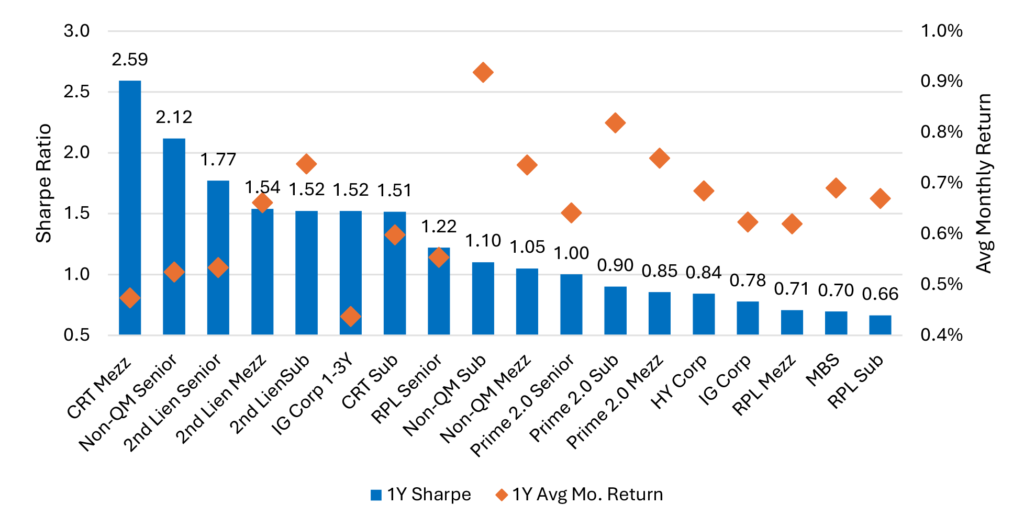
Managers who positioned at the top of the stack in non-QM and CRT mezzanine bonds delivered the best risk-adjusted returns to their investors last year. Looking ahead into 2026, those senior classes appear poised to outperform again, potentially driven by a combination of further Fed cuts and spread tightening from crossover corporate buyers. A continued decline in rate volatility could enhance returns for longer duration prime mezzanine and subordinate cash flows too.
Rounding out returns for 2025
Last year can likely be described as the top of the charts being populated by a combination of greatest hits and a best new artist. CRT mezzanine bonds have been somewhat of a stalwart in offering attractive risk-adjusted returns to structured product investors. While these bonds appear poised to continue to do so given the uncapped, floating-rate nature of the asset class, investors are required to trade relatively low absolute returns for low volatility of those returns as spreads on investment grade classes of those deals sit inside of 100 bp and absolute yields appear poised to decline if a newly minted Fed chair takes a more dovish stance on benchmark rates later this year.
Non-QM seniors, while somewhat of a relative newcomer have delivered attractive risk-adjusted returns given relatively low rate and spread duration as well as a low beta to both the broad MBS and investment grade corporate indices at 0.45 and 0.46 respectively over a 3-year observation. The newcomer of the group, senior classes of securitizations backed by second lien collateral posted a slightly worse Sharpe ratio than that of non-QM seniors.
While both non-QM and second lien seniors posted nearly identical average monthly returns of 0.52% and 0.53%, second liens returns were more volatile, largely driven by more meaningful post-Liberation Day spread widening. This dynamic looks likely to hold into future bouts of volatility as insurance capital will likely continue to provide somewhat of a backstop to potential spread widening in non-QM. Both non-QM and second lien seniors posted a substantially better Sharpe ration than the 1–3-year investment grade corporate index, which mimics the duration profile of the two RMBS exposures. Non-QM seniors bested the Sharpe of the short duration IG index by 60 bp. Second lien seniors beat the index risk-adjusted return by 25 bp (Exhibit 1).
Exhibit 1: Stacking up risk adjusted returns across RMBS exposures and major indices
Source: Santander US Capital, Intex Solutions, YieldBook, IDC
Looking to the year ahead
Looking into 2026, past may very well be prologue. Senior classes of both non-QM and second lien securitizations look likely to continue to deliver attractive risk-adjusted returns, potentially besting numbers posted last year. And enhanced returns can come from a couple potential sources. Short-end key rate exposures should do well if the Fed pivots to a more dovish stance under new leadership later this year. Short duration structured products may broadly benefit from spread tightening given heightened sponsorship from crossover corporate buyers looking to insulate themselves from what looks to be a substantial supply technical in corporate issuance which may grow that market by 9% to 10% next year.
Relative performance between the two cohorts will likely be primarily driven by prepayments and overall convexity. Non-QM seniors, particularly those backed exclusively or in large part by investor loans with prepayment penalties should both exhibit a longer ramp and slower terminal speeds than closed end second lien seniors.
Slowing HPA should improve convexity in both non-QM and second liens, albeit for different reasons. Less HPA should amplify the value of prepayment penalties in the non-QM cohort, as smaller amounts of trapped equity should weigh on investors’ inclination to pay larger penalties to release smaller amounts of equity. Slowing HPA will reduce combined LTV borrower deleveraging in second liens, which, in turn, will reduce SATO-based refinancing incentive. The spread between two-year and ten-year rates could weigh on relative performance too. A meaningful bear steepening of the yield curve could push non-QM issuer calls out-of-the-money, increasing potential extension risk, causing spreads to widen. Conversely, the deeper in-the-money call on second lien collateral looks to be far less susceptible to changes in the shape of the yield curve.
The continued, pronounced decline in rate volatility could help boost risk-adjusted returns on longer rate and spread duration cash flows into next year if these low levels of volatility continue to hold. Prime subordinates, particularly those backed by more positively convex agency eligible investor loans should outperform jumbo subs on both a risk and hedge adjusted basis as the markedly better convexity should translate to both more consistent returns and lower delta hedging costs. From a credit perspective, investors should skew exposures into either more seasoned, de-levered paper or post-2023 vintage bonds as the 2023 vintage continues to flash signs of relative underperformance in both prime and non-QM exposures.
This material is intended only for institutional investors and does not carry all of the independence and disclosure standards of retail debt research reports. In the preparation of this material, the author may have consulted or otherwise discussed the matters referenced herein with one or more of SCM’s trading desks, any of which may have accumulated or otherwise taken a position, long or short, in any of the financial instruments discussed in or related to this material. Further, SCM may act as a market maker or principal dealer and may have proprietary interests that differ or conflict with the recipient hereof, in connection with any financial instrument discussed in or related to this material.
This message, including any attachments or links contained herein, is subject to important disclaimers, conditions, and disclosures regarding Electronic Communications, which you can find at https://portfolio-strategy.apsec.com/sancap-disclaimers-and-disclosures.
Important Disclaimers
Copyright © 2026 Santander US Capital Markets LLC and its affiliates (“SCM”). All rights reserved. SCM is a member of FINRA and SIPC. This material is intended for limited distribution to institutions only and is not publicly available. Any unauthorized use or disclosure is prohibited.
In making this material available, SCM (i) is not providing any advice to the recipient, including, without limitation, any advice as to investment, legal, accounting, tax and financial matters, (ii) is not acting as an advisor or fiduciary in respect of the recipient, (iii) is not making any predictions or projections and (iv) intends that any recipient to which SCM has provided this material is an “institutional investor” (as defined under applicable law and regulation, including FINRA Rule 4512 and that this material will not be disseminated, in whole or part, to any third party by the recipient.
The author of this material is an economist, desk strategist or trader. In the preparation of this material, the author may have consulted or otherwise discussed the matters referenced herein with one or more of SCM’s trading desks, any of which may have accumulated or otherwise taken a position, long or short, in any of the financial instruments discussed in or related to this material. Further, SCM or any of its affiliates may act as a market maker or principal dealer and may have proprietary interests that differ or conflict with the recipient hereof, in connection with any financial instrument discussed in or related to this material.
This material (i) has been prepared for information purposes only and does not constitute a solicitation or an offer to buy or sell any securities, related investments or other financial instruments, (ii) is neither research, a “research report” as commonly understood under the securities laws and regulations promulgated thereunder nor the product of a research department, (iii) or parts thereof may have been obtained from various sources, the reliability of which has not been verified and cannot be guaranteed by SCM, (iv) should not be reproduced or disclosed to any other person, without SCM’s prior consent and (v) is not intended for distribution in any jurisdiction in which its distribution would be prohibited.
In connection with this material, SCM (i) makes no representation or warranties as to the appropriateness or reliance for use in any transaction or as to the permissibility or legality of any financial instrument in any jurisdiction, (ii) believes the information in this material to be reliable, has not independently verified such information and makes no representation, express or implied, with regard to the accuracy or completeness of such information, (iii) accepts no responsibility or liability as to any reliance placed, or investment decision made, on the basis of such information by the recipient and (iv) does not undertake, and disclaims any duty to undertake, to update or to revise the information contained in this material.
Unless otherwise stated, the views, opinions, forecasts, valuations, or estimates contained in this material are those solely of the author, as of the date of publication of this material, and are subject to change without notice. The recipient of this material should make an independent evaluation of this information and make such other investigations as the recipient considers necessary (including obtaining independent financial advice), before transacting in any financial market or instrument discussed in or related to this material.
Important disclaimers for clients in the EU and UK
This publication has been prepared by Trading Desk Strategists within the Sales and Trading functions of Santander US Capital Markets LLC (“SanCap”), the US registered broker-dealer of Santander Corporate & Investment Banking. This communication is distributed in the EEA by Banco Santander S.A., a credit institution registered in Spain and authorised and regulated by the Bank of Spain and the CNMV. Any EEA recipient of this communication that would like to affect any transaction in any security or issuer discussed herein should do so with Banco Santander S.A. or any of its affiliates (together “Santander”). This communication has been distributed in the UK by Banco Santander, S.A.’s London branch, authorised by the Bank of Spain and subject to regulatory oversight on certain matters by the Financial Conduct Authority (FCA) and the Prudential Regulation Authority (PRA).
The publication is intended for exclusive use for Professional Clients and Eligible Counterparties as defined by MiFID II and is not intended for use by retail customers or for any persons or entities in any jurisdictions or country where such distribution or use would be contrary to local law or regulation.
This material is not a product of Santander´s Research Team and does not constitute independent investment research. This is a marketing communication and may contain ¨investment recommendations¨ as defined by the Market Abuse Regulation 596/2014 ("MAR"). This publication has not been prepared in accordance with legal requirements designed to promote the independence of research and is not subject to any prohibition on dealing ahead of the dissemination of investment research. The author, date and time of the production of this publication are as indicated herein.
This publication does not constitute investment advice and may not be relied upon to form an investment decision, nor should it be construed as any offer to sell or issue or invitation to purchase, acquire or subscribe for any instruments referred herein. The publication has been prepared in good faith and based on information Santander considers reliable as of the date of publication, but Santander does not guarantee or represent, express or implied, that such information is accurate or complete. All estimates, forecasts and opinions are current as at the date of this publication and are subject to change without notice. Unless otherwise indicated, Santander does not intend to update this publication. The views and commentary in this publication may not be objective or independent of the interests of the Trading and Sales functions of Santander, who may be active participants in the markets, investments or strategies referred to herein and/or may receive compensation from investment banking and non-investment banking services from entities mentioned herein. Santander may trade as principal, make a market or hold positions in instruments (or related derivatives) and/or hold financial interest in entities discussed herein. Santander may provide market commentary or trading strategies to other clients or engage in transactions which may differ from views expressed herein. Santander may have acted upon the contents of this publication prior to you having received it.
This publication is intended for the exclusive use of the recipient and must not be reproduced, redistributed or transmitted, in whole or in part, without Santander’s consent. The recipient agrees to keep confidential at all times information contained herein.