The Big Idea
A tenuous tightening in credit
This material is a Marketing Communication and does not constitute Independent Investment Research.
Credit has had a good run since the Fed’s March meeting. After widening from the start of the year into the meeting, Bloomberg’s cash index investment grade spreads have since tightened on average by 30 bp and high yield by 65 bp. The price on the average S&P/LSTA leveraged loan has rebounded by $2.12. Equity markets have bounced in concert, with the S&P 500 up by 5.3%. And it is through the lens of the equity market that the tightening in credit looks tenuous.
Even though equity and credit have different claims on the aggregate US corporate balance sheet, they inform each other. Equity only gets the leftovers after paying debt. But equity, as Merton argued, can always turn over the company to debtholders if the value of the company drops below the nominal balance of debt. Debtholders have written a put option to equity. As the value of the company and its equity falls, the put comes closer to in-the-money and should be more valuable. That should get reflected in wider debt spreads. As equity rallies, of course, spreads should tighten.
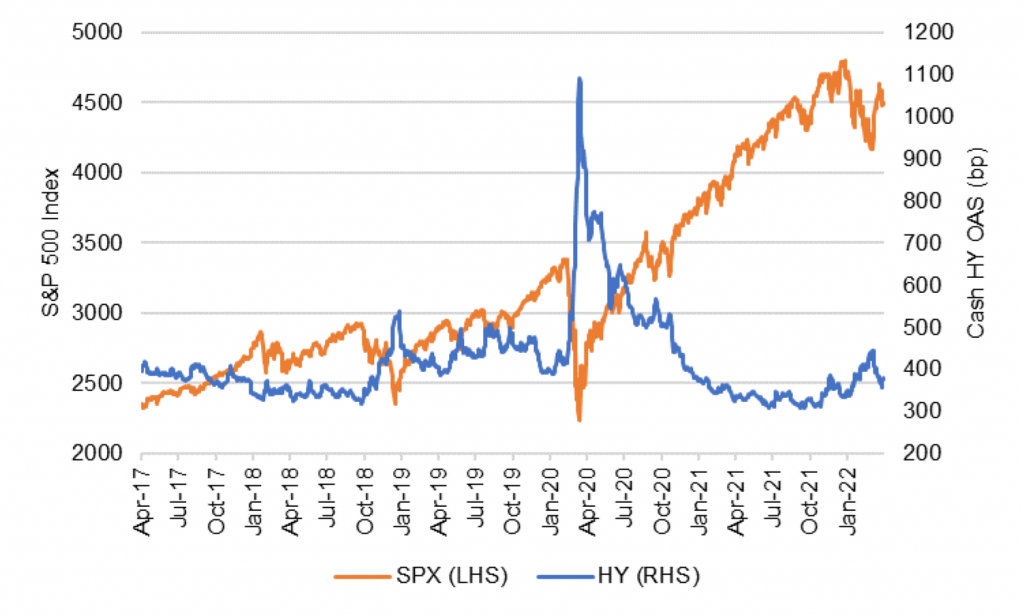
That is almost always the case. Equity and high yield show the clearest link since high yield has close exposure to the equity put. Equity prices and high yield spreads generally run in the expected direction, with higher equity prices driving high yield spreads tighter and lower prices driving spreads wider (Exhibit 1).
Exhibit 1: Equity prices and credit spreads move in synch
Source: Bloomberg, Amherst Pierpont Securities
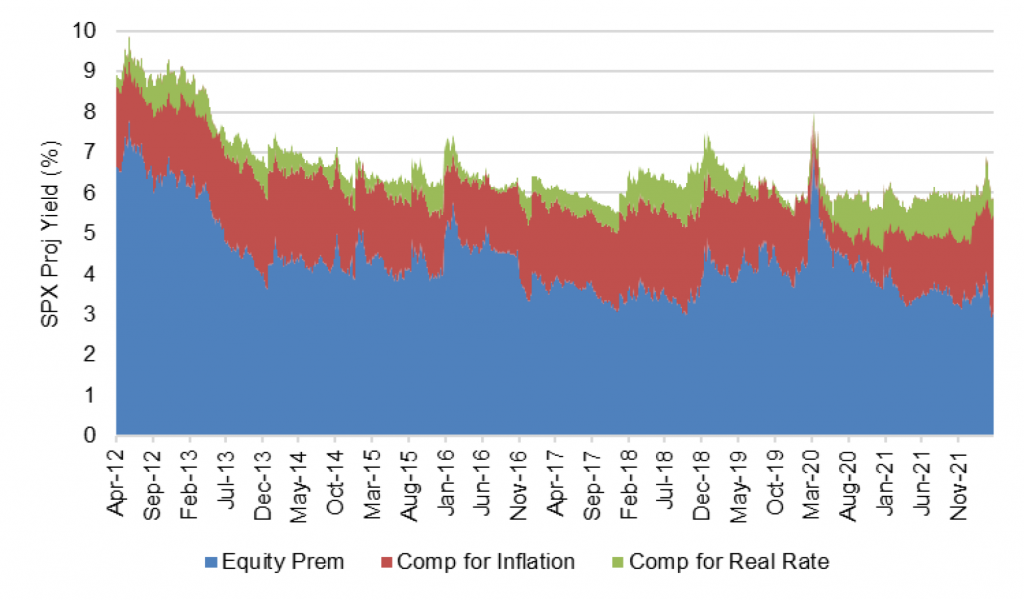
The recent rally in equity has left that market at the richest level in a decade based on the risk compensation left after covering the cost of inflation and real interest rates. One important benchmark of equity valuation is the ratio of projected earnings to equity price—in other words, the projected earnings yield on equity. This is better than the dividend yield on equity because forward net earnings reflect true expected equity returns, not just returns paid out through dividends. It is important to look at the spread between projected equity yield and longer interest rates. That helps break down the projected equity yield into an equity risk premium, compensation for inflation and compensation for the real interest rate.
Since March the compensation for equity risk left after covering the cost of inflation and real rates has tumbled (Exhibit 2). The projected 1-year earnings yield on the S&P 500 closed Friday at 5.51%. That yield needs to cover 2.88% of inflation implied by the closing spread between 10-year notes and TIPS and a negative 0.17% real rate, leaving only 2.80% compensation for equity risk. That is the single lowest equity risk premium in 10 years.
Exhibit 2: Equity looks rich, with the lowest risk premium in 10 years
Source: Bloomberg, Amherst Pierpont Securities
It is far from clear why risk premiums should go down in this market. The Fed is in the early stages of an inflation fight that the March minutes acknowledge involves significant uncertainty. The beginning of QT should raise, not lower, risk premiums. The implications of the Russia-Ukraine war for the economy are only beginning to be parsed. It seems unlikely that valuations in equity can go much higher, at least based on risk premium, and could easily go wider. Credit spreads should follow. The good run in credit since the March Fed meeting looks suspect.
Investors have plenty of ways to manage the risk of wider spreads, most easily by moving up in quality in credit. Corporate balance sheets generally are strong, so investors have a wide set of good choices. And investment grade balance sheets in particular have extended the maturity of their funding and have ample protection against higher rates and slowing growth. It is time to take advantage.
* * *
The view in rates
The rates market continues to reprice to higher yields, although the longer end of the curve is starting to trade wide to fair value. The curve should invert significantly over the next year with 2-year rates around 3.0% or higher and 10-year rates around 2.5%. Persistent supply and trade frictions from Russia-Ukraine could force the Fed to go higher than currently priced and push the 2-year note toward 3.5%. Friday closing rates on 10-year and longer Treasury debt at 2.70% and higher look like the wide end of fair value—more than enough to compensate for likely 2% inflation and 0.5% in real rates.
The Fed’s RRP balances closed Friday at $1.75 trillion, up $84 billion in the last week. The RRP rate after the March 16 FOMC rose from 5 bp to 30 bp, and the race is on to see if banks raise rates to defend their deposit base or let deposits flow into money market funds and on to the RRP. So far, that seem not the case.
Settings on 3-month LIBOR have closed Friday at 99 bp, up 3 bp in the last week. Setting on 3-month SOFR have drifted up to 78 bp, up 10 bp in the last week. The spread between 3-month LIBOR and SOFR has tightened in the last few weeks after initially widening after Russia’s February 24 invasion of Ukraine.
The 10-year note has finished the most recent session at 2.70%, up 32 bp in a week. Breakeven 10-year inflation finished the week at 289 bp, up 32 bp on the week. The 10-year real rate finished the week at negative 18 bp, up 25 bp from a week ago. Real rates increasingly anticipate an aggressive Fed will drain the system of an overhang of cash supply.
The Treasury yield curve has finished its most recent session with 2s10s at 19 bp, steeper by 26 bp in the last week, and 5s30s inverted by 3 bp, steeper by 10 bp over the last week.
The view in spreads
Spreads still look broadly biased to widen. Repricing since the March FOMC has taken sizable risk out of the market although plenty remains around inflation and the Fed path. And Russia-Ukraine remains. Of the major spread markets, corporate and structured credit is likely to outperform, as it has generally since March 2020. Corporates benefit from strong corporate fundamentals and from buyers not tied to Fed policy. The credit markets have a diversified base of buyers while the only net buyers of MBS during pandemic have been the Fed and banks.
The view in credit
Credit fundamentals look strong for now but will almost certainly soften later this year as the Fed dampens demand and growth begins to slow. Russia-Ukraine should have limited direct impact on either the US corporate or consumer balance sheet. Corporations have strong earnings, good margins, low multiples of debt to gross profits, low debt service and good liquidity. It will be important to watch inflation and see if costs begin to catch up with revenues. A higher real cost of funds would start to eat away at highly leveraged balance sheets with weak or volatile revenues. Consumer balance sheets look strong with rising income, substantial savings and big gains in real estate and investment portfolios. Homeowner equity jumped by $3.5 trillion in 2021, and mortgage delinquencies have dropped to a record low.
This material is intended only for institutional investors and does not carry all of the independence and disclosure standards of retail debt research reports. In the preparation of this material, the author may have consulted or otherwise discussed the matters referenced herein with one or more of SCM’s trading desks, any of which may have accumulated or otherwise taken a position, long or short, in any of the financial instruments discussed in or related to this material. Further, SCM may act as a market maker or principal dealer and may have proprietary interests that differ or conflict with the recipient hereof, in connection with any financial instrument discussed in or related to this material.
This message, including any attachments or links contained herein, is subject to important disclaimers, conditions, and disclosures regarding Electronic Communications, which you can find at https://portfolio-strategy.apsec.com/sancap-disclaimers-and-disclosures.
Important Disclaimers
Copyright © 2026 Santander US Capital Markets LLC and its affiliates (“SCM”). All rights reserved. SCM is a member of FINRA and SIPC. This material is intended for limited distribution to institutions only and is not publicly available. Any unauthorized use or disclosure is prohibited.
In making this material available, SCM (i) is not providing any advice to the recipient, including, without limitation, any advice as to investment, legal, accounting, tax and financial matters, (ii) is not acting as an advisor or fiduciary in respect of the recipient, (iii) is not making any predictions or projections and (iv) intends that any recipient to which SCM has provided this material is an “institutional investor” (as defined under applicable law and regulation, including FINRA Rule 4512 and that this material will not be disseminated, in whole or part, to any third party by the recipient.
The author of this material is an economist, desk strategist or trader. In the preparation of this material, the author may have consulted or otherwise discussed the matters referenced herein with one or more of SCM’s trading desks, any of which may have accumulated or otherwise taken a position, long or short, in any of the financial instruments discussed in or related to this material. Further, SCM or any of its affiliates may act as a market maker or principal dealer and may have proprietary interests that differ or conflict with the recipient hereof, in connection with any financial instrument discussed in or related to this material.
This material (i) has been prepared for information purposes only and does not constitute a solicitation or an offer to buy or sell any securities, related investments or other financial instruments, (ii) is neither research, a “research report” as commonly understood under the securities laws and regulations promulgated thereunder nor the product of a research department, (iii) or parts thereof may have been obtained from various sources, the reliability of which has not been verified and cannot be guaranteed by SCM, (iv) should not be reproduced or disclosed to any other person, without SCM’s prior consent and (v) is not intended for distribution in any jurisdiction in which its distribution would be prohibited.
In connection with this material, SCM (i) makes no representation or warranties as to the appropriateness or reliance for use in any transaction or as to the permissibility or legality of any financial instrument in any jurisdiction, (ii) believes the information in this material to be reliable, has not independently verified such information and makes no representation, express or implied, with regard to the accuracy or completeness of such information, (iii) accepts no responsibility or liability as to any reliance placed, or investment decision made, on the basis of such information by the recipient and (iv) does not undertake, and disclaims any duty to undertake, to update or to revise the information contained in this material.
Unless otherwise stated, the views, opinions, forecasts, valuations, or estimates contained in this material are those solely of the author, as of the date of publication of this material, and are subject to change without notice. The recipient of this material should make an independent evaluation of this information and make such other investigations as the recipient considers necessary (including obtaining independent financial advice), before transacting in any financial market or instrument discussed in or related to this material.
Important disclaimers for clients in the EU and UK
This publication has been prepared by Trading Desk Strategists within the Sales and Trading functions of Santander US Capital Markets LLC (“SanCap”), the US registered broker-dealer of Santander Corporate & Investment Banking. This communication is distributed in the EEA by Banco Santander S.A., a credit institution registered in Spain and authorised and regulated by the Bank of Spain and the CNMV. Any EEA recipient of this communication that would like to affect any transaction in any security or issuer discussed herein should do so with Banco Santander S.A. or any of its affiliates (together “Santander”). This communication has been distributed in the UK by Banco Santander, S.A.’s London branch, authorised by the Bank of Spain and subject to regulatory oversight on certain matters by the Financial Conduct Authority (FCA) and the Prudential Regulation Authority (PRA).
The publication is intended for exclusive use for Professional Clients and Eligible Counterparties as defined by MiFID II and is not intended for use by retail customers or for any persons or entities in any jurisdictions or country where such distribution or use would be contrary to local law or regulation.
This material is not a product of Santander´s Research Team and does not constitute independent investment research. This is a marketing communication and may contain ¨investment recommendations¨ as defined by the Market Abuse Regulation 596/2014 ("MAR"). This publication has not been prepared in accordance with legal requirements designed to promote the independence of research and is not subject to any prohibition on dealing ahead of the dissemination of investment research. The author, date and time of the production of this publication are as indicated herein.
This publication does not constitute investment advice and may not be relied upon to form an investment decision, nor should it be construed as any offer to sell or issue or invitation to purchase, acquire or subscribe for any instruments referred herein. The publication has been prepared in good faith and based on information Santander considers reliable as of the date of publication, but Santander does not guarantee or represent, express or implied, that such information is accurate or complete. All estimates, forecasts and opinions are current as at the date of this publication and are subject to change without notice. Unless otherwise indicated, Santander does not intend to update this publication. The views and commentary in this publication may not be objective or independent of the interests of the Trading and Sales functions of Santander, who may be active participants in the markets, investments or strategies referred to herein and/or may receive compensation from investment banking and non-investment banking services from entities mentioned herein. Santander may trade as principal, make a market or hold positions in instruments (or related derivatives) and/or hold financial interest in entities discussed herein. Santander may provide market commentary or trading strategies to other clients or engage in transactions which may differ from views expressed herein. Santander may have acted upon the contents of this publication prior to you having received it.
This publication is intended for the exclusive use of the recipient and must not be reproduced, redistributed or transmitted, in whole or in part, without Santander’s consent. The recipient agrees to keep confidential at all times information contained herein.