Uncategorized
New forbearance deferral eases extension risk in CRT
admin | May 15, 2020
This material is a Marketing Communication and does not constitute Independent Investment Research.
The decision by Fannie Mae and Freddie Mac to allow borrowers to defer repayment of forbearance should help mitigate one potential source of extension risk in credit risk transfer securities that pay claims on actual losses. An existing structural enhancement in later vintage deals may help mitigate extension as well, but the effect should be more pronounced in Fannie Mae’s CAS REMICs than in comparable STACR deals.
The enterprises’ May 13 announcement put to rest any uncertainty about whether they would offer deferral. Both enterprises will allow borrowers to append up to 12 months of forbearance to the maturity of their loan. The announcement has material implications for prepayment, delinquency and buyout rates and may mitigate some concerns about extension risk across both CAS and STACR bonds.
Once a borrower ends forbearance, servicers will provide a range of options to repay missed payments and return to a regular payment schedule. The top of the reimbursement waterfall would be for the borrower to pay back all past due principal and interest as well as associated taxes and insurance. However, given potential hardship and lost income, the GSEs will not require this. It appears the overwhelming majority of borrowers will likely be unable to repay the full amount due at the end of forbearance. Alternatively, borrowers can make up those payments over time through a repayment plan. However there are practical limitations to repayment plans. According to both agencies’ seller/servicer guidelines, servicers cannot offer payment plans longer than 12 months without authorization from the agencies. Nor can they require borrowers to pay more than 150% of their monthly payments. Borrowers who rack up more than six months of forbearance cannot be put on a 1-year payment plan as the payment would exceed 150% of their scheduled monthly payment. If the borrower is unable to repay through a payment plan, the past due payments are capitalized and deferred to the maturity date of the loan, but will not accrue interest on the capitalized balance.
All borrowers granted payment forbearance will be considered delinquent during the forbearance period. Borrowers in payment plans will be marked as delinquent for the purpose of delinquency rate calculations until all missed payments are fully recouped. Borrowers granted deferrals will be considered current once they make their first full scheduled monthly payment after exiting forbearance.
CRT investors have expressed concerns that large amounts of forbearance coupled with a disproportionately large amount of borrowers being put on repayment plans at the end of the forbearance period could cause delinquency rates to remain elevated for protracted periods of time, locking structures out from unscheduled principal in all CRT deals, and both scheduled and unscheduled principal in latter ones, potentially creating significant extension risk.
Now that the GSE deferral option has been formalized, extension seems increasingly improbable for a few reasons. First, repayment plans for borrowers with six or more months of forbearance seem unlikely. Second, given the significant uncertainty around the economic impact of COVID-19, servicers may hesitate to increase borrowers’ debt burdens through payment plans as this may exacerbate any hardship on borrowers. Increased debt burdens may cause borrowers to fall behind again and require more special servicing, forbearance or permanent modification. Additionally, Freddie Mac will reimburse servicer advances once the deferral has been ‘settled’.’ Ostensibly this means around the end of forbearance when a determination has been made whether to put the borrower into a payment plan. Advances made on loans put into repayment plans may be repaid by the borrower over a longer period. Assuming servicers have reasonable latitude to determine whether borrowers should be granted deferrals, this could give servicers incentive to offer deferrals instead of repayment plans.
The SSRA
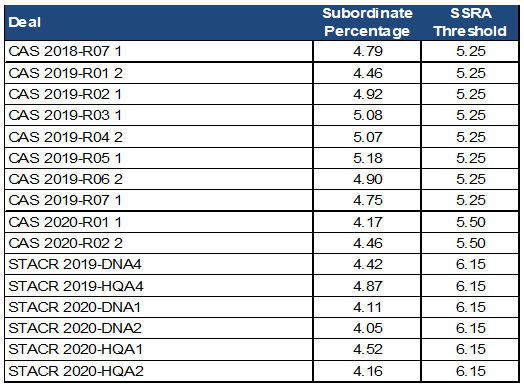
Other potential mitigants to extension risk are provisions in both Fannie Mae and Freddie Mac CRT that allow the deals to receive unscheduled principal regardless of whether delinquency trigger levels have been breached. Later vintage CAS REMIC structures and Freddie Mac STACR deals issued in late 2019 and beyond include a structural feature called the Supplemental Subordinate Reduction Amount. (SSRA) This feature allows both CAS and STACR bonds to receive both scheduled and unscheduled principal if the percentage of outstanding CRT relative to the reference pool balance meets a certain threshold. In that instance, the amount of unscheduled principal greater than the target percentage will be allocated to the senior-most bond remaining in the capital structure. This effectively turbos down the most senior bond that would have otherwise been locked out as a result of the delinquency trigger being tripped and should help mitigate extension risk, specifically on mezzanine classes of deals with this feature. If prepayment rates remain elevated, this feature will become increasingly more valuable as deals approach their SSRA targets. However these targets are not the same across all deals and are lower in Fannie Mae CAS deals than in STACR deals with the SSRA (Exhibit 1)
Exhibit 1: CAS deals have lower SSRA targets than STACR
Source, Intex Solutions, Amherst Pierpont Solutions
One potential caveat to this is that higher WAC 2019 vintage CRT that have been prepaying the fastest may me more susceptible to permanent or flex modifications if the borrower is unable to resume making their previous scheduled payments at the end of the forbearance period. The waterfall for flex modifications target the borrower’s rate, loan term and then balance so rate modifications that would be allocated as monthly principal losses would occur before term modifications that would not generate losses. Higher LTV, higher DTI loans may be particularly susceptible to flex modifications and increased flex modifications would deplete credit enhancement, potentially preventing deals from reaching their SSRA targets.
This material is intended only for institutional investors and does not carry all of the independence and disclosure standards of retail debt research reports. In the preparation of this material, the author may have consulted or otherwise discussed the matters referenced herein with one or more of SCM’s trading desks, any of which may have accumulated or otherwise taken a position, long or short, in any of the financial instruments discussed in or related to this material. Further, SCM may act as a market maker or principal dealer and may have proprietary interests that differ or conflict with the recipient hereof, in connection with any financial instrument discussed in or related to this material.
This message, including any attachments or links contained herein, is subject to important disclaimers, conditions, and disclosures regarding Electronic Communications, which you can find at https://portfolio-strategy.apsec.com/sancap-disclaimers-and-disclosures.
Important Disclaimers
Copyright © 2026 Santander US Capital Markets LLC and its affiliates (“SCM”). All rights reserved. SCM is a member of FINRA and SIPC. This material is intended for limited distribution to institutions only and is not publicly available. Any unauthorized use or disclosure is prohibited.
In making this material available, SCM (i) is not providing any advice to the recipient, including, without limitation, any advice as to investment, legal, accounting, tax and financial matters, (ii) is not acting as an advisor or fiduciary in respect of the recipient, (iii) is not making any predictions or projections and (iv) intends that any recipient to which SCM has provided this material is an “institutional investor” (as defined under applicable law and regulation, including FINRA Rule 4512 and that this material will not be disseminated, in whole or part, to any third party by the recipient.
The author of this material is an economist, desk strategist or trader. In the preparation of this material, the author may have consulted or otherwise discussed the matters referenced herein with one or more of SCM’s trading desks, any of which may have accumulated or otherwise taken a position, long or short, in any of the financial instruments discussed in or related to this material. Further, SCM or any of its affiliates may act as a market maker or principal dealer and may have proprietary interests that differ or conflict with the recipient hereof, in connection with any financial instrument discussed in or related to this material.
This material (i) has been prepared for information purposes only and does not constitute a solicitation or an offer to buy or sell any securities, related investments or other financial instruments, (ii) is neither research, a “research report” as commonly understood under the securities laws and regulations promulgated thereunder nor the product of a research department, (iii) or parts thereof may have been obtained from various sources, the reliability of which has not been verified and cannot be guaranteed by SCM, (iv) should not be reproduced or disclosed to any other person, without SCM’s prior consent and (v) is not intended for distribution in any jurisdiction in which its distribution would be prohibited.
In connection with this material, SCM (i) makes no representation or warranties as to the appropriateness or reliance for use in any transaction or as to the permissibility or legality of any financial instrument in any jurisdiction, (ii) believes the information in this material to be reliable, has not independently verified such information and makes no representation, express or implied, with regard to the accuracy or completeness of such information, (iii) accepts no responsibility or liability as to any reliance placed, or investment decision made, on the basis of such information by the recipient and (iv) does not undertake, and disclaims any duty to undertake, to update or to revise the information contained in this material.
Unless otherwise stated, the views, opinions, forecasts, valuations, or estimates contained in this material are those solely of the author, as of the date of publication of this material, and are subject to change without notice. The recipient of this material should make an independent evaluation of this information and make such other investigations as the recipient considers necessary (including obtaining independent financial advice), before transacting in any financial market or instrument discussed in or related to this material.
Important disclaimers for clients in the EU and UK
This publication has been prepared by Trading Desk Strategists within the Sales and Trading functions of Santander US Capital Markets LLC (“SanCap”), the US registered broker-dealer of Santander Corporate & Investment Banking. This communication is distributed in the EEA by Banco Santander S.A., a credit institution registered in Spain and authorised and regulated by the Bank of Spain and the CNMV. Any EEA recipient of this communication that would like to affect any transaction in any security or issuer discussed herein should do so with Banco Santander S.A. or any of its affiliates (together “Santander”). This communication has been distributed in the UK by Banco Santander, S.A.’s London branch, authorised by the Bank of Spain and subject to regulatory oversight on certain matters by the Financial Conduct Authority (FCA) and the Prudential Regulation Authority (PRA).
The publication is intended for exclusive use for Professional Clients and Eligible Counterparties as defined by MiFID II and is not intended for use by retail customers or for any persons or entities in any jurisdictions or country where such distribution or use would be contrary to local law or regulation.
This material is not a product of Santander´s Research Team and does not constitute independent investment research. This is a marketing communication and may contain ¨investment recommendations¨ as defined by the Market Abuse Regulation 596/2014 ("MAR"). This publication has not been prepared in accordance with legal requirements designed to promote the independence of research and is not subject to any prohibition on dealing ahead of the dissemination of investment research. The author, date and time of the production of this publication are as indicated herein.
This publication does not constitute investment advice and may not be relied upon to form an investment decision, nor should it be construed as any offer to sell or issue or invitation to purchase, acquire or subscribe for any instruments referred herein. The publication has been prepared in good faith and based on information Santander considers reliable as of the date of publication, but Santander does not guarantee or represent, express or implied, that such information is accurate or complete. All estimates, forecasts and opinions are current as at the date of this publication and are subject to change without notice. Unless otherwise indicated, Santander does not intend to update this publication. The views and commentary in this publication may not be objective or independent of the interests of the Trading and Sales functions of Santander, who may be active participants in the markets, investments or strategies referred to herein and/or may receive compensation from investment banking and non-investment banking services from entities mentioned herein. Santander may trade as principal, make a market or hold positions in instruments (or related derivatives) and/or hold financial interest in entities discussed herein. Santander may provide market commentary or trading strategies to other clients or engage in transactions which may differ from views expressed herein. Santander may have acted upon the contents of this publication prior to you having received it.
This publication is intended for the exclusive use of the recipient and must not be reproduced, redistributed or transmitted, in whole or in part, without Santander’s consent. The recipient agrees to keep confidential at all times information contained herein.