Uncategorized
MBS looks vulnerable
admin | February 21, 2020
This material is a Marketing Communication and does not constitute Independent Investment Research.
Another wave of refinancing looks set to hit MBS and widen spreads in the TBA market, but the market has not seen the impact yet. The MBA Refinancing Index has jumped this month to its highest level in five years without a response from spreads. But that response looks likely to come with MBS underperforming more convex assets. Investors have a range of good alternatives to TBA including MBS specified pools, agency CMBS or more liquid corporate credits.
The rise in refi
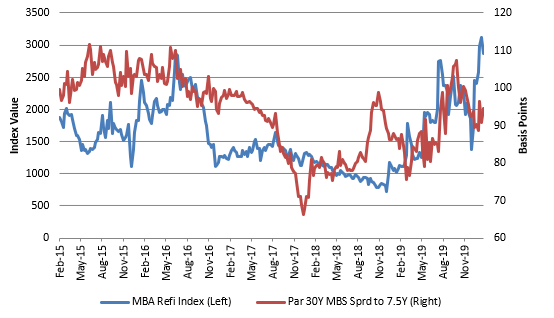
The MBA Refinancing Index touched 3,000 the first week of February and has only come off slightly since (Exhibit 1). Freddie Mac’s index of primary mortgage rates has dropped roughly 25 bp this year to around 3.50%, putting the single largest coupon in the MBS market, 30-year 3.5%s, in-the-money for refinancing by 50 bp or more. The underlying index for Ginnie Mae refinancing volume has stayed at or above 5-year highs most weeks since September, but the latest spike has come from a sharp acceleration in the index for Fannie Mae and Freddie Mac. The conventional index has jumped above even the highest levels seen last fall. The market seems ripe for a surprising acceleration in conventional speeds.
Exhibit 1: Elevated refinancing typically drives wider spreads in MBS
Source: Bloomberg, Amherst Pierpont Securities
Reasons to expect wider spreads
Elevated refinancing typically coincides with wider spreads in MBS driven by a temporary imbalance in pool supply and demand, greater fundamental risk and delta hedging. The imbalance comes from a simple mismatch between the sale of pools from refinanced loans and the return of investor cash from the same loans. Loans refinanced in February, for instance, will start getting pooled and sold for regular conventional settlement on March 12. Although investors will see pool balances step down on the March 5 factor day, they will not receive cash until March 25. A surprising share of investors hesitate to buy MBS forward until actually receiving cash, leading to an excess of supply as prepayment waves ramp up and an excess of demand as they fade. Beyond cash flow timing, refinancing also raises fundamental risk in MBS since it is the most volatile component of prepayments and most subject to change from one refi episode to the next. Delta hedging by mortgage servicers, mortgage REITs, broker/dealers and other MBS portfolios also adds to option cost and actual market volatility, contributing further to wider spreads.
MBS spreads clearly respond to a wide set of influences including net supply of mortgage debt and net demand from a global set of investors along with spreads in competing assets, but it seems surprising that spreads have not widened more than a few basis points as the MBS indices have moved higher. Spreads should move out to at least the levels of last fall, which were more than 10 bp wider than current levels.
Good alternatives to TBA
The TBA market in Ginnie Mae MBS has already priced for very fast speeds, as Brian Landy points out this week. The price spread between Ginnie Mae II 2.5% through 3.5% TBAs and their conventional counterparts has dropped to the lowest levels in a year. This follows prepayments in October and November where the Ginnie Mae TBA deliverable in refinanceable coupons was as much a 30 CPR faster than conventional. The recent spike in the conventional refi index could surprise the market and spur gains in the Ginnie-conventional spread.
Investors should also look at the 1 WALA pools in Ginnie Mae II 3.0%s. Both FHA and VA put significant limits on refinancing for the first six to seven months after origination. This protection should be valuable and trades only 3.5/32s above TBA.
The appeal of 0% VA pools from the Ginnie Mae custom program continues to grow. Prepayment speeds in VA loans after seven months spike to much higher levels than FHA, and the lifting of VA loan limits this year promises to make the speed differential greater.
In conventional MBS, investors should look at selling 30-year 4.0% and 4.5% pools of $225K max, $200K max and high LTV and buying similar stories in 30-year 3.0%s. Speeds in the specified pools in the higher coupons look likely to accelerate faster than their corresponding TBA, cutting into the value of the specifieds. In 30-year 3.0%s, the specified pools should accelerate more slowly than TBA.
The agency CMBS market also offers possibilities for investors that want to stay in agency credit and add convexity. The longest agency CMBS, Fannie Mae’s 15-year/14.5-year DUS trade around 71 bp over the swap curve with the most liquid 10-year/9.5-year DUS around 55 bp over.
More liquid corporate credits also look promising since a range of factors should keep US credit spreads well bid. US economic growth looks increasingly strong relative to Europe and China, and the Fed looks committed to keeping financial conditions easy. Credit should outperform MBS for as long as prepayments remain elevated.
For investors using the pending rise in refinanced loans to tactically reallocate away from MBS, liquidity in the alternative investment is critical. Once refi activity peaks and heads lower, the same dynamics that look set to drive MBS spreads wider should start reversing field. Investors getting out of agency MBS now will need the liquidity to get back in.
* * *
The view in rates
Uncertainty about the coronavirus continues to shape the outlook for global growth and inflation and the level and shape of US rates. China’s economy, which contributed 19% of global GDP last year, has seen large parts idled. Expanding quarantines in China and voluntary and imposed restrictions on travel remain. The easy—arguably too easy—narrative of contagion keeps forcing US rates down to worst-case levels. Futures now imply a Fed rate cut by July. It is likely that pent up demand will resurface once there’s clarity on the coronavirus and global GDP should partially if not fully rebound. Given the emerging scientific and public health collaboration to address the outbreak, it seems likely that the uncertainty around the outbreak will fall quickly.
The view in spreads
The appetite for risk and spread and compounding income is still strong. Spread assets continue to trade well, and anecdotal evidence of investor interest in new risk keeps building. Investors have clearly stepped back at times to watch the coronavirus play out, but the trend seems to be increasingly to step back in. The US economy looks healthy enough to keep credit concerns at bay for investment grade companies and even most high yield companies, so spreads have room to compress further once uncertainty around the virus drops. Prepayment risk should keep pushing MBS spreads wider, and MBS should underperform credit.
The view in credit
A variety of measures of corporate leverage remain high, but leverage spells trouble only if growth falls below current expectations and financing for leveraged borrowers tightens. The downgrade of Kraft Heinz in February highlights the risk that some highly leveraged companies will stumble a world with sub-2% GDP growth, but that shouldn’t come as a surprise. It looks more likely that US growth might slightly exceed expectations after adjusting for coronavirus effects, lifting corporate fundaments. As for the consumer, that is a story of generally continued strength with low unemployment, strong income, rising net worth and low debt service as a share of income.
This material is intended only for institutional investors and does not carry all of the independence and disclosure standards of retail debt research reports. In the preparation of this material, the author may have consulted or otherwise discussed the matters referenced herein with one or more of SCM’s trading desks, any of which may have accumulated or otherwise taken a position, long or short, in any of the financial instruments discussed in or related to this material. Further, SCM may act as a market maker or principal dealer and may have proprietary interests that differ or conflict with the recipient hereof, in connection with any financial instrument discussed in or related to this material.
This message, including any attachments or links contained herein, is subject to important disclaimers, conditions, and disclosures regarding Electronic Communications, which you can find at https://portfolio-strategy.apsec.com/sancap-disclaimers-and-disclosures.
Important Disclaimers
Copyright © 2026 Santander US Capital Markets LLC and its affiliates (“SCM”). All rights reserved. SCM is a member of FINRA and SIPC. This material is intended for limited distribution to institutions only and is not publicly available. Any unauthorized use or disclosure is prohibited.
In making this material available, SCM (i) is not providing any advice to the recipient, including, without limitation, any advice as to investment, legal, accounting, tax and financial matters, (ii) is not acting as an advisor or fiduciary in respect of the recipient, (iii) is not making any predictions or projections and (iv) intends that any recipient to which SCM has provided this material is an “institutional investor” (as defined under applicable law and regulation, including FINRA Rule 4512 and that this material will not be disseminated, in whole or part, to any third party by the recipient.
The author of this material is an economist, desk strategist or trader. In the preparation of this material, the author may have consulted or otherwise discussed the matters referenced herein with one or more of SCM’s trading desks, any of which may have accumulated or otherwise taken a position, long or short, in any of the financial instruments discussed in or related to this material. Further, SCM or any of its affiliates may act as a market maker or principal dealer and may have proprietary interests that differ or conflict with the recipient hereof, in connection with any financial instrument discussed in or related to this material.
This material (i) has been prepared for information purposes only and does not constitute a solicitation or an offer to buy or sell any securities, related investments or other financial instruments, (ii) is neither research, a “research report” as commonly understood under the securities laws and regulations promulgated thereunder nor the product of a research department, (iii) or parts thereof may have been obtained from various sources, the reliability of which has not been verified and cannot be guaranteed by SCM, (iv) should not be reproduced or disclosed to any other person, without SCM’s prior consent and (v) is not intended for distribution in any jurisdiction in which its distribution would be prohibited.
In connection with this material, SCM (i) makes no representation or warranties as to the appropriateness or reliance for use in any transaction or as to the permissibility or legality of any financial instrument in any jurisdiction, (ii) believes the information in this material to be reliable, has not independently verified such information and makes no representation, express or implied, with regard to the accuracy or completeness of such information, (iii) accepts no responsibility or liability as to any reliance placed, or investment decision made, on the basis of such information by the recipient and (iv) does not undertake, and disclaims any duty to undertake, to update or to revise the information contained in this material.
Unless otherwise stated, the views, opinions, forecasts, valuations, or estimates contained in this material are those solely of the author, as of the date of publication of this material, and are subject to change without notice. The recipient of this material should make an independent evaluation of this information and make such other investigations as the recipient considers necessary (including obtaining independent financial advice), before transacting in any financial market or instrument discussed in or related to this material.
Important disclaimers for clients in the EU and UK
This publication has been prepared by Trading Desk Strategists within the Sales and Trading functions of Santander US Capital Markets LLC (“SanCap”), the US registered broker-dealer of Santander Corporate & Investment Banking. This communication is distributed in the EEA by Banco Santander S.A., a credit institution registered in Spain and authorised and regulated by the Bank of Spain and the CNMV. Any EEA recipient of this communication that would like to affect any transaction in any security or issuer discussed herein should do so with Banco Santander S.A. or any of its affiliates (together “Santander”). This communication has been distributed in the UK by Banco Santander, S.A.’s London branch, authorised by the Bank of Spain and subject to regulatory oversight on certain matters by the Financial Conduct Authority (FCA) and the Prudential Regulation Authority (PRA).
The publication is intended for exclusive use for Professional Clients and Eligible Counterparties as defined by MiFID II and is not intended for use by retail customers or for any persons or entities in any jurisdictions or country where such distribution or use would be contrary to local law or regulation.
This material is not a product of Santander´s Research Team and does not constitute independent investment research. This is a marketing communication and may contain ¨investment recommendations¨ as defined by the Market Abuse Regulation 596/2014 ("MAR"). This publication has not been prepared in accordance with legal requirements designed to promote the independence of research and is not subject to any prohibition on dealing ahead of the dissemination of investment research. The author, date and time of the production of this publication are as indicated herein.
This publication does not constitute investment advice and may not be relied upon to form an investment decision, nor should it be construed as any offer to sell or issue or invitation to purchase, acquire or subscribe for any instruments referred herein. The publication has been prepared in good faith and based on information Santander considers reliable as of the date of publication, but Santander does not guarantee or represent, express or implied, that such information is accurate or complete. All estimates, forecasts and opinions are current as at the date of this publication and are subject to change without notice. Unless otherwise indicated, Santander does not intend to update this publication. The views and commentary in this publication may not be objective or independent of the interests of the Trading and Sales functions of Santander, who may be active participants in the markets, investments or strategies referred to herein and/or may receive compensation from investment banking and non-investment banking services from entities mentioned herein. Santander may trade as principal, make a market or hold positions in instruments (or related derivatives) and/or hold financial interest in entities discussed herein. Santander may provide market commentary or trading strategies to other clients or engage in transactions which may differ from views expressed herein. Santander may have acted upon the contents of this publication prior to you having received it.
This publication is intended for the exclusive use of the recipient and must not be reproduced, redistributed or transmitted, in whole or in part, without Santander’s consent. The recipient agrees to keep confidential at all times information contained herein.