


The Big Idea
Fed balance sheet checkup
Stephen Stanley | October 23, 2026
This material is a Marketing Communication and does not constitute Independent Investment Research.
Chair Warsh has long advocated for a much smaller Fed balance sheet in advance of taking his seat at the Fed. Big changes in the direction of the Fed’s balance sheet policy will probably await the recommendation of Warsh’s working group on the subject, presumably some time in 2027. In the meantime, the Fed has dramatically slowed the growth in the balance sheet without sparking, at least so far, any signs of stress in the money markets.
Fed balance sheet basics
After the Global Financial Crisis and again during the pandemic, the FOMC was forced to slash its policy rate to the effective zero bound, leaving it with no room to inject further stimulus into the economy via interest rates. In both cases, the Fed sought to add more liquidity by purchasing securities, expanding its balance sheet. Once the emergency had passed, the Fed reversed course and winnowed down the size of its bloated balance sheet.
In 2019, the Fed overshot, removing too much liquidity and causing a significant disruption in the repo market that required large injections of liquidity to meet demand for funds. As the post-pandemic unwind progressed, officials were determined not to repeat the same mistake.
As a result, at the first sign of trouble in the repo market in October 2025, the FOMC abruptly announced that it would end its balance sheet reduction at the end of November. This entailed halting the $5 billion a month runoff in maturing Treasury securities and replacing the redemptions in its MBS portfolio (which typically amount to around $15 billion a month) with purchases of Treasury bills.
Reflecting its intent to avoid the 2019 mistake, the Fed’s published guidance on balance sheet normalization directed that the Fed would stop the contraction somewhat before the balance sheet reached the appropriate size and then allow the economy and the demand for liquidity to grow until it ultimately matched the new balance sheet size. However, Fed officials were clearly alarmed by the persistence of elevated money market rates in November and early December of last year, likely concluding that, despite their best efforts, they may have overshot again, as they did in 2019.
At the very next FOMC meeting in December 2025, the committee ended the transition period and voted to begin growing the balance sheet, beginning right away (as opposed to the delayed implementation seen in October).
The FOMC changed its operating systems for regulating bank reserves in 2008, when Congress authorized the payment of interest on reserves. The Fed shifted to what it calls an ample reserves regime, where the Fed seeks to maintain plentiful liquidity and use administered rates (the interest on reserves rate, the RP rate, and the reverse RP rate) to keep money market rates squarely inside of the fed funds target range as opposed to the pre-2008 norm of precisely calibrating the level of reserves to hit the funds rate target.
Financial market participants do not have much experience with a “normal” ample reserves balance sheet regime, because the Fed has either been conducting QE, expanding the balance sheet, or unwinding via QT, reducing the balance sheet, for all but a few months of the past 17 years. So, a quick primer on what the landscape is supposed to look like is in order.
The liquidity demands of the economy should grow in rough tandem with the nominal expansion of activity. If the level of the Fed’s balance sheet at the end of 2025, about $6.6 trillion including the securities portfolio of $6.27 trillion and other sources of funds, is appropriate for the economy, then we might presume that the Fed’s balance sheet would need to grow by around 4% to 4.5% a year, which is about what the FOMC economic projections suggest for the long-run growth rate of nominal GDP growth going forward. That would work out to about a $250 billion to $300 billion annual increase. Chair Powell confirmed this rough calculation in December 2025, as he indicated that the FOMC believed that the balance sheet would be expected to expand by around $20 billion to $25 billion a month.
Progress report
The new balance sheet strategy imposed at the end of 2025 has been in place for about 10 months, so enough time has passed to judge how conditions have developed. The first point to note is that the tightness seen in the repo market in late 2025 dissipated quickly with the announcements by the Fed last year and has not returned.
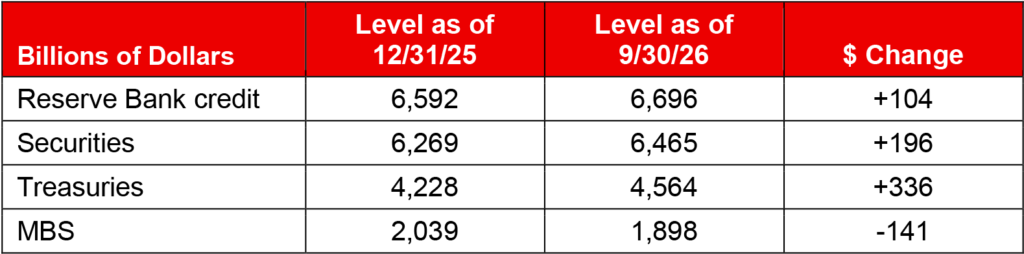
Exhibit 1 summarizes the changes in key line items of the asset side of the Fed’s balance sheet from the end of 2025 to the end of this September.
Exhibit 1: asset side of the Fed’s balance sheet
Source: Santander US Capital Markets
As the parameters of the Fed’s announcements last year laid out, the Fed is buying Treasury bills for two purposes. First, bills are being purchased to replace the run-off of its MBS portfolio, which has amounted to around $15 billion a month. On top of that, the Fed is also buying bills to grow the balance sheet, so that liquidity can expand in line with the economy’s growth. In the first nine months of the year, the Fed bought $336 billion in bills, of which $141 billion replaced MBS runoff and about $196 billion represented balance sheet growth. The headline balance sheet figure (the top line of Exhibit 1) grew by less than the amount of securities purchases because the Fed issued a significant amount of short-term repo liquidity over year-end last year and thus had repos outstanding on December 31.
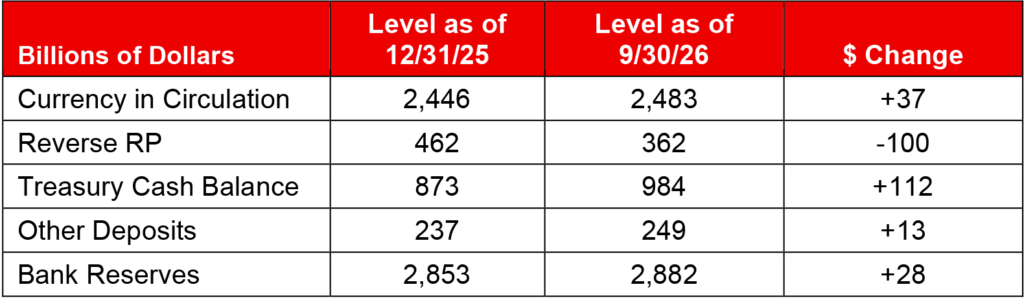
Exhibit 2 shows the evolution of the key categories on the liability side of the balance sheet. The “other deposits” line item represents deposits held at the Fed by international organizations, GSEs, and designated financial market utilities.
Exhibit 2: liability side of the Fed’s balance sheet
Source: Santander US Capital Markets
There are a couple of anomalies to point out. First, as with repos on the asset side, there was a spike in activity of the Fed’s reverse RP program at year-end, so the 12/31 level of reverse RPs was inflated. Second, the swing in the Treasury’s cash balance is inordinately large, reflecting quirks in the government’s finances around year-end 2025 and Q3 quarter-end this year. As it happens, those two anomalies roughly cancel out.
The important development illustrated in Exhibit 2 is that the key categories on the liability side of the Fed’s balance sheet have not grown as fast as expected. As noted above, one would imagine that, over time, both currency in circulation and bank reserves would need to grow roughly in tandem with the size of the economy. Perhaps currency can expand more slowly, as an increasing proportion of transactions are done electronically, but the rise in the first three quarters of this year, $37 billion, amounts to only about a 1½% advance. Even more importantly, bank reserves have only increased at about a 1% pace in the first three quarters of 2026, far short of the nominal expansion of the economy. My presumption is that as the financial regulatory regime appears to be easing somewhat, banks are feeling comfortable with holding a lower level of precautionary reserves.
Change of regime?
While Chair Warsh has long argued for a smaller Fed balance sheet, he noted as he took office that the Fed would maintain its current game plan, waiting until his working group could study the issue and come back with recommendations, probably in the first half of 2027. As a result, the Fed pledged to continue with the existing policy for the time being.
However, it appears that Warsh may be seeking to push back a little at the margin. In each of the past three months, starting in mid-August, the Fed has made no Treasury bill purchases to grow the balance sheet, only buying enough to cover the MBS runoff. As a result, unless the Fed buys a large amount of T-bills in the last six weeks of the year, it will fall well short of the $20 to $25 billion a month pace signaled by Chair Powell late last year.
What has been the result of that subtle shift in the Fed’s balance sheet strategy for the money markets? So far, nothing. Money markets are showing no signs of tightness or dislocation.
This should not be particularly surprising given how slowly the key categories on the liability side of the Fed’s balance sheet have expanded so far this year. Think of the liability side of the Fed’s balance sheet as demand for liquidity and the asset side as the supply of liquidity. The Fed is seeking to move the growth in securities and thus the asset side of the balance sheet to track the demand for liquidity, the liability side. The slow growth in bank reserves and currency suggests that the Fed has made a proper mid-course adjustment.
My takeaway is that the tightness seen in the repo markets was a temporary phenomenon, perhaps driven by some force independent of the long-term demand for liquidity in the economy. At the time, when money markets quieted down, it appeared to be in response to the Fed’s shift in balance sheet strategy. In retrospect, however, it may be that the Fed overreacted to what now looks like it might have been a fleeting trend. Given the slow growth so far this year in the demand for liquidity, it appears that the Fed has made a wise move by pausing its balance sheet expansion.
Put differently, the Fed’s balance sheet shrinkage through 2025 was an effort to probe for the lowest level of liquidity provision that would comfortably support the needs of the financial system. When the repo market tightened last fall, the Fed concluded, with good reason, that it had reached that minimum and needed to begin growing the balance sheet. With the benefit of nine more months of information, it appears possible that the Fed can probe further, as the behavior in the money markets is still consistent with the possibility that excess liquidity remains. In essence, the shift in the Fed’s strategy over the past three months puts us back in the mode that the Fed had talked about before 2025, the period when the Fed would hold the balance sheet steady and allow the economy’s growth to bring the demand of liquidity up to match the supply. While there will be seasonal demand for liquidity in the upcoming Christmas season and heading toward tax day in April, which may necessitate some Fed balance sheet growth, the Fed may be in a position to limit the increase in its balance sheet until either money market conditions tighten noticeably or the FOMC has a chance to debate a much larger shift in its strategy.