By the Numbers
Ginnie Mae TBA quality remains under pressure
This material is a Marketing Communication and does not constitute Independent Investment Research.
VA concentration in recently issued Ginnie Mae multiple-issuer pools has fallen as higher mortgage rates curb refinancing, but the decline offers limited relief for TBA investors. The VA share remains historically high, while custom pooling continues to remove FHA and other call-protected loans from TBA-deliverable multi pools. More than half of FHA issuance now goes into custom pools, reinforcing the adverse selection that leaves Ginnie Mae multi pools, and therefore TBA, with lower convexity.
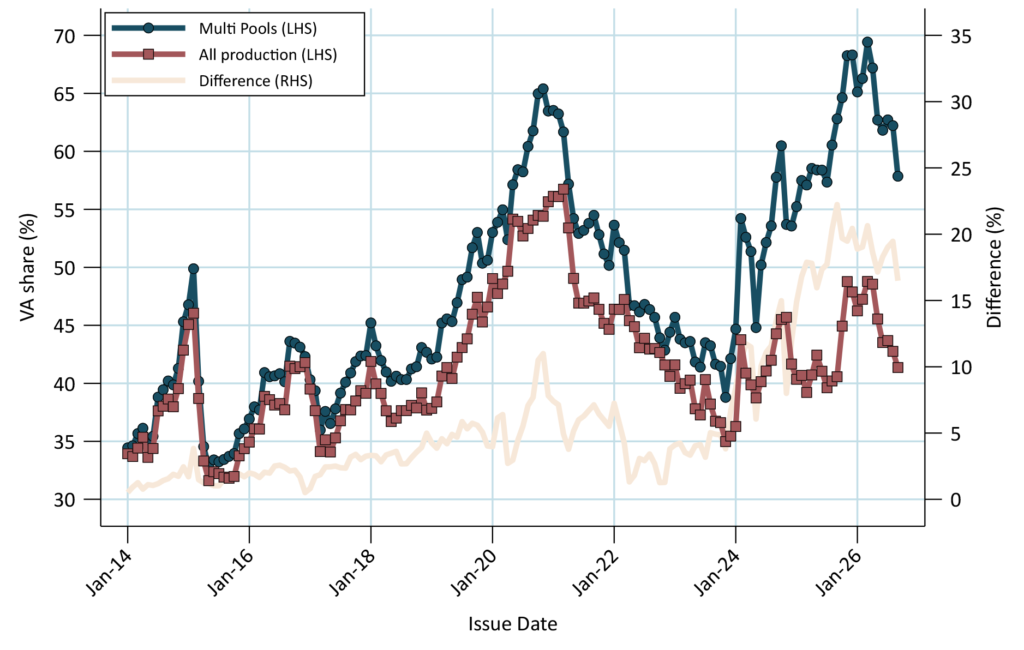
VA loans accounted for 57% of all collateral in newly issued multiple-issuer pools in September, the first time the share fell below 60% since last October (Exhibit 1). The high VA share reflects heavy custom-pool issuance, which diverts FHA, rural housing and low-balance loans from multi pools. Mortgage rates also play a role because VA loans prepay faster when rates decline, which boosts VA refinancing and its share of government loan production. That effect pushed the VA share to 70% after rates declined last fall and is unwinding now that rates are higher. Still, September’s share was comparable to the historically elevated levels recorded just before last year’s decline in rates, suggesting that the improvement in TBA collateral quality is limited.
Exhibit 1. Higher rates are reducing VA concentration in multi pools
Source: Ginnie Mae, Santander US Capital Markets.
The average loan size of new multi pools increased slightly in September despite the lower VA share in these pools (Exhibit 2). VA loans are typically larger than other government loans. But custom-pool investors generally prefer low-balance loans for their slower refinancing, so the non-VA loans that are put into multi pools usually have large balances. Investor interest in low-balance collateral should persist despite higher mortgage rates as more frequent moves by these borrowers provide extension protection.
Exhibit 2. Multi-pool loan sizes remain near record highs
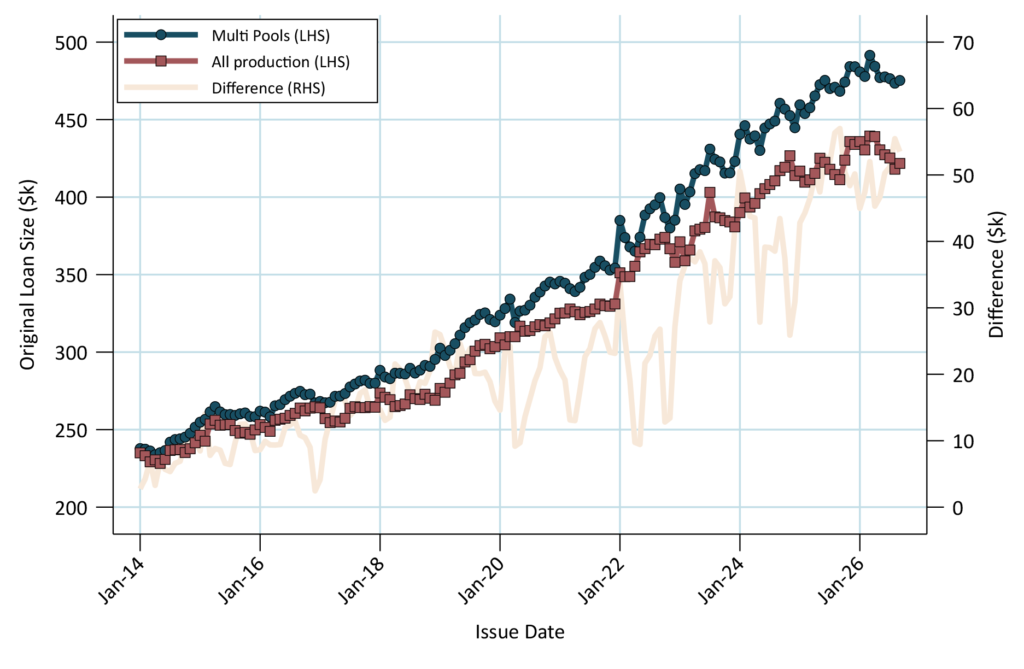
Average loan size is balance-weighted to better represent the prepayment exposure of each loan cohort.
Source: Ginnie Mae, Santander US Capital Markets.
Multi-pool volume accounts for about 40% of all FHA production, a share that has been less than 50% for more than a year (Exhibit 3). An even smaller share of loans from the Rural Housing Service and Public and Indian Housing programs is issued in multi pools. Although this collateral divergence supports custom pool pay-ups, investors must weigh the collateral advantage against the liquidity of the TBA market.
Exhibit 3. Most FHA production now bypasses multi pools
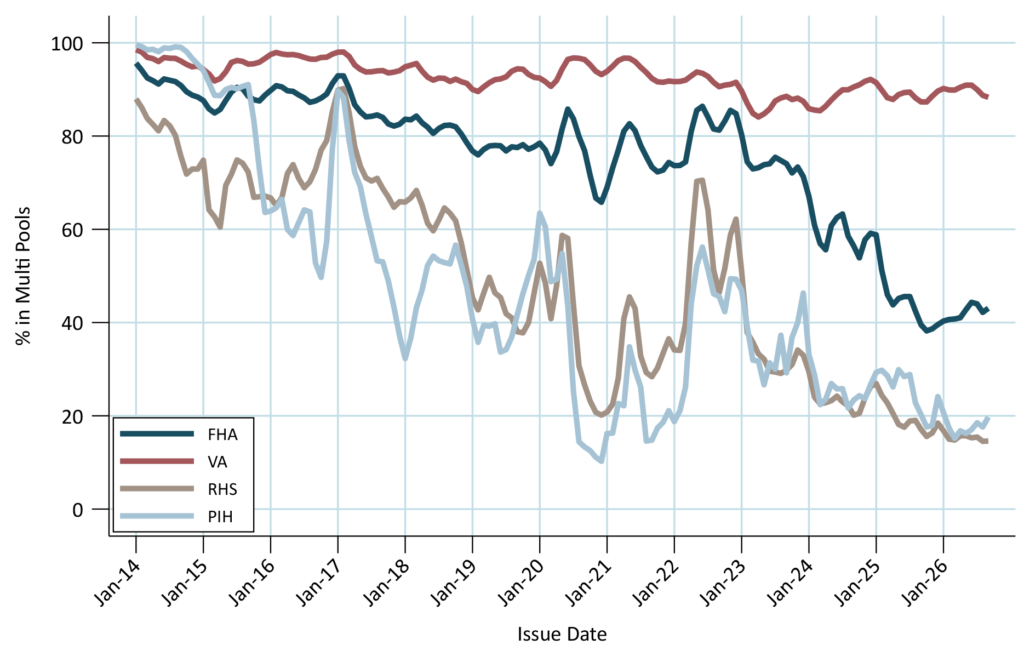
RHS: USDA’s Rural Housing Service loans. PIH: HUD’s Public and Indian Housing loans.
Source: Ginnie Mae, Santander US Capital Markets.
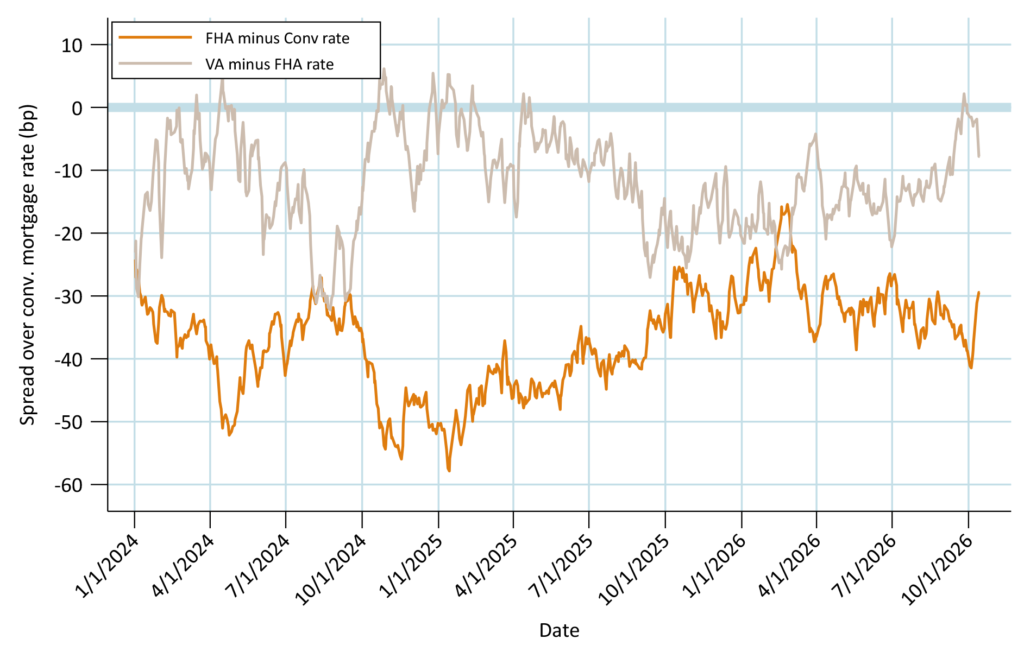
Despite the pay-up originators receive for many FHA loans, these borrowers often pay a higher rate than VA borrowers (Exhibit 4). FHA mortgage rates have generally been below conventional rates since the start of 2024, while VA rates have often been lower still. However, every FHA borrower must pay an annual mortgage insurance premium, typically 55 bp, while VA borrowers do not pay an annual premium. Including that premium widens the cost disadvantage of FHA borrowers relative to VA borrowers, even though VA loans offer investors less favorable convexity. These comparisons raise questions about how much of the FHA pay-up reaches borrowers, but do not establish the extent of pass-through.
Exhibit 4. VA rates remain below FHA rates
Source: Optimal Blue, Ginnie Mae, Santander US Capital Markets.
Custom pools accounted for more than a third of Ginnie Mae issuance in September, remaining near historically elevated levels despite higher mortgage rates and a changing FHA/VA production mix (Exhibit 5). This robust issuance suggests that structural pooling incentives continue to weigh on TBA collateral quality, despite a modest near-term improvement from higher mortgage rates.
Exhibit 5. Custom pools remain more than a third of total issuance
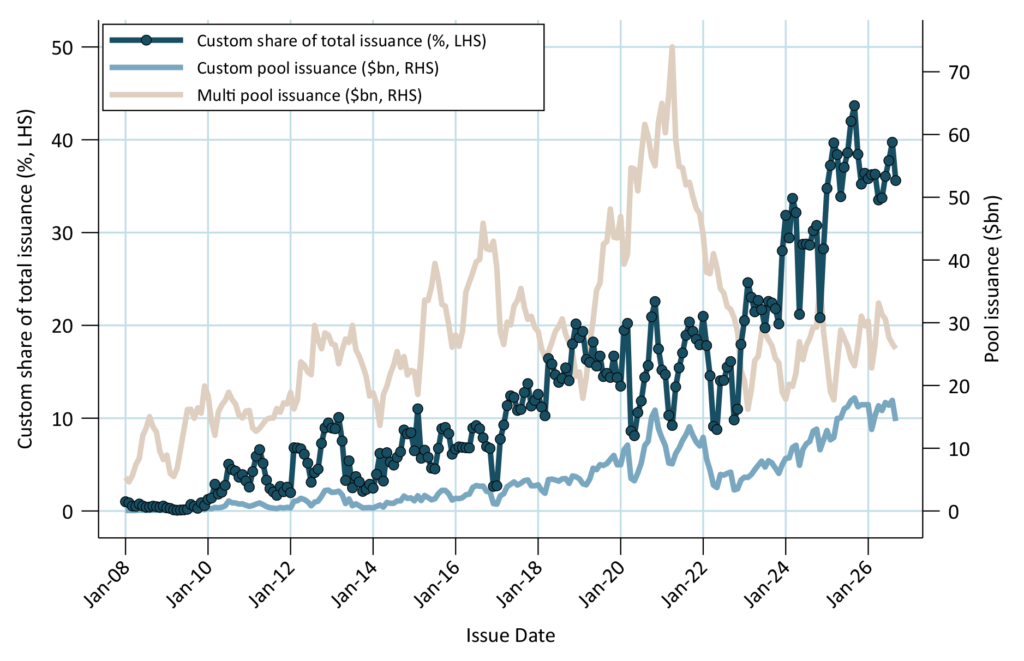
Custom-pool issuance as a share of total Ginnie Mae issuance. Fixed-rate 30-year MBS. Includes Ginnie Mae I and II pools. Ginnie Mae I production began slowing in late 2009 and had largely stopped by 2014.
Source: Ginnie Mae, Santander US Capital Markets.
Pooling in Ginnie Mae MBS continues to direct call-protected collateral, including FHA and low-balance loans, into custom pools. This lowers the convexity of the TBA-deliverable multiple-issuer pools. That risks becoming a downward spiral as TBA collateral quality deteriorates and pay-ups rise, making separate pooling profitable for an increasingly broad range of collateral. This issue is discussed in more detail here. Unless pooling incentives change, Ginnie Mae investors need to treat collateral-quality deterioration as a persistent factor in TBA valuation and specified-pool pay-ups.
This material is intended only for institutional investors and does not carry all of the independence and disclosure standards of retail debt research reports. In the preparation of this material, the author may have consulted or otherwise discussed the matters referenced herein with one or more of SCM’s trading desks, any of which may have accumulated or otherwise taken a position, long or short, in any of the financial instruments discussed in or related to this material. Further, SCM may act as a market maker or principal dealer and may have proprietary interests that differ or conflict with the recipient hereof, in connection with any financial instrument discussed in or related to this material.
This message, including any attachments or links contained herein, is subject to important disclaimers, conditions, and disclosures regarding Electronic Communications, which you can find at https://portfolio-strategy.apsec.com/sancap-disclaimers-and-disclosures.
Important Disclaimers
Copyright © 2026 Santander US Capital Markets LLC and its affiliates (“SCM”). All rights reserved. SCM is a member of FINRA and SIPC. This material is intended for limited distribution to institutions only and is not publicly available. Any unauthorized use or disclosure is prohibited.
In making this material available, SCM (i) is not providing any advice to the recipient, including, without limitation, any advice as to investment, legal, accounting, tax and financial matters, (ii) is not acting as an advisor or fiduciary in respect of the recipient, (iii) is not making any predictions or projections and (iv) intends that any recipient to which SCM has provided this material is an “institutional investor” (as defined under applicable law and regulation, including FINRA Rule 4512 and that this material will not be disseminated, in whole or part, to any third party by the recipient.
The author of this material is an economist, desk strategist or trader. In the preparation of this material, the author may have consulted or otherwise discussed the matters referenced herein with one or more of SCM’s trading desks, any of which may have accumulated or otherwise taken a position, long or short, in any of the financial instruments discussed in or related to this material. Further, SCM or any of its affiliates may act as a market maker or principal dealer and may have proprietary interests that differ or conflict with the recipient hereof, in connection with any financial instrument discussed in or related to this material.
This material (i) has been prepared for information purposes only and does not constitute a solicitation or an offer to buy or sell any securities, related investments or other financial instruments, (ii) is neither research, a “research report” as commonly understood under the securities laws and regulations promulgated thereunder nor the product of a research department, (iii) or parts thereof may have been obtained from various sources, the reliability of which has not been verified and cannot be guaranteed by SCM, (iv) should not be reproduced or disclosed to any other person, without SCM’s prior consent and (v) is not intended for distribution in any jurisdiction in which its distribution would be prohibited.
In connection with this material, SCM (i) makes no representation or warranties as to the appropriateness or reliance for use in any transaction or as to the permissibility or legality of any financial instrument in any jurisdiction, (ii) believes the information in this material to be reliable, has not independently verified such information and makes no representation, express or implied, with regard to the accuracy or completeness of such information, (iii) accepts no responsibility or liability as to any reliance placed, or investment decision made, on the basis of such information by the recipient and (iv) does not undertake, and disclaims any duty to undertake, to update or to revise the information contained in this material.
Unless otherwise stated, the views, opinions, forecasts, valuations, or estimates contained in this material are those solely of the author, as of the date of publication of this material, and are subject to change without notice. The recipient of this material should make an independent evaluation of this information and make such other investigations as the recipient considers necessary (including obtaining independent financial advice), before transacting in any financial market or instrument discussed in or related to this material.
Important disclaimers for clients in the EU and UK
This publication has been prepared by Trading Desk Strategists within the Sales and Trading functions of Santander US Capital Markets LLC (“SanCap”), the US registered broker-dealer of Santander Corporate & Investment Banking. This communication is distributed in the EEA by Banco Santander S.A., a credit institution registered in Spain and authorised and regulated by the Bank of Spain and the CNMV. Any EEA recipient of this communication that would like to affect any transaction in any security or issuer discussed herein should do so with Banco Santander S.A. or any of its affiliates (together “Santander”). This communication has been distributed in the UK by Banco Santander, S.A.’s London branch, authorised by the Bank of Spain and subject to regulatory oversight on certain matters by the Financial Conduct Authority (FCA) and the Prudential Regulation Authority (PRA).
The publication is intended for exclusive use for Professional Clients and Eligible Counterparties as defined by MiFID II and is not intended for use by retail customers or for any persons or entities in any jurisdictions or country where such distribution or use would be contrary to local law or regulation.
This material is not a product of Santander´s Research Team and does not constitute independent investment research. This is a marketing communication and may contain ¨investment recommendations¨ as defined by the Market Abuse Regulation 596/2014 ("MAR"). This publication has not been prepared in accordance with legal requirements designed to promote the independence of research and is not subject to any prohibition on dealing ahead of the dissemination of investment research. The author, date and time of the production of this publication are as indicated herein.
This publication does not constitute investment advice and may not be relied upon to form an investment decision, nor should it be construed as any offer to sell or issue or invitation to purchase, acquire or subscribe for any instruments referred herein. The publication has been prepared in good faith and based on information Santander considers reliable as of the date of publication, but Santander does not guarantee or represent, express or implied, that such information is accurate or complete. All estimates, forecasts and opinions are current as at the date of this publication and are subject to change without notice. Unless otherwise indicated, Santander does not intend to update this publication. The views and commentary in this publication may not be objective or independent of the interests of the Trading and Sales functions of Santander, who may be active participants in the markets, investments or strategies referred to herein and/or may receive compensation from investment banking and non-investment banking services from entities mentioned herein. Santander may trade as principal, make a market or hold positions in instruments (or related derivatives) and/or hold financial interest in entities discussed herein. Santander may provide market commentary or trading strategies to other clients or engage in transactions which may differ from views expressed herein. Santander may have acted upon the contents of this publication prior to you having received it.
This publication is intended for the exclusive use of the recipient and must not be reproduced, redistributed or transmitted, in whole or in part, without Santander’s consent. The recipient agrees to keep confidential at all times information contained herein.