


The Big Idea
Revisiting inflation after benchmark revisions
Stephen Stanley | October 2, 2026
This material is a Marketing Communication and does not constitute Independent Investment Research.
The BEA on September 30 released important annual revisions to the PCE deflator. The long-awaited revisions seemed set to modestly lower the inflation readings of recent years. In fact, the adjustment was slightly larger than expected. Core inflation as a result is still far above the FOMC’s 2% target, but the new data offer a somewhat less disturbing picture that will likely encourage a cautious Fed approach to rate hikes.
Methodological changes
The BEA revises the GDP accounts each year to incorporate new data and refine methods. This year’s revisions included some important changes to the PCE deflators.
In particular, the BEA changed the inputs for calculating prices for three PCE deflator categories: portfolio management fees, computer software and legal services. Each had well-known measurement flaws, so the changes should improve the inflation data.
Portfolio management. I have long pointed to the spurious methodology that the BEA used to calculate portfolio management prices. Many investment managers, including hedge funds, charge both a fixed percentage of assets and a share of investment returns. The traditional model was 2% of assets and 20% of returns. Investors consequently pay more to their investment managers when markets, especially stocks, rise, and vice versa. By using the PPI for portfolio management and investment advice services, the BEA has been conflating market moves with prices, as the PCE deflator gauge for this line item has long been tightly correlated with the direction of the stock market.
The new method is not perfect, but it should be better. The BEA now uses industry employment as a proxy for real output. The deflator becomes the residual from dividing nominal spending by that employment-based “real” measure. The approach will likely make the category harder for economists to forecast, especially at first.
Economists predicted that this change would lower the overall PCE deflator by one to two tenths of a percentage point.
Computer software. Before, as is the case for the majority of categories in the PCE deflator, the PCE deflator for computer software simply used the corresponding CPI line item (with a different weight). Unfortunately, the CPI for computer software and accessories has been polluted by the fervor of the AI buildout. Certain items like flash drives that are more hardware than software and have seen steep price hikes are included in the CPI gauge of software. As a result, the CPI component at the current juncture does not offer a clean view of the prices that consumers face for software. This is not a major problem for the CPI, because the weight of the line item is infinitesimally small, 0.03% of the overall CPI. In contrast, the weight for the PCE deflator is 1.1%.
To address this issue, the BEA is now using a composite index that will be derived from the CPI component, the PPI for game software publishing, the PPI for hosting server pages, and the PPI for other IT infrastructure provisioning services.
The expectation was that the new composite index could bring down the overall PCE deflator inflation measure by around a tenth of a percentage point.
Legal services. The legal services line item of the PCE deflator was another one that was historically a simple passthrough of the corresponding CPI category but with a different weight. The problem is that the BLS has developed problems with the CPI gauge for legal services. The BLS has stopped publishing the legal services results because they do not meet the BLS publication quality guidelines. The numbers have recently recorded implausibly large swings that are not consistent, according to the BEA, with other source data. As with computer software, the weight for this category is much larger in the PCE deflator (0.8%) than for the CPI (0.3%).
The BEA is now using a composite price index that uses detailed PPIs for selected legal services consumed by households instead of the unreliable CPI line item.
This change was widely expected to raise the PCE deflator, providing a partial offset to the other two alterations. The net impact of the three changes was expected to lower the year-over-year advance in the PCE deflator by around two tenths of a percentage point.
Results
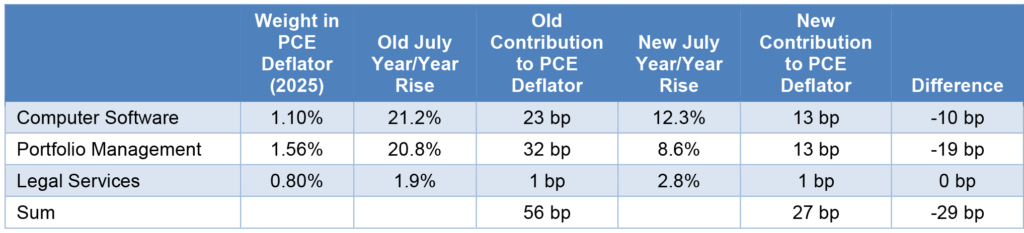
The revisions were broadly in line with expectations (Exhibit 1). For the 12 months ended in July, the surge in computer software prices was pared from over 21% to just above 12%. Given the weight in the index, the contribution from this line item dropped by a full tenth of a percentage point, to a still considerable 13 basis points. Similarly, the rise in portfolio management fees in the 12 months ended July was cut from 20.8% to 8.6%, reducing the contribution to the PCE deflator by 19 basis points (coincidentally, the new contribution for this line item was also 13 basis points, the same as for computer software). Finally, the change to the legal services gauge was not large enough to make a discernible difference.
Exhibit 1: Impact of methodological revisions on PCE inflation
Source: BEA.
In total, the revisions to these three line items produced a downward adjustment to the year-over-year advance in the July PCE deflator of 29 basis points. In the end, the year-over-year increase in the August core PCE deflator uses the pre-revision figures for July and my estimate for August would have been 3.4%. I expected the methodological revisions to take the figure down to 3.2%, but the actual result was 3.0%. In the end, the downward adjustments to the computer software and portfolio management categories were about as expected, but the legal services revision, while upward, was not large enough to provide a meaningful offset.
Policy implications
In a different context, these changes might have been a big deal. Three or four tenths of a percentage point would have been a gamechanger if core inflation had been running, say, in the mid 2%’s prior to the annual revisions. However, unfortunately, inflation has been so far above the Fed’s 2% target that even the new lower trend remains extremely troublesome.
The FOMC is likely to conclude that it still has a significant inflation problem. The prevailing narrative among policymakers for the past three years has been that underlying inflation had moderated to below 3% and that it would likely narrow further toward 2% but that special factors, such as tariffs and an oil shock were obscuring the underlying improvement.
The trajectory before the revisions pointed to an acceleration in core inflation. After running close to 3% in 2024 and 2025, the core PCE deflator had accelerated to 3.3% in June and July on a year-over-year basis. While Fed officials usually ascribed the pickup to tariffs and/or energy price effects, in reality, the surge in computer software prices and portfolio management fees under the old methodology accounted for a substantial portion of the acceleration.
Under the new methodology, it would be fair to say that core PCE inflation has been mostly steady for nearly three years running, clocking in at 2.9% in 2024 and 2025 and 3.0% over the last 12 months. The new outlook still likely calls for some degree of policy tightening, but it is a relief to learn that core inflation is not actually gaining speed.
Optimists could slice the data differently and come to an even brighter conclusion. The June and July core PCE inflation gains were each 0.13%, a benign pace of advance. A resurgence in August, to a 0.25% monthly rise, does suggest caution, but the three-month annualized rate of increase through August was only 2.0%, and even the six-month annualized clip was 2.7%, still below the year-over-year result. Some doves may take this as evidence that underlying inflation is cooling (Governor Waller made an argument along these lines a while back even without the benefit of the new, more restrained, data). I would not go quite that far, but I would say that even the suggestion of better news on inflation is likely to convince the FOMC to operate cautiously, tightening slowly and carefully. I look for another quarter-point hike in December, but in my view, an October move, which would not only come days before the mid-term elections but would also mean back-to-back increases in quick succession, is exceedingly unlikely. I also believe that these data argue against the aggressive tightening campaign recently priced in fed funds futures (at one point a few days ago, roughly 100 basis points of hikes over the next year to nearly 5%). I continue to believe, instead, that the FOMC will move the target rate to a level (4.125%) widely seen as modestly restrictive and then leave it there for as long as it takes to return inflation to 2%, rather than risk overshooting and potentially pushing the economy into recession.