The Big Idea
Possible trouble brewing for shelter costs
This material is a Marketing Communication and does not constitute Independent Investment Research.
The Fed has its hands full trying to bring inflation down to its 2% target. Tariffs and energy costs pushed up prices in recent years. Core services inflation has picked up this year. But one important part of the basket getting little airtime lately is shelter costs. Rent and owners’ equivalent rent (OER) have generally decelerated in recent years, but one prominent real-time measure of rents points to a possible pickup in the months ahead. That would only add another headache to the Fed’s already difficult task of controlling inflation.
Shelter costs and market rents
When rents skyrocketed during the pandemic, markets had to learn more than they probably wanted to know about how the BLS measures rent and OER. Both rent and OER are based on rents, not home prices. Owners’ equivalent rent estimates how much a homeowner would pay to rent their own home. That means shelter costs, which account for over 40% of the core CPI and around 15% of the core PCE deflator, are tied to rents and not home prices.
The BLS tries to measure everyone’s rent, not only those signing new leases. Since most tenants sign annual leases, shifts in the rental market take a while to flow into the BLS measures. Only a fraction of the BLS sample signs new leases and sees their rents change in a given month. When rents surged and then normalized earlier in this decade, we learned that shelter costs tended to lag gauges of market rents by a year or even more.
That makes timelier market-rent indexes useful guides to where BLS rent and OER measures may go next.
Zillow rent index
Zillow publishes one of those measures. It uses its vast database of real estate transactions to compute a home price index as well as a rent gauge. The rent gauge uses repeat transactions so it can make apples-to-apples comparisons on the same properties. That method may work especially well for rents because rentals usually turn over more often than homes. In any case, Zillow’s Observed Rent Index (ZORI) is calculated based on the changes in rent for the same properties over time and is limited to the middle 30% of units by price of each local market, so that swings at the extremes of the price range do not distort the results.
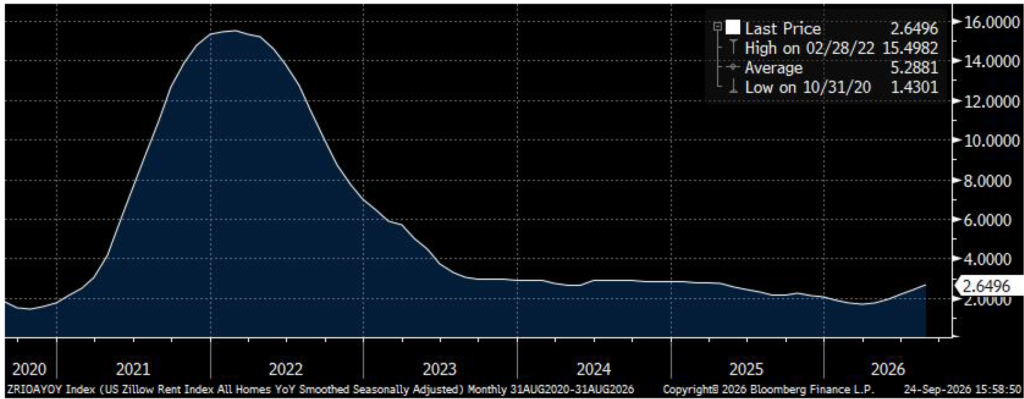
The ZORI gauge peaked in February 2022 while the BLS rent and OER gains peaked on a year-over-year basis in March and April of 2023, respectively, slightly more than a year later (Exhibit 1). The lag makes ZORI a window into the future of this considerable component of core inflation.
Exhibit 1: Zillow observed rent index year-over-year change
Source: Zillow, Bloomberg.
The latest data show ZORI steadily cooled year-over-year through 2025 and bottomed out in March. That suggests shelter costs in the CPI and PCE deflator (the CPI monthly changes pass through directly to the PCE deflator, though the weights are much lower in the latter, as noted above) could keep slowing for another two or three quarters.
As an aside, the BLS shelter costs measures have been distorted since last October by the absence of a monthly CPI survey in that period due to the federal government shutdown. As a result, the trends in the CPI and PCE inflation gauges for shelter costs have not been tracking the market rent indicators as cleanly as they normally would.
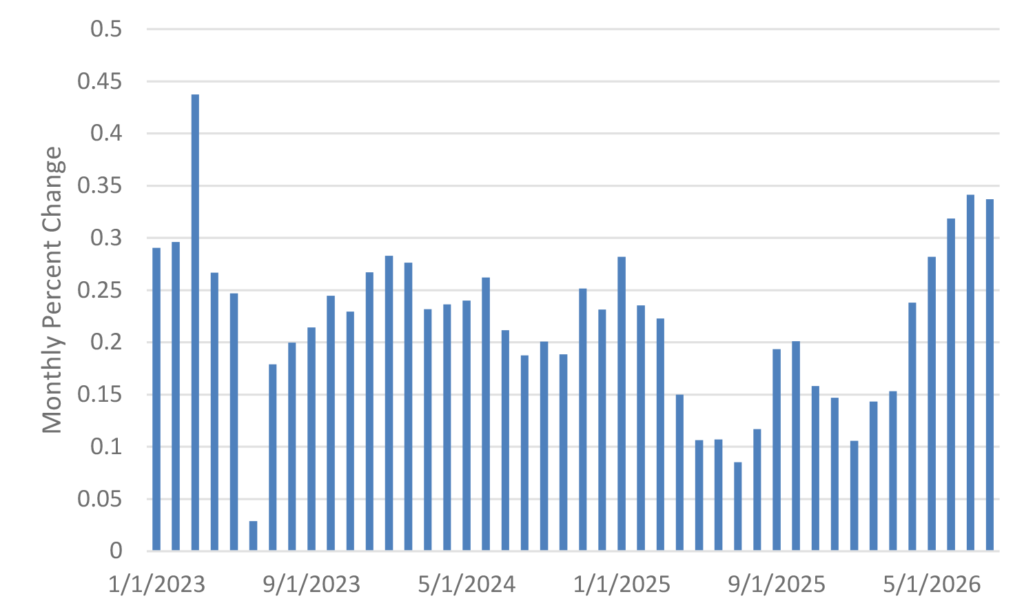
After a series of unusually benign monthly readings from mid-2025 through March—predominantly between +0.1% and +0.2%–year-over-year rents have picked up noticeably (Exhibit 2). The last four observations, beginning in May, were +0.28%, +0.32%, +0.34%, and +0.34%. To put those results into perspective, with the exception of an outlier +0.4% jump in March 2023, there had not been a single reading of +0.30% or higher between September 2022 and June 2026.
Exhibit 2: Zillow observed rent index monthly change
Note: Seasonally adjusted monthly changes for the ZORI.
Source: Zillow.
While the year-over-year acceleration has so far been relatively modest, from a low of 1.7% in March to 2.6% in August, the average monthly pace over the past four months equates to an annualized rate of close to 4%. If that clip is sustained, then we can expect the BLS shelter costs measures to accelerate by between one and two percentage points, likely in 2027. If this comes to fruition, it could be a substantial offset to the expected relief on inflation next year from the fading of tariff and oil shock impacts and may frustrate the FOMC’s efforts to return inflation to the 2% target in a timely manner.
This material is intended only for institutional investors and does not carry all of the independence and disclosure standards of retail debt research reports. In the preparation of this material, the author may have consulted or otherwise discussed the matters referenced herein with one or more of SCM’s trading desks, any of which may have accumulated or otherwise taken a position, long or short, in any of the financial instruments discussed in or related to this material. Further, SCM may act as a market maker or principal dealer and may have proprietary interests that differ or conflict with the recipient hereof, in connection with any financial instrument discussed in or related to this material.
This message, including any attachments or links contained herein, is subject to important disclaimers, conditions, and disclosures regarding Electronic Communications, which you can find at https://portfolio-strategy.apsec.com/sancap-disclaimers-and-disclosures.
Important Disclaimers
Copyright © 2026 Santander US Capital Markets LLC and its affiliates (“SCM”). All rights reserved. SCM is a member of FINRA and SIPC. This material is intended for limited distribution to institutions only and is not publicly available. Any unauthorized use or disclosure is prohibited.
In making this material available, SCM (i) is not providing any advice to the recipient, including, without limitation, any advice as to investment, legal, accounting, tax and financial matters, (ii) is not acting as an advisor or fiduciary in respect of the recipient, (iii) is not making any predictions or projections and (iv) intends that any recipient to which SCM has provided this material is an “institutional investor” (as defined under applicable law and regulation, including FINRA Rule 4512 and that this material will not be disseminated, in whole or part, to any third party by the recipient.
The author of this material is an economist, desk strategist or trader. In the preparation of this material, the author may have consulted or otherwise discussed the matters referenced herein with one or more of SCM’s trading desks, any of which may have accumulated or otherwise taken a position, long or short, in any of the financial instruments discussed in or related to this material. Further, SCM or any of its affiliates may act as a market maker or principal dealer and may have proprietary interests that differ or conflict with the recipient hereof, in connection with any financial instrument discussed in or related to this material.
This material (i) has been prepared for information purposes only and does not constitute a solicitation or an offer to buy or sell any securities, related investments or other financial instruments, (ii) is neither research, a “research report” as commonly understood under the securities laws and regulations promulgated thereunder nor the product of a research department, (iii) or parts thereof may have been obtained from various sources, the reliability of which has not been verified and cannot be guaranteed by SCM, (iv) should not be reproduced or disclosed to any other person, without SCM’s prior consent and (v) is not intended for distribution in any jurisdiction in which its distribution would be prohibited.
In connection with this material, SCM (i) makes no representation or warranties as to the appropriateness or reliance for use in any transaction or as to the permissibility or legality of any financial instrument in any jurisdiction, (ii) believes the information in this material to be reliable, has not independently verified such information and makes no representation, express or implied, with regard to the accuracy or completeness of such information, (iii) accepts no responsibility or liability as to any reliance placed, or investment decision made, on the basis of such information by the recipient and (iv) does not undertake, and disclaims any duty to undertake, to update or to revise the information contained in this material.
Unless otherwise stated, the views, opinions, forecasts, valuations, or estimates contained in this material are those solely of the author, as of the date of publication of this material, and are subject to change without notice. The recipient of this material should make an independent evaluation of this information and make such other investigations as the recipient considers necessary (including obtaining independent financial advice), before transacting in any financial market or instrument discussed in or related to this material.
Important disclaimers for clients in the EU and UK
This publication has been prepared by Trading Desk Strategists within the Sales and Trading functions of Santander US Capital Markets LLC (“SanCap”), the US registered broker-dealer of Santander Corporate & Investment Banking. This communication is distributed in the EEA by Banco Santander S.A., a credit institution registered in Spain and authorised and regulated by the Bank of Spain and the CNMV. Any EEA recipient of this communication that would like to affect any transaction in any security or issuer discussed herein should do so with Banco Santander S.A. or any of its affiliates (together “Santander”). This communication has been distributed in the UK by Banco Santander, S.A.’s London branch, authorised by the Bank of Spain and subject to regulatory oversight on certain matters by the Financial Conduct Authority (FCA) and the Prudential Regulation Authority (PRA).
The publication is intended for exclusive use for Professional Clients and Eligible Counterparties as defined by MiFID II and is not intended for use by retail customers or for any persons or entities in any jurisdictions or country where such distribution or use would be contrary to local law or regulation.
This material is not a product of Santander´s Research Team and does not constitute independent investment research. This is a marketing communication and may contain ¨investment recommendations¨ as defined by the Market Abuse Regulation 596/2014 ("MAR"). This publication has not been prepared in accordance with legal requirements designed to promote the independence of research and is not subject to any prohibition on dealing ahead of the dissemination of investment research. The author, date and time of the production of this publication are as indicated herein.
This publication does not constitute investment advice and may not be relied upon to form an investment decision, nor should it be construed as any offer to sell or issue or invitation to purchase, acquire or subscribe for any instruments referred herein. The publication has been prepared in good faith and based on information Santander considers reliable as of the date of publication, but Santander does not guarantee or represent, express or implied, that such information is accurate or complete. All estimates, forecasts and opinions are current as at the date of this publication and are subject to change without notice. Unless otherwise indicated, Santander does not intend to update this publication. The views and commentary in this publication may not be objective or independent of the interests of the Trading and Sales functions of Santander, who may be active participants in the markets, investments or strategies referred to herein and/or may receive compensation from investment banking and non-investment banking services from entities mentioned herein. Santander may trade as principal, make a market or hold positions in instruments (or related derivatives) and/or hold financial interest in entities discussed herein. Santander may provide market commentary or trading strategies to other clients or engage in transactions which may differ from views expressed herein. Santander may have acted upon the contents of this publication prior to you having received it.
This publication is intended for the exclusive use of the recipient and must not be reproduced, redistributed or transmitted, in whole or in part, without Santander’s consent. The recipient agrees to keep confidential at all times information contained herein.