The Big Idea
Removing a dose of accommodation
This material is a Marketing Communication and does not constitute Independent Investment Research.
Fed Chair Warsh offered a comprehensive case for raising rates, citing economic strength, stubbornly high inflation and a persistent increase in oil and commodity prices due to a shift in the geopolitical situation. Warsh also repeated a point he made at Jackson Hole: broad financial conditions are far from restrictive. Measures of financial conditions confirm that, despite a longstanding view of many Fed officials that monetary policy was modestly restrictive, the broad environment has been easy for some time.
Fed funds rate and neutrality
Central bankers have long compared the policy rate with an estimate of neutral. A “neutral” rate is the setting that neither stimulates nor restricts the economy over time. It is impossible to observe neutral in the real world, so officials guess where it lies and adjust based on how the economy responds to various interest rate levels.
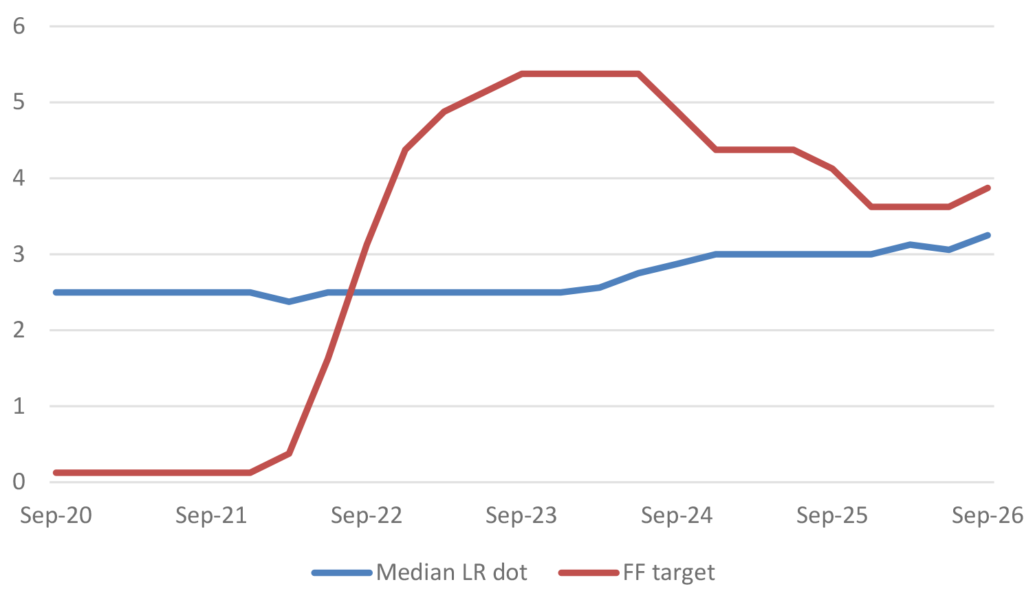
The FOMC’s quarterly “dot” projections include estimates of the “longer-run” funds rate, a close proxy to policymakers’ view of neutral. Comparing the FOMC’s quarterly median estimates of neutral with the actual funds rate target helps show how Fed officials regarded the stance of its rate policy (Exhibit 1).
Exhibit 1: Target Fed funds rate compared to long-run neutral
Source: Federal Reserve.
By this gauge, monetary policy has been restrictive since the summer of 2022, when the rapid hiking cycle took the policy rate above the Fed’s then-current estimate of a roughly 2.5% neutral level. This is why so many Fed officials have been referring to policy this year as “modestly restrictive.”
Financial conditions indices
Financial conditions include far more than the overnight fed funds rate. Various indices try to measure broad financial conditions. Two different ones offer a picture that is quite far from “modestly restrictive.”
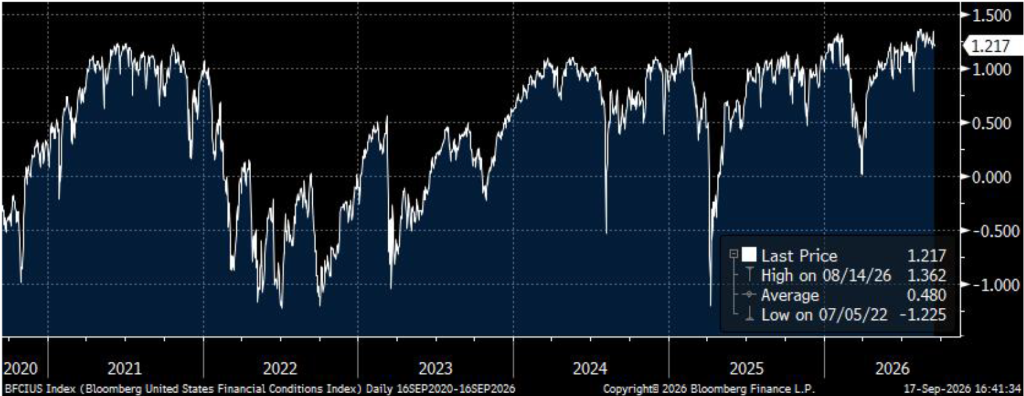
The Bloomberg Financial Conditions index is relatively simple. It includes a few money market spreads, several bond spreads, and, for equities, the S&P 500 and the VIX. For the Bloomberg gauge, up is easier and down is tighter (Exhibit 2). Zero represents average conditions over the period from 1994 to July 1, 2008, and the index is scaled so that +1 represents one standard deviation easier than the mean and -1 represents one standard deviation tighter.
As the graph shows, this index has spent almost all of the last three years above zero, meaning financial conditions have been easier than usual. The few dips below zero were generally tied to events with little connection to monetary policy. In early 2023, the failure of SVB and several other banks led to a period of tightness. In the summer of 2024, there was a momentary panic over the unwind of the carry trade globally. And then the brief drops in 2025 and 2026 followed Liberation Day and the US-Iran conflict, respectively. None of these episodes lasted very long, and none was related to Fed policy.
By this measure, financial conditions over the past month or so have been the easiest in recent years. In fact, the local peak set in August was the highest, or easiest, reading in more than 30 years.
Exhibit 2: Bloomberg Financial Conditions Index
Source: Bloomberg.
The Chicago Fed National Financial Conditions Index offers a broader view. It is my preferred measure because it includes 105 measures of financial activity. Along with market prices and spreads, it includes responses from the Federal Reserve Board’s Senior Loan Officer Survey, the NFIB small business survey, and the University of Michigan survey of consumers. Unlike the Bloomberg measure, it does not update daily. It is calculated weekly, with revisions, and some components are reported less often. The Senior Loan Officer survey, for example, is conducted only quarterly. That makes the index less timely, but broader.
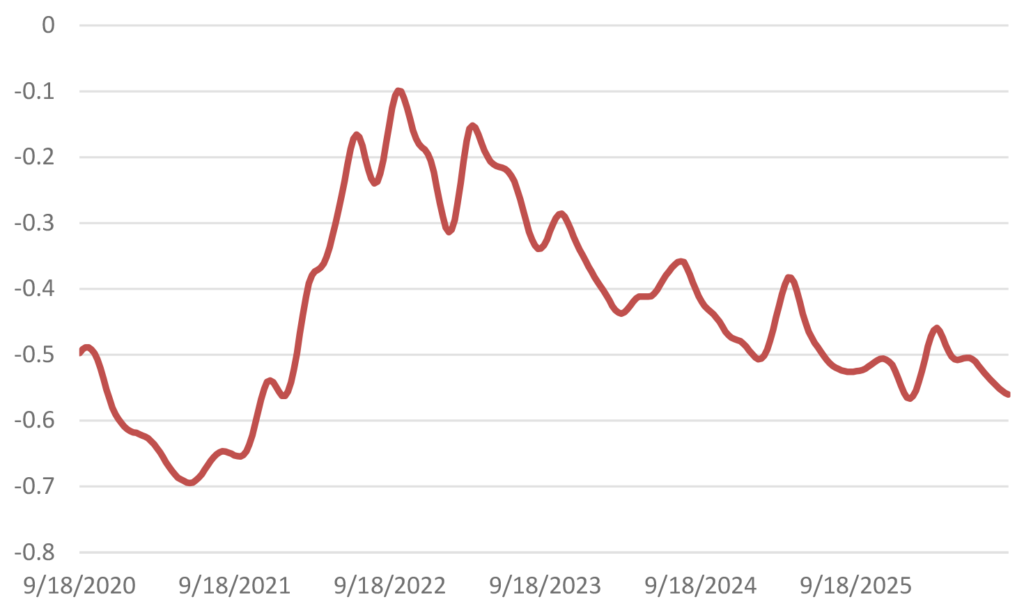
For the Chicago Fed National Financial Conditions Index, up is tighter and down is looser, with 0 representing the long-term median of conditions and, like the Bloomberg composite, it is scaled to standard deviations (Exhibit 3). By this measure, financial conditions consistently have been easier than average over the past six years. Moreover, as with the Bloomberg gauge, the Chicago Fed index indicates that financial conditions have loosened considerably this year. By this gauge, financial conditions are currently roughly at their easiest since just before the Fed began to hike rates off of the zero bound in early 2022.
Exhibit 3: Chicago Fed National Financial Conditions Index
Source: Chicago Fed.
Conclusion
Financial condition indices help explain why Chair Warsh noted at Jackson Hole and repeated Wednesday that “I would be hard-pressed to describe broad financial conditions as restrictive,” He added that the bulk of the FOMC generally shares that view. The FOMC appears to be warming to the view long held by a group of hawkish policymakers that a neutral policy setting is actually noticeably higher than the current consensus thinks. The median longer-run dot inched up to 3.25% in the most recent estimates, its highest level in more than a decade.
The Fed may be willing to push the envelope if modest hikes fail to curb inflation. Warsh described the September rate hike as removing a “dose of accommodation,” which leaves open the possibility that at least some on the FOMC believe that the new policy stance is still in easy territory rather than restrictive. I still expect the Fed to raise rates only one more time and then hold steady for an extended period until inflation finally slides back close to 2%, but the rhetoric of Warsh and the FOMC opens the door to a more aggressive approach.
This material is intended only for institutional investors and does not carry all of the independence and disclosure standards of retail debt research reports. In the preparation of this material, the author may have consulted or otherwise discussed the matters referenced herein with one or more of SCM’s trading desks, any of which may have accumulated or otherwise taken a position, long or short, in any of the financial instruments discussed in or related to this material. Further, SCM may act as a market maker or principal dealer and may have proprietary interests that differ or conflict with the recipient hereof, in connection with any financial instrument discussed in or related to this material.
This message, including any attachments or links contained herein, is subject to important disclaimers, conditions, and disclosures regarding Electronic Communications, which you can find at https://portfolio-strategy.apsec.com/sancap-disclaimers-and-disclosures.
Important Disclaimers
Copyright © 2026 Santander US Capital Markets LLC and its affiliates (“SCM”). All rights reserved. SCM is a member of FINRA and SIPC. This material is intended for limited distribution to institutions only and is not publicly available. Any unauthorized use or disclosure is prohibited.
In making this material available, SCM (i) is not providing any advice to the recipient, including, without limitation, any advice as to investment, legal, accounting, tax and financial matters, (ii) is not acting as an advisor or fiduciary in respect of the recipient, (iii) is not making any predictions or projections and (iv) intends that any recipient to which SCM has provided this material is an “institutional investor” (as defined under applicable law and regulation, including FINRA Rule 4512 and that this material will not be disseminated, in whole or part, to any third party by the recipient.
The author of this material is an economist, desk strategist or trader. In the preparation of this material, the author may have consulted or otherwise discussed the matters referenced herein with one or more of SCM’s trading desks, any of which may have accumulated or otherwise taken a position, long or short, in any of the financial instruments discussed in or related to this material. Further, SCM or any of its affiliates may act as a market maker or principal dealer and may have proprietary interests that differ or conflict with the recipient hereof, in connection with any financial instrument discussed in or related to this material.
This material (i) has been prepared for information purposes only and does not constitute a solicitation or an offer to buy or sell any securities, related investments or other financial instruments, (ii) is neither research, a “research report” as commonly understood under the securities laws and regulations promulgated thereunder nor the product of a research department, (iii) or parts thereof may have been obtained from various sources, the reliability of which has not been verified and cannot be guaranteed by SCM, (iv) should not be reproduced or disclosed to any other person, without SCM’s prior consent and (v) is not intended for distribution in any jurisdiction in which its distribution would be prohibited.
In connection with this material, SCM (i) makes no representation or warranties as to the appropriateness or reliance for use in any transaction or as to the permissibility or legality of any financial instrument in any jurisdiction, (ii) believes the information in this material to be reliable, has not independently verified such information and makes no representation, express or implied, with regard to the accuracy or completeness of such information, (iii) accepts no responsibility or liability as to any reliance placed, or investment decision made, on the basis of such information by the recipient and (iv) does not undertake, and disclaims any duty to undertake, to update or to revise the information contained in this material.
Unless otherwise stated, the views, opinions, forecasts, valuations, or estimates contained in this material are those solely of the author, as of the date of publication of this material, and are subject to change without notice. The recipient of this material should make an independent evaluation of this information and make such other investigations as the recipient considers necessary (including obtaining independent financial advice), before transacting in any financial market or instrument discussed in or related to this material.
Important disclaimers for clients in the EU and UK
This publication has been prepared by Trading Desk Strategists within the Sales and Trading functions of Santander US Capital Markets LLC (“SanCap”), the US registered broker-dealer of Santander Corporate & Investment Banking. This communication is distributed in the EEA by Banco Santander S.A., a credit institution registered in Spain and authorised and regulated by the Bank of Spain and the CNMV. Any EEA recipient of this communication that would like to affect any transaction in any security or issuer discussed herein should do so with Banco Santander S.A. or any of its affiliates (together “Santander”). This communication has been distributed in the UK by Banco Santander, S.A.’s London branch, authorised by the Bank of Spain and subject to regulatory oversight on certain matters by the Financial Conduct Authority (FCA) and the Prudential Regulation Authority (PRA).
The publication is intended for exclusive use for Professional Clients and Eligible Counterparties as defined by MiFID II and is not intended for use by retail customers or for any persons or entities in any jurisdictions or country where such distribution or use would be contrary to local law or regulation.
This material is not a product of Santander´s Research Team and does not constitute independent investment research. This is a marketing communication and may contain ¨investment recommendations¨ as defined by the Market Abuse Regulation 596/2014 ("MAR"). This publication has not been prepared in accordance with legal requirements designed to promote the independence of research and is not subject to any prohibition on dealing ahead of the dissemination of investment research. The author, date and time of the production of this publication are as indicated herein.
This publication does not constitute investment advice and may not be relied upon to form an investment decision, nor should it be construed as any offer to sell or issue or invitation to purchase, acquire or subscribe for any instruments referred herein. The publication has been prepared in good faith and based on information Santander considers reliable as of the date of publication, but Santander does not guarantee or represent, express or implied, that such information is accurate or complete. All estimates, forecasts and opinions are current as at the date of this publication and are subject to change without notice. Unless otherwise indicated, Santander does not intend to update this publication. The views and commentary in this publication may not be objective or independent of the interests of the Trading and Sales functions of Santander, who may be active participants in the markets, investments or strategies referred to herein and/or may receive compensation from investment banking and non-investment banking services from entities mentioned herein. Santander may trade as principal, make a market or hold positions in instruments (or related derivatives) and/or hold financial interest in entities discussed herein. Santander may provide market commentary or trading strategies to other clients or engage in transactions which may differ from views expressed herein. Santander may have acted upon the contents of this publication prior to you having received it.
This publication is intended for the exclusive use of the recipient and must not be reproduced, redistributed or transmitted, in whole or in part, without Santander’s consent. The recipient agrees to keep confidential at all times information contained herein.