


The Big Idea
Bending the curve
Stephen Stanley | August 21, 2026
This material is a Marketing Communication and does not constitute Independent Investment Research.
The US Treasury now plans to at least double the size of its long-term debt buybacks to try to rein in rising bond yields, to bend the yield curve. The measure could turn the tide in theory but will most likely prove about as successful as early 2020 steps to stem the spread of Covid, the last time the government tried to bend a different curve. Treasury’s actions along with recent Federal Reserve moves are putting an even greater burden on the short end of the Treasury market.
Ramping Up buybacks
The Treasury announced on August 19 that it would “at least double” the size of liquidity support operations for the 10- to 20-year and 20- to 30-year sectors starting next month. The step was highly unusual, coming outside the usual quarterly refunding cycle. In fact, Treasury had set the schedule for buybacks for the next quarter (through early November) only two weeks before.
Taking a step back, Treasury began liquidity support buybacks in early 2024. Off-the-run Treasury securities were suffering from insufficient liquidity, according to Treasury, and would benefit from periodic operations. Treasury could absorb illiquid paper that investors were stuck with without roiling the market. Treasury’s premise seemed questionable. Aside from special situations, such as the period after the Covid lockdowns when investors needed to raise cash through large sales and dealers could not easily expand their balance sheets, off-the-run Treasuries do not generally suffer from a supply overhang that requires regular Treasury intervention.
In any case, the track record of the buybacks over the past 2.5 years is that Treasury tends to find ample sellers of off-the-run securities in the 2-year and shorter end of the coupon curve and in the 10-year and longer end and rarely approaches its upside limits between two and ten years.
The recent announcement revealed that Treasury sees the buyback program as not merely a liquidity support exercise but also as a means to attempt to steer the bond market. Treasury Secretary Scott Bessent appeared on CNBC on Thursday, the day after the official announcement, to discuss the decision. He made it quite clear that he was increasing buybacks to steer—some might use the word “manipulate”—the long end of the Treasury market. He stated that “we believe that the yields don’t reflect the underlying fundamentals.” He went on to say that “all we’re trying to do is get people to focus on the fundamentals and not trade the headlines during a quiet period in a thin market. So, we are trying to keep the market in equilibrium.”
The abrupt decision, coming just two weeks after the quarterly refunding announcement, strongly suggested that this was a frantic response to the backup in long yields in recent weeks. By going on TV, owning the move himself rather than leaving it to the usual debt management team, Bessent implicitly confirmed that this was a political step, an effort to tamp down interest rates in the run-up to the midterm elections.
That alone would be troubling enough, but Bessent’s declaration that he knows better than the collective wisdom of the market where bond yields should be speaks to someone willing to try to dictate to financial markets. As a sophisticated market participant throughout his career, Bessent should know better. Indeed, his history as an integral part of the team at Soros Fund Management that took down the peg of the British pound in the European Exchange Rate Mechanism in 1992, would make him uniquely aware of the futility of a government trying to fight financial markets.
Speaking of that 1992 episode, the first thing that came to mind when I saw the announcement on Wednesday is that it is analogous to currency intervention. Typically, currency intervention has a limited impact unless it is accompanied by supporting policy moves. Spending a few billion dollars in a market where billions and billions change hands on a daily basis is a drop in the bucket. In the case of the buybacks, there are seven operations between September 9 and the end of the quarterly buyback calendar, so the magnitude of this step is $14 billion or more. While this amount could be sufficient to make a difference for the yield of specific off-the-run issues, it seems unlikely that this amount of buying would noticeably move the on-the-run bond yields, which are the ones that will be most relevant to the broader economy.
Currency intervention can work when two conditions hold. First, the market has gotten extended in a certain direction. And second, when policymakers follow up the currency intervention with supporting substantive steps. For example, when the Japanese and U.S. moved recently to support the yen, the Japanese government and Bank of Japan sent signals that a rate hike could come sooner than financial markets had anticipated, a move that would justify a firmer yen. While the yen has weakened again against the dollar since the intervention, it has held onto a significant portion of the big move seen on the day of the operation.
Bessent in his CNBC interview asserted that the first condition holds. He posited that the long end of the Treasury market was oversold in a period of thin volumes. Whether the second condition will hold remains to be seen. Bessent discussed efforts that the administration is making to trim the deficit, though financial markets are likely to be skeptical until deficits actually decline. The fact that the 30-year bond gave back about half of Wednesday’s rally on Thursday does not bode well for the staying power of the impact.
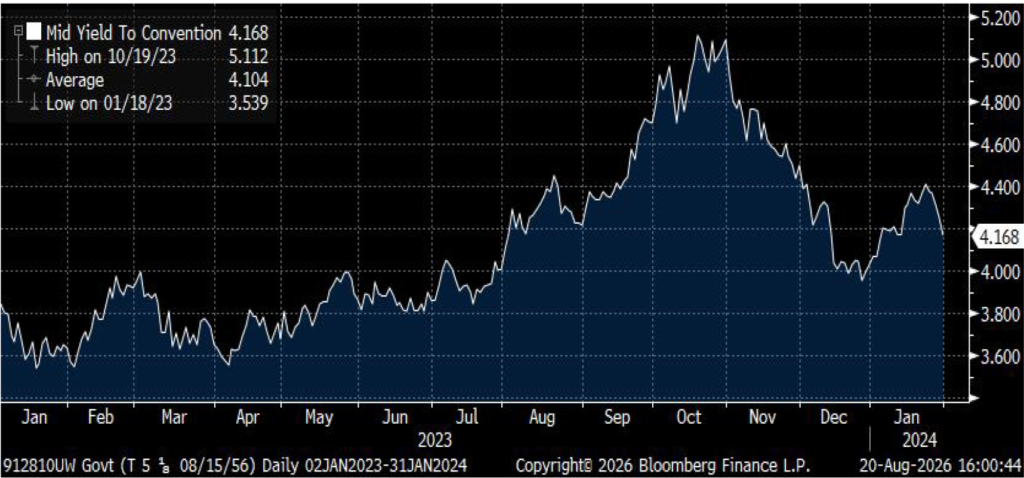
Bessent nevertheless has reason to believe that modest intervention in the long end of the Treasury market could turn the tide. In the fall of 2023, yields were surging as the Fed had hiked its policy rates to levels that no one had even imagined a few years before. At that time, both 10- and 30-year yields rose to around 5%. In August, Treasury began a series of coupon auction size increases across the entire yield curve in the face of rising borrowing needs. At that quarterly announcement, Treasury raised 10-year auction sizes by $3 billion per month, 20-year auction sizes by $1 billion per month, and 30-year auction sizes by $2 billion per month.
Then at the November refunding announcement, with the long end of the Treasury curve suffering, debt managers scaled back the pace of auction size increases by $1 billion per month (so 10s were bumped up by $2 billion per month, 20s were held steady, and 30s were boosted by $1 billion per month). There was no fanfare associated with this shift, but financial market participants certainly noticed. The move kicked off a sustained rally in the Treasury market (see Exhibit 1). I have often said that Treasury has never gotten more bang for its buck than the impact of that trivial ($9 billion) tweak to issuance plans.
Exhibit 1: Treasury Generic 30-Year Yield
Source: Bloomberg.
While the Treasury announcement in November 2023 was the catalyst for turning the bond market, the economic fundamentals shifted in a manner that reinforced the issuance tweak. Payroll growth slowed, core inflation cooled sharply in the second half of 2023, and the FOMC, which had entered the fall expecting to hike further, ended up calling it a day at a funds rate target of 5.125%. So, both conditions for a successful intervention held in that instance.
I cannot resist mentioning one irony of this buyback strategy. All through 2024, Bessent vociferously criticized Treasury Secretary Janet Yellen for manipulating the bond market with an issuance strategy that leaned heavily on T-bills to try to tamp down long-end yields, increasing the interest rate risk for the federal government in the process. I suspect those accusations will be hung around his neck by the press for months.
In retrospect, the subtle little tweak to the language in the recent August Treasury refunding announcement, changing “potential future increases” in coupon auction sizes in May to “potential future changes” highlights just how aggressive Bessent could be in managing issuance to tamp down long-term yields. The seemingly minor language adjustment opens the door to Treasury possibly cutting the size of bond auctions, even as overall financing needs continue to ascend. That would take Bessent’s activism to an entirely different level, but Bessent may want to leave that option out there as an implicit threat, perhaps making traders and investors think twice about selling bonds, much like a threat of currency intervention.
Yield curve implications
When Treasury debt managers first raised the idea of doing liquidity support buybacks, it seemed the concept was essentially to seek to capture the on-the-run/off-the-run spread by buying back higher yielding off-the-run issues and funding that exercise by issuing more on-the-run securities. Such a construct would have amounted to a tiny monetary benefit to Treasury (to make the math easy, a 5 bp arbitrage over $100 billion per year in buybacks would net the Treasury $5 billion, less than rounding error in the context of $2 trillion annual financing needs) while not meaningfully altering the duration of the debt mix.
However, Treasury strategy has evolved differently than I first imagined. Since buybacks started in the spring of 2024, it has held coupon auction sizes steady, making no changes to nominal coupon auction sizes. That is an extraordinarily long 2.5 years of stasis. It has filled the marginal borrowing requirement by raising more in the bill sector.
As a result, a larger buyback calendar will for now require more Treasury bill debt. This may or may not be an explicit part of the strategy, but the augmentation of long-end buybacks serves as a mini version of Operation Twist. To be sure, if we are talking about $14 billion, then the impact on the shape of the yield curve is likely to be minimal. Certainly, an extra $14 billion in bill supply over the course of a quarter is not going to be noticed.
Interplay with the Fed
The Treasury buyback strategy is entirely separate from Fed policy. However, may be changes afoot at the Fed, driven by Chair Warsh, that could have relevance for Treasury debt management.
When the Fed abruptly pivoted from balance sheet contraction last fall to balance sheet expansion, it had massive implications for Treasury financing. Every dollar that the Fed lends to Treasury is a dollar that does not need to be borrowed from the public. When the Fed was shrinking its Treasury balance sheet by allowing a portion of its maturing holdings to roll off, Treasury had to borrow more from the public to make up the difference. In fiscal years 2023 and 2024, the Fed rolled off a cumulative $1.3 trillion in securities, ballooning the amount that Treasury had to borrow from the public. This was the main impetus for the increases in coupon auction sizes in 2023.
In contrast, now the Fed is rolling over its MBS runoff into Treasury bills at a pace of $15 to $20 billion a month. It is also purchasing bills to expand the balance sheet, a program then-Chair Powell estimated would reach $250 billion to $300 billion. The Fed consequently is lending more to Treasury, reducing what it must borrow from the public. The pace of Fed activity so far this year suggests at least a $400 billion annual pace. As I have laid out in detail in each of the past several Quarter Refunding Preview pieces, this has been a gamechanger for Treasury, significantly pushing out the timetable for when coupon auction sizes might increase.
As with Treasury’s marginal debt issuance, all of the Fed’s purchases are taking place in the bill market. The Fed operations occur in the secondary market, so they do not immediately impact Treasury’s financing needs, but when the bills that the Fed bought mature, the Fed rolls them over in auctions, at which point, the Fed’s actions do impact Treasury’s funding picture. This has taken a massive burden off of the bill market, as a marginal buyer of around $400 billion per year has come on the scene, reducing what private players need to take down.
We know that Chair Warsh thinks that the Fed’s balance sheet is too large. It seems highly probable that he will hold off on pushing for major changes to the Fed’s balance sheet strategy until the task force comes back with recommendations, perhaps early next year. However, in the meantime, there is some suggestion that Warsh may be pushing to bend the curve on balance sheet expansion.
This is tricky because there is seasonality to the demand for cash and for bank reserves. As a result, the provision of liquidity and the trajectory of balance sheet expansion varies over the course of a year. If the Fed could simply maintain a steady pace, then its reserve management purchases would proceed at a constant clip, perhaps $20 billion to $25 billion a month. Instead, the Fed bought $40 billion a month for reserve management purposes for four months, from mid-December to mid-April (liquidity needs build up through the April 15 tax date), accounting for $160 billion in just four months. That left only $90 to $140 billion for the remaining 8 months of the year. Reserve management purchases slowed to $25 billion in late April/early May and to $10 billion in the next three monthly cycles, bringing the cumulative increase to $225 billion through eight months.
I figured that the Fed would likely go on buying a small amount, perhaps $10 billion per month until late in the year, when it would need to ratchet up the provision of liquidity again. Instead, the Fed announced earlier this month that it will do no reserve management purchases in late August through early September. This could be something that would have happened regardless of the change in leadership at the Fed, just a normal seasonal swing. Or it could be a sign that Warsh has prevailed upon the FOMC to bend the curve a bit on bank reserves, feeling in the dark for the point at which reserves start to become scarce. Under Powell, the Fed was focused on avoiding a repeat of the 2019 debacle, when the Fed overshot on QT, caused mayhem in the money markets, and was forced to inject billions in the repo market to reverse its mistake. Thus, the Fed may have stopped well short of the proper reserves equilibrium last year, when it responded quickly and forcefully to the first signs of tightening in money market liquidity. Warsh may be exhorting the FOMC to push a little and see whether the balance sheet could be smaller than the path previously envisioned without causing disruption.
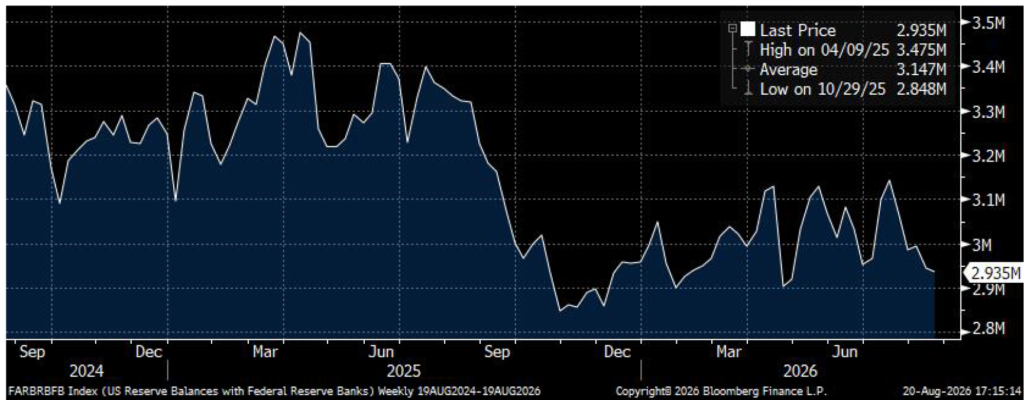
If this is what is transpiring, then the Fed may be able to afford to maintain a stingy rate of reserve management purchases for a while. Bank reserves have stayed noticeably higher than last fall’s nadir through all of 2026, and there have been absolutely no signs of stress in the money markets in recent months as the provision of new liquidity has dissipated (Exhibit 2).
Exhibit 2: Bank Reserves
Source: Bloomberg.
If we assume, based on volatility in money market rates last fall, that the proper level of reserves at that time was somewhere around $2.9 trillion, then the equilibrium level a year later, this fall, should be around 5% to 6% higher, tracking the nominal growth in the economy. That would put the “right” level for reserves well above $3 trillion, and yet the current level of $2.935 trillion is apparently more than enough to keep the money markets well supplied. This perspective would suggest that perhaps the Fed did overreact last fall and may have room to allow the balance sheet to grow more slowly than previously envisioned.
How is this related to the prior discussion of Treasury buybacks? If the Fed slows its reserve management purchases, then Treasury will have to cover more of its borrowing needs by borrowing from the public. And, as with the boost to buybacks, this is likely to be seen entirely in bill supply. This effect is also likely to be relatively small, at least at first, perhaps $5 billion to $10 billion a month less in reserve management purchases. But if a slower pace is sustained for a while, the difference will add up. And, if bigger changes are forthcoming next year, when the task force’s conclusions are taken up by the FOMC, the situation could shift much more meaningfully.
The bottom line is that Treasury debt managers are asking a lot from the buyers of Treasury bills, and the acceleration of buybacks as well as a possible moderation in Fed bill purchases could require private investors to take down more bills, and possibly at exactly the same time that the Fed is bending the curve down on the growth in its liquidity provision.