The Big Idea
Corporate profits and pricing power
This material is a Marketing Communication and does not constitute Independent Investment Research.
Corporate profits surged in 2021 and 2022, as businesses in the aggregate managed to expand their margins in the face of severe input cost increases. Profit margins have remained elevated relative to the pre-pandemic trend in recent years, a likely contributor to stubbornly high inflation. The PPI data on wholesale and retail margins suggest that firms may look to further boost their profitability this year, a result that would likely keep inflation well above the Fed’s 2% target.
Corporate profits
As part of the National Income and Product Accounts (NIPA), the Bureau of Economic Analysis (BEA) calculates corporate profits. Ultimately, the main source for these figures are data forwarded from the IRS compiled from corporate income tax returns. However, the tax data are only available with a lag, so the BEA has to extrapolate from the latest available tax figures to create quarterly estimates for the most recent periods. Those quarterly estimates are derived from Census Bureau figures collected from various industries as well as the tabulations from a sample of corporate earnings reports. Thus, the BEA’s corporate profits series should be broadly in line over time with the quarterly shareholder reports that financial markets focus on, but the two do not necessarily have to be entirely consistent.
Recent trends
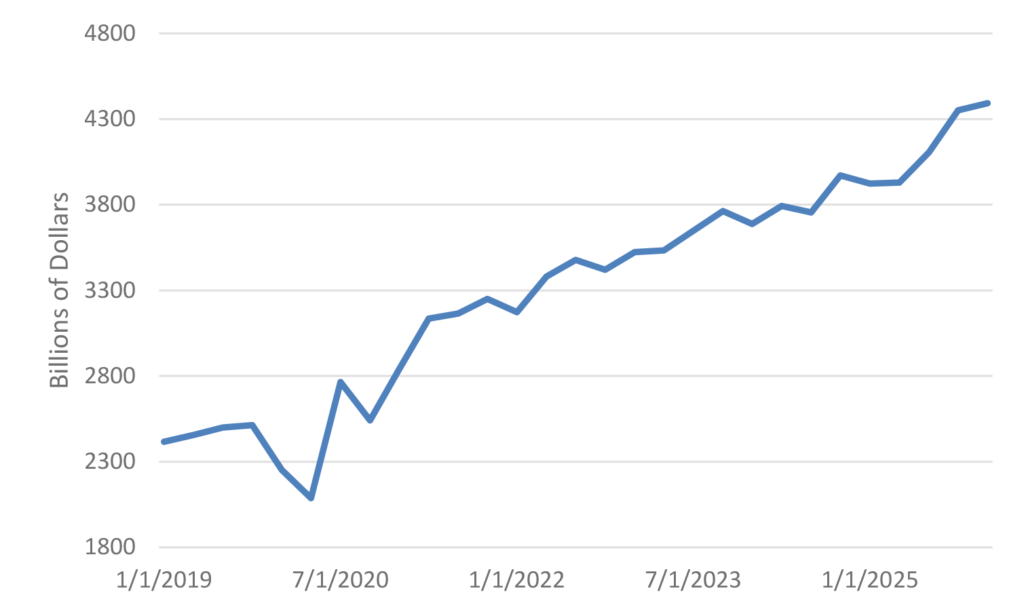
The BEA’s gauge of corporate profits has generally been robust since the economy reopened after the initial phase of Covid in 2021. In each year beginning in 2021, the annual pace of growth in corporate profits has exceeded the advance in nominal GDP. The two rose at close to the same pace in 2024, then profits took a hit in the first half of 2025, perhaps due in part to the imposition of steep tariffs. Since then, however, corporate profits have surged, posting quarterly increases of 4.5% in the third quarter last year and 6.0% in the fourth—these are not annualized figures—followed by a more modest 0.9% advance in the first quarter this year (Exhibit 1).
Exhibit 1: Corporate profits
Source: BEA.
Profit margin
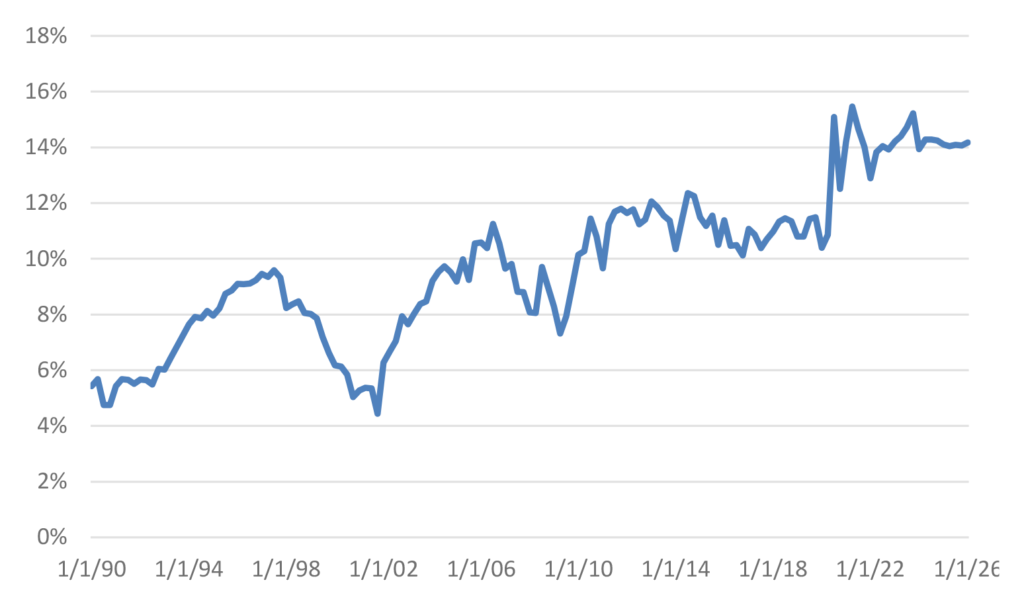
The BEA also publishes data on how real gross value added for nonfinancial domestic corporations is allocated between costs, taxes, and profits. This allows a look into profit margins, showing after-tax profits as a percentage of the price charged per unit of gross value added for this subset of businesses (Exhibit 2).
Exhibit 2: Nonfinancial domestic corporations profit margin
Source: BEA, Santander US Capital Markets.
Profit margins clearly widened after the pandemic, inching up from a 10% to 12% range to around 14%. When I last examined this data a couple of years ago, I predicted that “getting inflation back to 2% on a sustainable basis will require squeezing profit margins back down to something closer to the pre-pandemic trend.” As you can see, profit margins appear to have settled in at around 14%, substantially higher than the pre-pandemic norm. And, not surprisingly in light of this fact, inflation decelerated from its highs but has not yet come close to returning to the Fed’s 2% target.
Déjà vu?
The fact that businesses were able to markedly expand their profit margins in the wake of the pandemic, at a time when both labor and nonlabor costs were surging, was an extraordinary development. It signaled a significant shift in businesses’ pricing power that contributed to the disastrous surge in inflation during that period.
The corporate sector is facing a vaguely similar situation in 2026. Costs have exploded, reflecting a toxic mix of tariff hikes and, more recently, a severe energy price shock. In the aggregate, businesses, especially those facing consumers, chose to absorb at least some of the tariff-related costs last year, waiting for clarity on a final outcome before going to their customers and asking for higher prices.
Many analysts, including me, expected that there would be a wave of price hikes in early 2026, as companies sought to recover some portion of their higher costs. As a result, the timing of the energy price shock was especially inopportune, as it came at a moment when executives were already focused on passing through input cost increases. The risk is that this will accelerate and perhaps intensify the passthrough of higher energy prices as well.
It is a little early to gain a feel for how this drama will play out, but there is a risk that businesses will attempt to repeat the 2021-2022 playbook and widen their profit margins further, raising prices by enough to recover their costs and then some. It worked once, so firms may go back to the well.
The monthly data from the PPI on wholesale and retail services “prices,” which in reality attempt to measure margins in those industries, are worrisome. Consistent with the prevailing narrative from the business community, margins contracted last year in the wake of the imposition of tariffs. For wholesalers, the PPI margin gauge declined by 2.2% in April 2025 and was then little changed on balance from May through October, rebounding by less than 1%. Similarly, the retail PPI margin measure sagged by 2.5% on balance from June through November.
However, both gauges have rocketed higher over the past several months. The PPI wholesale trade index has jumped by more than 8% over the last six months (through April). Similarly, the retail PPI measure has increased in each of the past five months, a cumulative rise of 7.5%. As a result, relative to a year ago, the PPI data show that wholesale margins have risen by over 9% and retail margins by over 5½% vs. a year ago. To be fair, this is nothing like what happened in 2021, when the PPI wholesale and retail trade figures spiked by 12% and 17%, respectively. Nonetheless, it suggests that Fed officials need to be very concerned that businesses, emboldened by the experience of 2021-2022, intend to test the limits of their pricing power in the wake of another round of significant input cost inflation.
This material is intended only for institutional investors and does not carry all of the independence and disclosure standards of retail debt research reports. In the preparation of this material, the author may have consulted or otherwise discussed the matters referenced herein with one or more of SCM’s trading desks, any of which may have accumulated or otherwise taken a position, long or short, in any of the financial instruments discussed in or related to this material. Further, SCM may act as a market maker or principal dealer and may have proprietary interests that differ or conflict with the recipient hereof, in connection with any financial instrument discussed in or related to this material.
This message, including any attachments or links contained herein, is subject to important disclaimers, conditions, and disclosures regarding Electronic Communications, which you can find at https://portfolio-strategy.apsec.com/sancap-disclaimers-and-disclosures.
Important Disclaimers
Copyright © 2026 Santander US Capital Markets LLC and its affiliates (“SCM”). All rights reserved. SCM is a member of FINRA and SIPC. This material is intended for limited distribution to institutions only and is not publicly available. Any unauthorized use or disclosure is prohibited.
In making this material available, SCM (i) is not providing any advice to the recipient, including, without limitation, any advice as to investment, legal, accounting, tax and financial matters, (ii) is not acting as an advisor or fiduciary in respect of the recipient, (iii) is not making any predictions or projections and (iv) intends that any recipient to which SCM has provided this material is an “institutional investor” (as defined under applicable law and regulation, including FINRA Rule 4512 and that this material will not be disseminated, in whole or part, to any third party by the recipient.
The author of this material is an economist, desk strategist or trader. In the preparation of this material, the author may have consulted or otherwise discussed the matters referenced herein with one or more of SCM’s trading desks, any of which may have accumulated or otherwise taken a position, long or short, in any of the financial instruments discussed in or related to this material. Further, SCM or any of its affiliates may act as a market maker or principal dealer and may have proprietary interests that differ or conflict with the recipient hereof, in connection with any financial instrument discussed in or related to this material.
This material (i) has been prepared for information purposes only and does not constitute a solicitation or an offer to buy or sell any securities, related investments or other financial instruments, (ii) is neither research, a “research report” as commonly understood under the securities laws and regulations promulgated thereunder nor the product of a research department, (iii) or parts thereof may have been obtained from various sources, the reliability of which has not been verified and cannot be guaranteed by SCM, (iv) should not be reproduced or disclosed to any other person, without SCM’s prior consent and (v) is not intended for distribution in any jurisdiction in which its distribution would be prohibited.
In connection with this material, SCM (i) makes no representation or warranties as to the appropriateness or reliance for use in any transaction or as to the permissibility or legality of any financial instrument in any jurisdiction, (ii) believes the information in this material to be reliable, has not independently verified such information and makes no representation, express or implied, with regard to the accuracy or completeness of such information, (iii) accepts no responsibility or liability as to any reliance placed, or investment decision made, on the basis of such information by the recipient and (iv) does not undertake, and disclaims any duty to undertake, to update or to revise the information contained in this material.
Unless otherwise stated, the views, opinions, forecasts, valuations, or estimates contained in this material are those solely of the author, as of the date of publication of this material, and are subject to change without notice. The recipient of this material should make an independent evaluation of this information and make such other investigations as the recipient considers necessary (including obtaining independent financial advice), before transacting in any financial market or instrument discussed in or related to this material.
Important disclaimers for clients in the EU and UK
This publication has been prepared by Trading Desk Strategists within the Sales and Trading functions of Santander US Capital Markets LLC (“SanCap”), the US registered broker-dealer of Santander Corporate & Investment Banking. This communication is distributed in the EEA by Banco Santander S.A., a credit institution registered in Spain and authorised and regulated by the Bank of Spain and the CNMV. Any EEA recipient of this communication that would like to affect any transaction in any security or issuer discussed herein should do so with Banco Santander S.A. or any of its affiliates (together “Santander”). This communication has been distributed in the UK by Banco Santander, S.A.’s London branch, authorised by the Bank of Spain and subject to regulatory oversight on certain matters by the Financial Conduct Authority (FCA) and the Prudential Regulation Authority (PRA).
The publication is intended for exclusive use for Professional Clients and Eligible Counterparties as defined by MiFID II and is not intended for use by retail customers or for any persons or entities in any jurisdictions or country where such distribution or use would be contrary to local law or regulation.
This material is not a product of Santander´s Research Team and does not constitute independent investment research. This is a marketing communication and may contain ¨investment recommendations¨ as defined by the Market Abuse Regulation 596/2014 ("MAR"). This publication has not been prepared in accordance with legal requirements designed to promote the independence of research and is not subject to any prohibition on dealing ahead of the dissemination of investment research. The author, date and time of the production of this publication are as indicated herein.
This publication does not constitute investment advice and may not be relied upon to form an investment decision, nor should it be construed as any offer to sell or issue or invitation to purchase, acquire or subscribe for any instruments referred herein. The publication has been prepared in good faith and based on information Santander considers reliable as of the date of publication, but Santander does not guarantee or represent, express or implied, that such information is accurate or complete. All estimates, forecasts and opinions are current as at the date of this publication and are subject to change without notice. Unless otherwise indicated, Santander does not intend to update this publication. The views and commentary in this publication may not be objective or independent of the interests of the Trading and Sales functions of Santander, who may be active participants in the markets, investments or strategies referred to herein and/or may receive compensation from investment banking and non-investment banking services from entities mentioned herein. Santander may trade as principal, make a market or hold positions in instruments (or related derivatives) and/or hold financial interest in entities discussed herein. Santander may provide market commentary or trading strategies to other clients or engage in transactions which may differ from views expressed herein. Santander may have acted upon the contents of this publication prior to you having received it.
This publication is intended for the exclusive use of the recipient and must not be reproduced, redistributed or transmitted, in whole or in part, without Santander’s consent. The recipient agrees to keep confidential at all times information contained herein.