By the Numbers
New capital rules could lift insurer demand for mortgage loans
This material is a Marketing Communication and does not constitute Independent Investment Research.
Insurance company demand for residential whole loans, particularly non-QM loans, has been on the rise in recent years. Now, new updates to insurers’ capital framework for residential mortgages may spur even more demand, particularly from small and mid-sized life companies. Potentially more meaningfully, the changes could broadly increase life companies’ appetite to finance residential whole loans, providing a potentially robust alternative to securitization term financing for aggregators and a meaningful source of competition to securitization conduits.
Enter NAIC Item #2026-02-L
On April 30, the National Association of Insurance Commissioners Life RBC Working Group adopted Item #2026-02-L, which could create both additional capacity for smaller life companies to begin adding whole loans and broad-based increased demand to finance the asset class. Before adopting this item, which goes into effect at the end of this year, indirect investments in residential mortgage loans through an unaffiliated joint venture (JV), partnership or limited liability company (LLC) required 1.75% capital instead of the 0.68% capital for direct investments in residential mortgage loans. The revised framework would look to align Risk Based Capital (RBC) requirements with direct investments in loans at 0.68%. The nuanced point here is that it would allow smaller insurers to report whole both whole loan investments or financings that employ an unaffiliated trust as a single investment rather than having to schedule out individual loans as they would under a Schedule B direct investment or loan-on-loan financing.
The recent changes look to be part of a broader NAIC initiative to normalize RBC across residential whole loan exposures. In 2024, the NAIC adjusted the RBC framework for residential whole loans, aligning capital on both loans held in an affiliated JV and collateralized lending against performing residential whole loans with direct investments (Exhibit 1). Prior to the 2024 changes, RBC on loans held in an affiliated JV or LLC carried a 1.75% RBC factor, while ‘loan-on-loan’s structures saw their RBC factors reduced by 90%, from 6.8% to 68 bp.
Exhibit 1: The NAIC residential whole loan capital framework at a glance

Source: Santander US Capital Markets, NAIC, Mayer Brown
Note: Capital ratios are exclusive to first lien residential mortgage loans that are less than 90 days past due.
Annuity sales drive heightened asset demand from life insurers
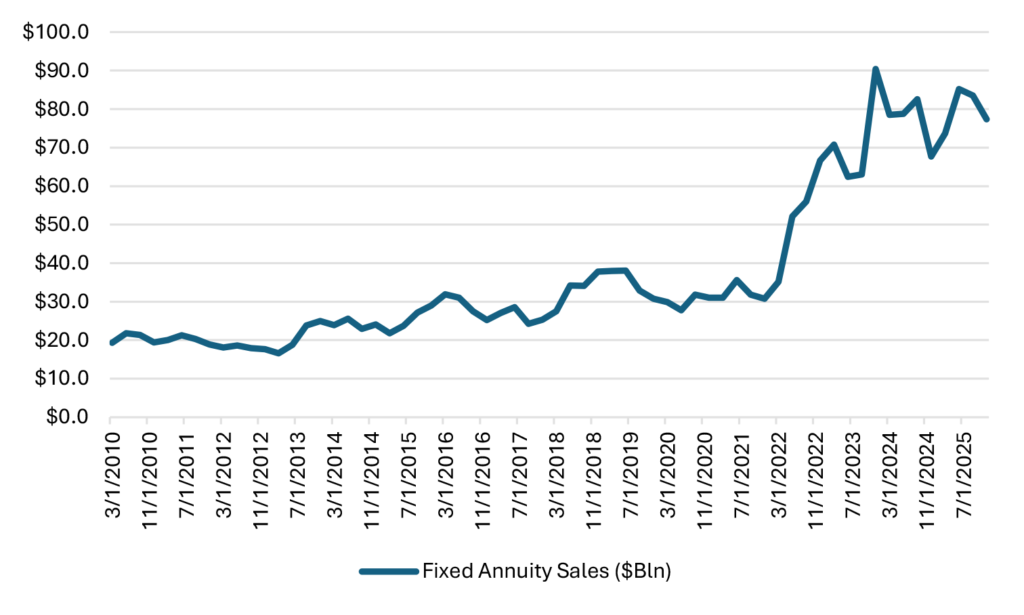
Heightened demand from life insurers for residential loans has been driven by growth on the liability side of the balance sheet, as sales of fixed annuities have risen dramatically in recent years. For the better part of the past 15 years, quarterly sales of fixed annuity sales ranged from $20 to $30 billion. Over the past three years, sales of fixed annuities have more than doubled, peaking at $90 billion in the fourth quarter of 2023 (Exhibit 2).
Exhibit 2: Heightened annuity sales spur asset demand from life insurers
Source: Santander US Capital Markets, Bloomberg LP
Marked growth in annuity sales has been fueled by two factors. First, private equity companies have established captive life insurance companies as vehicles for generating sticky, stable funding through the combination of annuity sales and access to the Federal Home Loan Bank funding complex. This, in turn, allows them to fund illiquid or more complex assets more efficiently than they could through traditional warehouse financing agreements. Additionally, the Fed’s aggressive hiking cycle pushed benchmark rates up rapidly through 2022, and those elevated rates fueled heightened demand from retail investors for fixed annuities.
Life company demand competes with securitization conduits
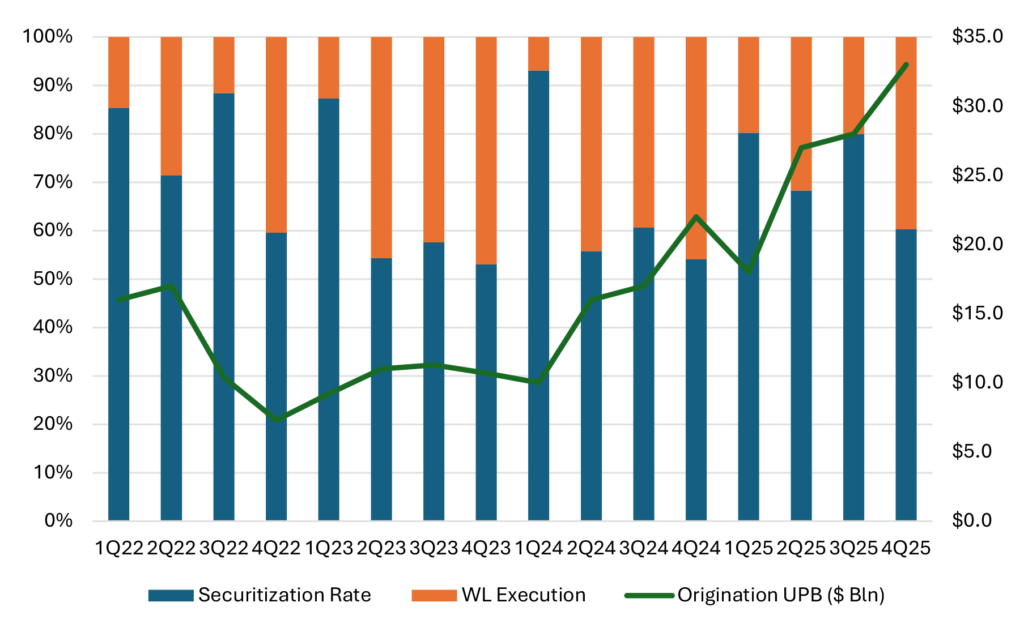
The early stages of the non-QM market were marked by an ‘originate-to-securitize’ model as balance sheet demand for these loans from both depositories and insurance companies was negligible at best. And while depository balance sheet demand for these loans remains moribund, life insurance company balance sheet demand for the product has grown exponentially, vacuuming up nearly half of all originations in some recent quarters (Exhibit 3). While disproportionate insurance demand could initially be explained away by the funding advantage life companies maintained over securitization conduits when the yield curve was inverted, allowing them to price longer-dated annuities at lower yields than a securitization cost of funds, the normalization of the yield curve to some degree has done little to stymie insurance company demand for loans.
Exhibit 3: Insurance balance sheets compete with securitization conduits for non-QM loans
Source: Santander US Capital Markets, Inside Mortgage Finance
Likely implications
The updated capital framework may make it easier for smaller and mid-size insurance companies to invest in whole loans, but the more meaningful impact may be in companies’ ability to finance these assets. Typically, for insurance companies to achieve the RBC ‘floor’ of 68 bp for residential mortgage loans, they are reported under Schedule B on a loan-by-loan basis. Investments in unaffiliated JVs or LLCs would allow an insurance company to record these investments on Schedule BA as a single line item that would garner the same capital treatment, assuming all the loans are performing. Similarly, it would allow insurance companies to classify ‘loan-on-loan’ structures in a similar fashion, potentially providing both greater liquidity to the asset class and competition for securitization conduits if more insurance companies are willing to finance whole loans and classify that lending arrangement under a single line item under Schedule BA.
Ultimately, the applicability of this change will be limited to some degree based on a handful of factors. And those factors may ultimately skew the value proposition towards lending against these assets rather than owning them outright. First, while the regulators may look through these LLCs to the underlying assets, the Federal Home Loan Banks would not, thereby making these trusts ineligible investments for Federal Home Loan Bank financing. Secondly, investments classified under Schedule BA are subject to mark-to-market accounting treatment. As a result, insurance companies are more likely to add exposure through floating-rate, term loan financing structures rather than direct investments.
Another potential headwind to growth in loan investments is the fact that there is already a well-worn path for insurance companies to invest in loans through asset managers via Separately Managed Accounts (SMAs) which are generally accounted for as individual line-item direct investments under Schedule B. And away from mark-to-market considerations, insurance companies cannot classify a significant amount of their investments under schedule BA. Ultimately, these changes to the capital framework should translate to increased exposure to the asset class and greater competition for securitization conduits, but it appears more likely that competition will come in the form of term financing rather than an outright bid for the assets.
This material is intended only for institutional investors and does not carry all of the independence and disclosure standards of retail debt research reports. In the preparation of this material, the author may have consulted or otherwise discussed the matters referenced herein with one or more of SCM’s trading desks, any of which may have accumulated or otherwise taken a position, long or short, in any of the financial instruments discussed in or related to this material. Further, SCM may act as a market maker or principal dealer and may have proprietary interests that differ or conflict with the recipient hereof, in connection with any financial instrument discussed in or related to this material.
This message, including any attachments or links contained herein, is subject to important disclaimers, conditions, and disclosures regarding Electronic Communications, which you can find at https://portfolio-strategy.apsec.com/sancap-disclaimers-and-disclosures.
Important Disclaimers
Copyright © 2026 Santander US Capital Markets LLC and its affiliates (“SCM”). All rights reserved. SCM is a member of FINRA and SIPC. This material is intended for limited distribution to institutions only and is not publicly available. Any unauthorized use or disclosure is prohibited.
In making this material available, SCM (i) is not providing any advice to the recipient, including, without limitation, any advice as to investment, legal, accounting, tax and financial matters, (ii) is not acting as an advisor or fiduciary in respect of the recipient, (iii) is not making any predictions or projections and (iv) intends that any recipient to which SCM has provided this material is an “institutional investor” (as defined under applicable law and regulation, including FINRA Rule 4512 and that this material will not be disseminated, in whole or part, to any third party by the recipient.
The author of this material is an economist, desk strategist or trader. In the preparation of this material, the author may have consulted or otherwise discussed the matters referenced herein with one or more of SCM’s trading desks, any of which may have accumulated or otherwise taken a position, long or short, in any of the financial instruments discussed in or related to this material. Further, SCM or any of its affiliates may act as a market maker or principal dealer and may have proprietary interests that differ or conflict with the recipient hereof, in connection with any financial instrument discussed in or related to this material.
This material (i) has been prepared for information purposes only and does not constitute a solicitation or an offer to buy or sell any securities, related investments or other financial instruments, (ii) is neither research, a “research report” as commonly understood under the securities laws and regulations promulgated thereunder nor the product of a research department, (iii) or parts thereof may have been obtained from various sources, the reliability of which has not been verified and cannot be guaranteed by SCM, (iv) should not be reproduced or disclosed to any other person, without SCM’s prior consent and (v) is not intended for distribution in any jurisdiction in which its distribution would be prohibited.
In connection with this material, SCM (i) makes no representation or warranties as to the appropriateness or reliance for use in any transaction or as to the permissibility or legality of any financial instrument in any jurisdiction, (ii) believes the information in this material to be reliable, has not independently verified such information and makes no representation, express or implied, with regard to the accuracy or completeness of such information, (iii) accepts no responsibility or liability as to any reliance placed, or investment decision made, on the basis of such information by the recipient and (iv) does not undertake, and disclaims any duty to undertake, to update or to revise the information contained in this material.
Unless otherwise stated, the views, opinions, forecasts, valuations, or estimates contained in this material are those solely of the author, as of the date of publication of this material, and are subject to change without notice. The recipient of this material should make an independent evaluation of this information and make such other investigations as the recipient considers necessary (including obtaining independent financial advice), before transacting in any financial market or instrument discussed in or related to this material.
Important disclaimers for clients in the EU and UK
This publication has been prepared by Trading Desk Strategists within the Sales and Trading functions of Santander US Capital Markets LLC (“SanCap”), the US registered broker-dealer of Santander Corporate & Investment Banking. This communication is distributed in the EEA by Banco Santander S.A., a credit institution registered in Spain and authorised and regulated by the Bank of Spain and the CNMV. Any EEA recipient of this communication that would like to affect any transaction in any security or issuer discussed herein should do so with Banco Santander S.A. or any of its affiliates (together “Santander”). This communication has been distributed in the UK by Banco Santander, S.A.’s London branch, authorised by the Bank of Spain and subject to regulatory oversight on certain matters by the Financial Conduct Authority (FCA) and the Prudential Regulation Authority (PRA).
The publication is intended for exclusive use for Professional Clients and Eligible Counterparties as defined by MiFID II and is not intended for use by retail customers or for any persons or entities in any jurisdictions or country where such distribution or use would be contrary to local law or regulation.
This material is not a product of Santander´s Research Team and does not constitute independent investment research. This is a marketing communication and may contain ¨investment recommendations¨ as defined by the Market Abuse Regulation 596/2014 ("MAR"). This publication has not been prepared in accordance with legal requirements designed to promote the independence of research and is not subject to any prohibition on dealing ahead of the dissemination of investment research. The author, date and time of the production of this publication are as indicated herein.
This publication does not constitute investment advice and may not be relied upon to form an investment decision, nor should it be construed as any offer to sell or issue or invitation to purchase, acquire or subscribe for any instruments referred herein. The publication has been prepared in good faith and based on information Santander considers reliable as of the date of publication, but Santander does not guarantee or represent, express or implied, that such information is accurate or complete. All estimates, forecasts and opinions are current as at the date of this publication and are subject to change without notice. Unless otherwise indicated, Santander does not intend to update this publication. The views and commentary in this publication may not be objective or independent of the interests of the Trading and Sales functions of Santander, who may be active participants in the markets, investments or strategies referred to herein and/or may receive compensation from investment banking and non-investment banking services from entities mentioned herein. Santander may trade as principal, make a market or hold positions in instruments (or related derivatives) and/or hold financial interest in entities discussed herein. Santander may provide market commentary or trading strategies to other clients or engage in transactions which may differ from views expressed herein. Santander may have acted upon the contents of this publication prior to you having received it.
This publication is intended for the exclusive use of the recipient and must not be reproduced, redistributed or transmitted, in whole or in part, without Santander’s consent. The recipient agrees to keep confidential at all times information contained herein.