By the Numbers
Value in non-QM prepay penalties as home price appreciation slows
This material is a Marketing Communication and does not constitute Independent Investment Research.
Investors in non-QM trusts backed by investor loans have exposure to collateral that, for the most part, carries prepayment penalties. But current market pricing suggests bond investors ascribe little to no value to these penalties, perhaps because strong home price appreciation in recent years has reduced the penalties’ effect. With home price appreciation likely slowing, the value of non-QM penalties should rise.
Prepayment penalties at a glance
Non-QM securitizations are somewhat unique in the broader MBS securitization ecosystem in that they are one of the very few exposures where loans on single-family homes can carry prepayment penalties. Prepayment penalties were commonplace in pre-crisis private MBS transactions. But subsequent Dodd-Frank legislation precluded mortgage originators from attaching those penalties to consumer loans going forward. Investor loans on single-family residences are somewhat unique in that they fall outside the scope of the Dodd Frank legislation and the Qualified Mortgage rules as they are considered business purpose loans and can carry prepayment penalties, like multifamily and other commercial real estate loans. Prepayment penalties on non-QM investor loans are also structurally similar to those found in commercial real estate in that they come in different tenors and the cost of the penalty may remain fixed or decline over that tenor.
Valuing prepayment protection
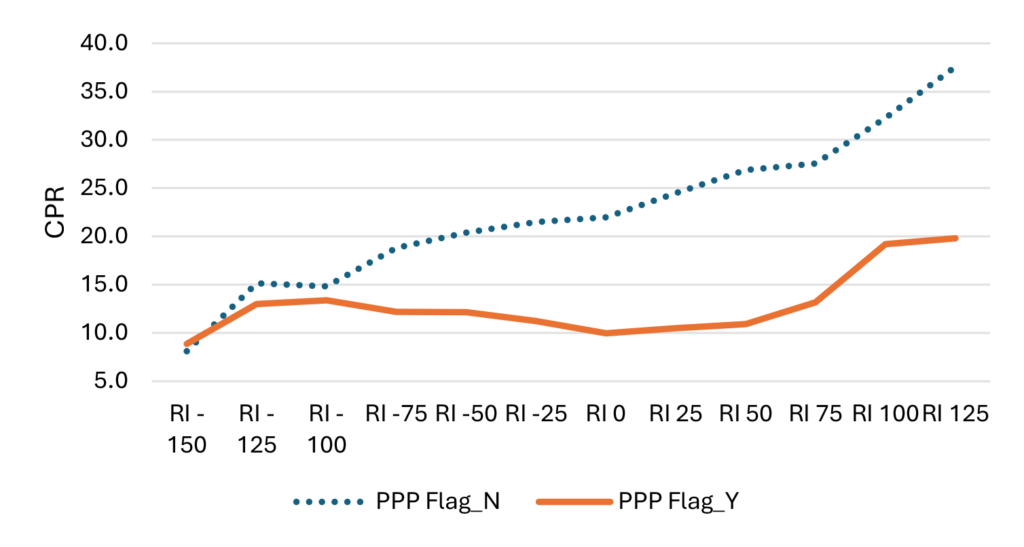
The most simplistic way to value prepayment penalties is to compare prepayment rates on loans that carry prepayment penalties relative to those without penalties given the same amount refinancing incentive. Given differences in risk-based pricing on non-QM whole loans, refinancing incentive is valued net of those difference or ‘SATO-adjusted.’ With the caveat that this analysis does not control for other loan attributes like loan size and age that will have some impact on prepayment speeds, non-QM loans with prepayment penalties pay substantially slower both at- and in-the-money than those without. At-the-money speeds on loans with penalties are roughly 15 CPR slower than no penalty loans. And that differential remains roughly consistent as refinancing incentive increases (Exhibit 1).
Exhibit 1: Non-QM loans with penalties pay 15 CPR slower at-the-money
Source: Santander US Capital Markets, CoreLogic Loan Performance
Another key factor that the above analysis does not account for is the loans’ mark-to-market LTVs. And one plausible reason as to why the market has not historically ascribed substantial value to prepayment penalties is that investor loans that carry both prepayment penalties and significant amounts of mark-to-market equity prepay very fast. The explanation for this is a fairly simple one in that investors will gladly pay a 5-point or, in some instances, smaller penalty to unlock 20 or more points of equity, which the investor can then invest in an additional property and re-lever the existing one.
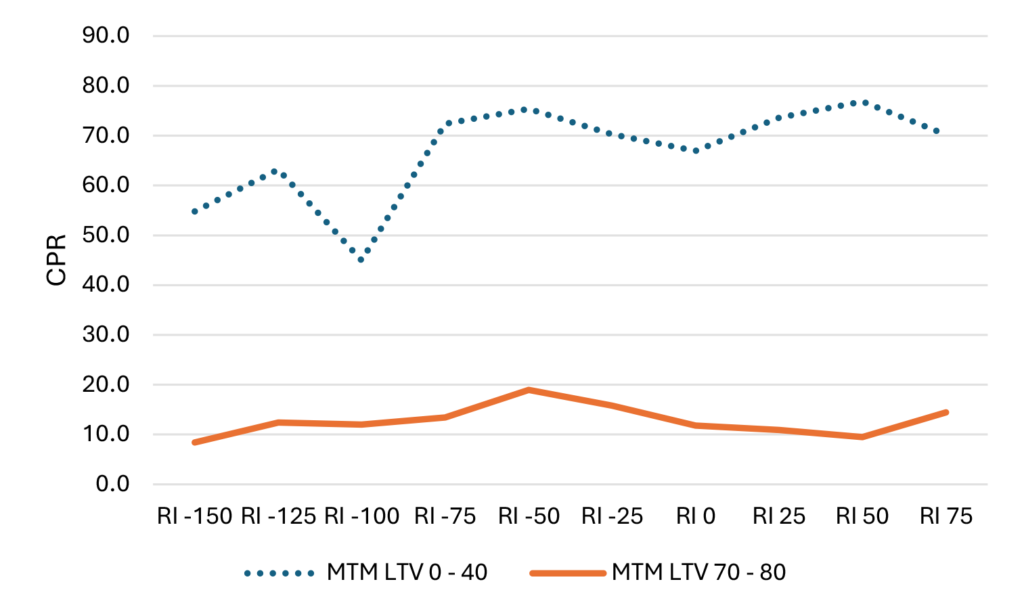
By creating a cohort of loans with prepayment penalties and original LTVs between 70 and 80 and then generating prepayment S-curves based on mark-to-market LTV illustrates the prepayment incentive that trapped equity creates on these loans. Prepayment penalty loans that carry 30 or more points of mark-to-market equity prepay at upwards of 65 CPR with no rate incentive. And both in and out-of-the-money speeds are fairly consistent with at-the-money ones. Conversely, loans with current LTVs that are in-line with their original ones prepay slower than 12 CPR at-the-money and just 15 CPR with 75 bp of refinancing incentive (Exhibit 2).
Exhibit 2: Trapped equity offsets the value of prepayment penalties
Source: Santander US Capital Markets, CoreLogic Loan Performance
The pronounced difference in speeds on loans that have experienced substantial home price appreciation versus those that have not suggests that the value of prepayment penalties should increase as home price appreciation slows and become far less valuable as it increases. With CoreLogic forecasting a 3.6% increase in home prices nationally this year, the amount of equity investors build this year could fall short of the value of a prepayment penalty, suppressing prepayments on these investor loans.
Penalty term matters too
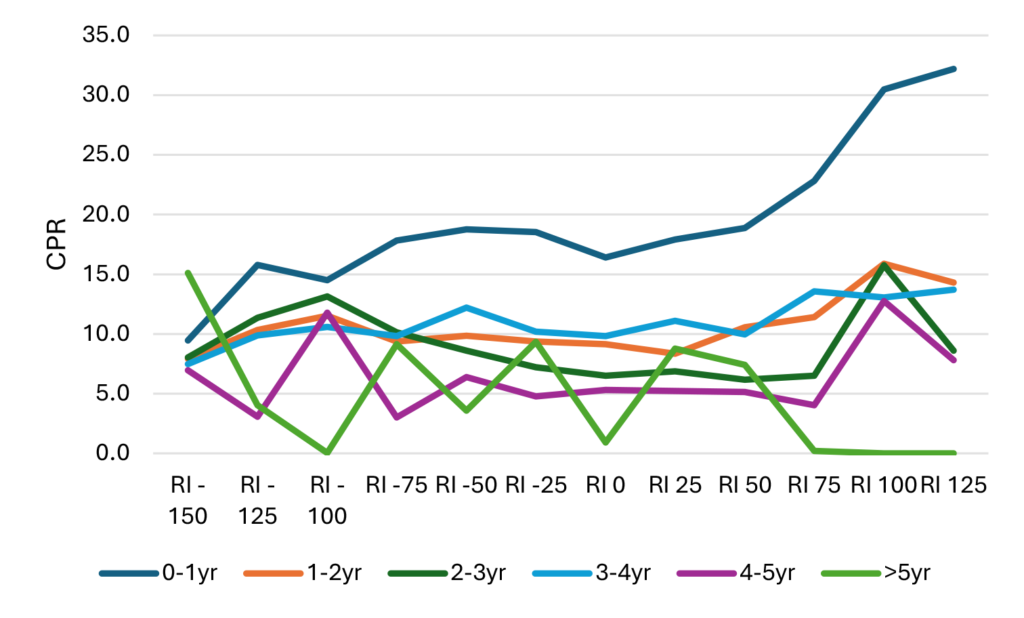
While borrower equity looks to have the most meaningful impact, certain other factors influence how effective penalties are in suppressing prepayment rates. The term of the prepayment penalty looks to carry substantial weight. Prepayment penalties on non-QM investor loans tend to be structured with either 3- or 5-year terms and either carry a fixed penalty or declining point structure, meaning the penalty the borrower must pay to prepay the loans declines by one point every year the loan seasons. Loans with 5-year prepayment penalties prepay near zero at-the-money with peak speeds of roughly 9 CPR observed when the borrower has 25 bp of refinancing incentive. Conversely, loans where the remaining penalty term is a year or less prepay at 16 CPR at-the-money with speeds increasing to 32 CPR when borrowers have more than 100 bp of incentive to prepay (Exhibit 3).
Exhibit 3: Prepay penalty term matters
Source: Santander US Capital Markets, CoreLogic Loan Performance
One challenge investors may be faced with when trying to value prepayment penalties is empirical models may not be providing sufficient value to them. Running the ‘AAA’ classes of EFMT 2025-INV5, a deal fully collateralized by investor loans where the majority carry prepayment penalties, and EFMT 2025-NQM5 transactions through Yield Book’s OAS model shows very little difference in long-term speed or option cost even when running both bonds to maturity (Exhibit 4). If the dispersion in empirical speeds between loans with penalties relative to those without continues to hold or widens further, it seems plausible that model updates will better capture this, lowering option cost and increasing OAS on bonds backed by these loans.
Exhibit 4: Models may not be capturing convexity from penalty loans

Source: Santander US Capital Markets, Yield Book
This material is intended only for institutional investors and does not carry all of the independence and disclosure standards of retail debt research reports. In the preparation of this material, the author may have consulted or otherwise discussed the matters referenced herein with one or more of SCM’s trading desks, any of which may have accumulated or otherwise taken a position, long or short, in any of the financial instruments discussed in or related to this material. Further, SCM may act as a market maker or principal dealer and may have proprietary interests that differ or conflict with the recipient hereof, in connection with any financial instrument discussed in or related to this material.
This message, including any attachments or links contained herein, is subject to important disclaimers, conditions, and disclosures regarding Electronic Communications, which you can find at https://portfolio-strategy.apsec.com/sancap-disclaimers-and-disclosures.
Important Disclaimers
Copyright © 2026 Santander US Capital Markets LLC and its affiliates (“SCM”). All rights reserved. SCM is a member of FINRA and SIPC. This material is intended for limited distribution to institutions only and is not publicly available. Any unauthorized use or disclosure is prohibited.
In making this material available, SCM (i) is not providing any advice to the recipient, including, without limitation, any advice as to investment, legal, accounting, tax and financial matters, (ii) is not acting as an advisor or fiduciary in respect of the recipient, (iii) is not making any predictions or projections and (iv) intends that any recipient to which SCM has provided this material is an “institutional investor” (as defined under applicable law and regulation, including FINRA Rule 4512 and that this material will not be disseminated, in whole or part, to any third party by the recipient.
The author of this material is an economist, desk strategist or trader. In the preparation of this material, the author may have consulted or otherwise discussed the matters referenced herein with one or more of SCM’s trading desks, any of which may have accumulated or otherwise taken a position, long or short, in any of the financial instruments discussed in or related to this material. Further, SCM or any of its affiliates may act as a market maker or principal dealer and may have proprietary interests that differ or conflict with the recipient hereof, in connection with any financial instrument discussed in or related to this material.
This material (i) has been prepared for information purposes only and does not constitute a solicitation or an offer to buy or sell any securities, related investments or other financial instruments, (ii) is neither research, a “research report” as commonly understood under the securities laws and regulations promulgated thereunder nor the product of a research department, (iii) or parts thereof may have been obtained from various sources, the reliability of which has not been verified and cannot be guaranteed by SCM, (iv) should not be reproduced or disclosed to any other person, without SCM’s prior consent and (v) is not intended for distribution in any jurisdiction in which its distribution would be prohibited.
In connection with this material, SCM (i) makes no representation or warranties as to the appropriateness or reliance for use in any transaction or as to the permissibility or legality of any financial instrument in any jurisdiction, (ii) believes the information in this material to be reliable, has not independently verified such information and makes no representation, express or implied, with regard to the accuracy or completeness of such information, (iii) accepts no responsibility or liability as to any reliance placed, or investment decision made, on the basis of such information by the recipient and (iv) does not undertake, and disclaims any duty to undertake, to update or to revise the information contained in this material.
Unless otherwise stated, the views, opinions, forecasts, valuations, or estimates contained in this material are those solely of the author, as of the date of publication of this material, and are subject to change without notice. The recipient of this material should make an independent evaluation of this information and make such other investigations as the recipient considers necessary (including obtaining independent financial advice), before transacting in any financial market or instrument discussed in or related to this material.
Important disclaimers for clients in the EU and UK
This publication has been prepared by Trading Desk Strategists within the Sales and Trading functions of Santander US Capital Markets LLC (“SanCap”), the US registered broker-dealer of Santander Corporate & Investment Banking. This communication is distributed in the EEA by Banco Santander S.A., a credit institution registered in Spain and authorised and regulated by the Bank of Spain and the CNMV. Any EEA recipient of this communication that would like to affect any transaction in any security or issuer discussed herein should do so with Banco Santander S.A. or any of its affiliates (together “Santander”). This communication has been distributed in the UK by Banco Santander, S.A.’s London branch, authorised by the Bank of Spain and subject to regulatory oversight on certain matters by the Financial Conduct Authority (FCA) and the Prudential Regulation Authority (PRA).
The publication is intended for exclusive use for Professional Clients and Eligible Counterparties as defined by MiFID II and is not intended for use by retail customers or for any persons or entities in any jurisdictions or country where such distribution or use would be contrary to local law or regulation.
This material is not a product of Santander´s Research Team and does not constitute independent investment research. This is a marketing communication and may contain ¨investment recommendations¨ as defined by the Market Abuse Regulation 596/2014 ("MAR"). This publication has not been prepared in accordance with legal requirements designed to promote the independence of research and is not subject to any prohibition on dealing ahead of the dissemination of investment research. The author, date and time of the production of this publication are as indicated herein.
This publication does not constitute investment advice and may not be relied upon to form an investment decision, nor should it be construed as any offer to sell or issue or invitation to purchase, acquire or subscribe for any instruments referred herein. The publication has been prepared in good faith and based on information Santander considers reliable as of the date of publication, but Santander does not guarantee or represent, express or implied, that such information is accurate or complete. All estimates, forecasts and opinions are current as at the date of this publication and are subject to change without notice. Unless otherwise indicated, Santander does not intend to update this publication. The views and commentary in this publication may not be objective or independent of the interests of the Trading and Sales functions of Santander, who may be active participants in the markets, investments or strategies referred to herein and/or may receive compensation from investment banking and non-investment banking services from entities mentioned herein. Santander may trade as principal, make a market or hold positions in instruments (or related derivatives) and/or hold financial interest in entities discussed herein. Santander may provide market commentary or trading strategies to other clients or engage in transactions which may differ from views expressed herein. Santander may have acted upon the contents of this publication prior to you having received it.
This publication is intended for the exclusive use of the recipient and must not be reproduced, redistributed or transmitted, in whole or in part, without Santander’s consent. The recipient agrees to keep confidential at all times information contained herein.