

The Long and Short
Another surplus note in the market
Dan Bruzzo, CFA | July 18, 2025
This material is a Marketing Communication and does not constitute Independent Investment Research.
Life insurance company Symetra (SYA: A3/BBB+) issued a new surplus note in the investment grade corporate bond market within the last week. This was the second deal of its kind this year, with Northwestern Mutual Life Insurance (NWMLIC: Aa3/AA-/AA) bringing a similar offering at the end of May. These two deals were the first surplus notes issued since late 2024. The structure offers an attractive means for investors to target higher rated insurance companies while potentially adding spread over comparable or lower-rated notes issued at the senior unsecured level. Surplus notes have traditionally traded at an aggregate spread to their senior, publicly issued counterparts. While that spread has compressed over the years with increased risk appetite and price discovery in this niche segment, these structures still allow conservative investors to gain exposure to higher-rated credits in the long-end of the curve, without conceding much spread.
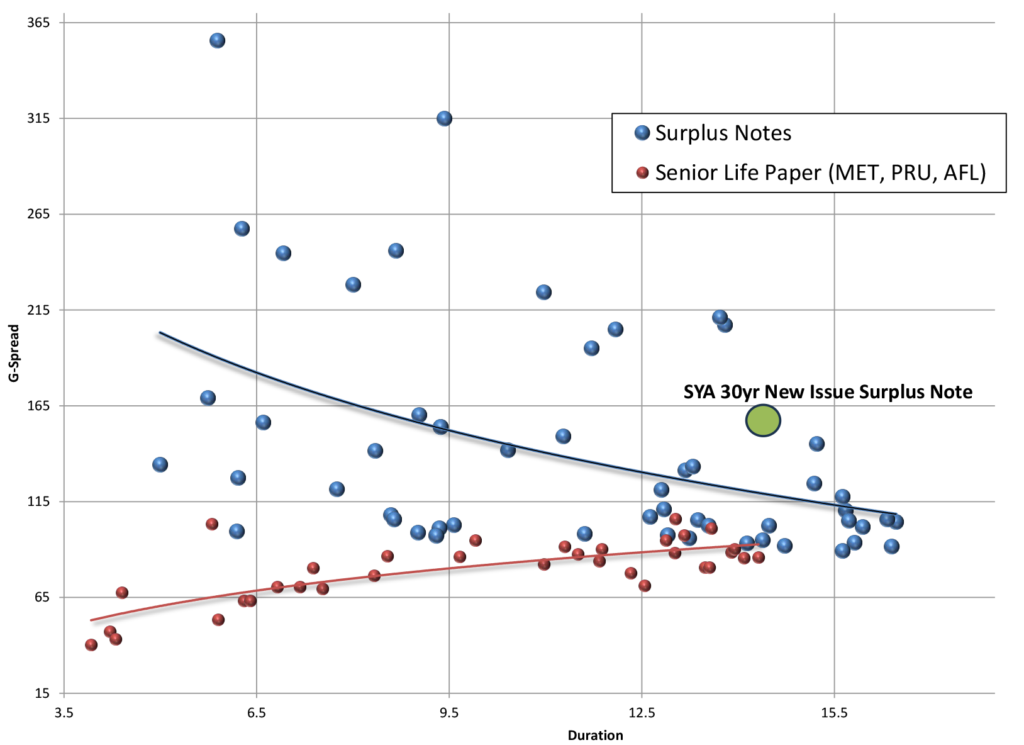
SYA priced $500 million of subordinated operating company surplus notes at a spread of 157 bp over the 30-year, after initial price talk of 187.5 bp. These subordinated bonds were rated ‘A3/BBB+’, as the insurance financial strength ratings at the operating company are currently ‘A1/A’. At this price, the notes provide an attractive discount to similarly rated senior unsecured life insurance company notes outstanding (Exhibit 1). Roughly two months ago, NWMLIC priced $1 billion of similarly structured paper at spread of 108 bp over the 30-year, after initial price talk in the 135 bp area. Those bonds are currently indicated at a level closer to 102 bp, given their significantly higher ‘AA’ ratings. Issuance has been relatively dormant over the past couple of years, but these two deals demonstrate the opportunity for the primary market to pick up again, and new surplus issuers often come in waves.
SYA has been owned by Sumitomo Life Insurance Company (SUMILF: A3/A-) for almost 10 years. The parent company has demonstrated strong implicit support in past years by offering term loans to the US subsidiary for funding purposes. SYA only began issuing in the US dollar public debt markets in 2024 with its inaugural senior unsecured debt launch of an 8-year note, which is non-index eligible with just $250 million outstanding. It is the only other public debt maturity currently outstanding besides the new surplus notes. Meanwhile, the company has a $300 million revolving credit facility available to it through 2028.
The company is primarily focused on bank-placed retirement planning, offering mostly fixed and fixed-indexed annuity products as well as some universal life and group health products. Although this represents a bit of product concentration, SYA largely sticks to its areas of expertise limiting the complexity of its operating risk. The issuer is both well capitalized and maintains moderate leverage relative to its current ratings category, both independently and when considering the implicit support and strategic importance to the ultimate parent company.
Exhibit 1: Insurance surplus notes credit curve and senior unsecured life paper
Source: Santander US Capital Markets LLC, Bloomberg/TRACE g-spread indications
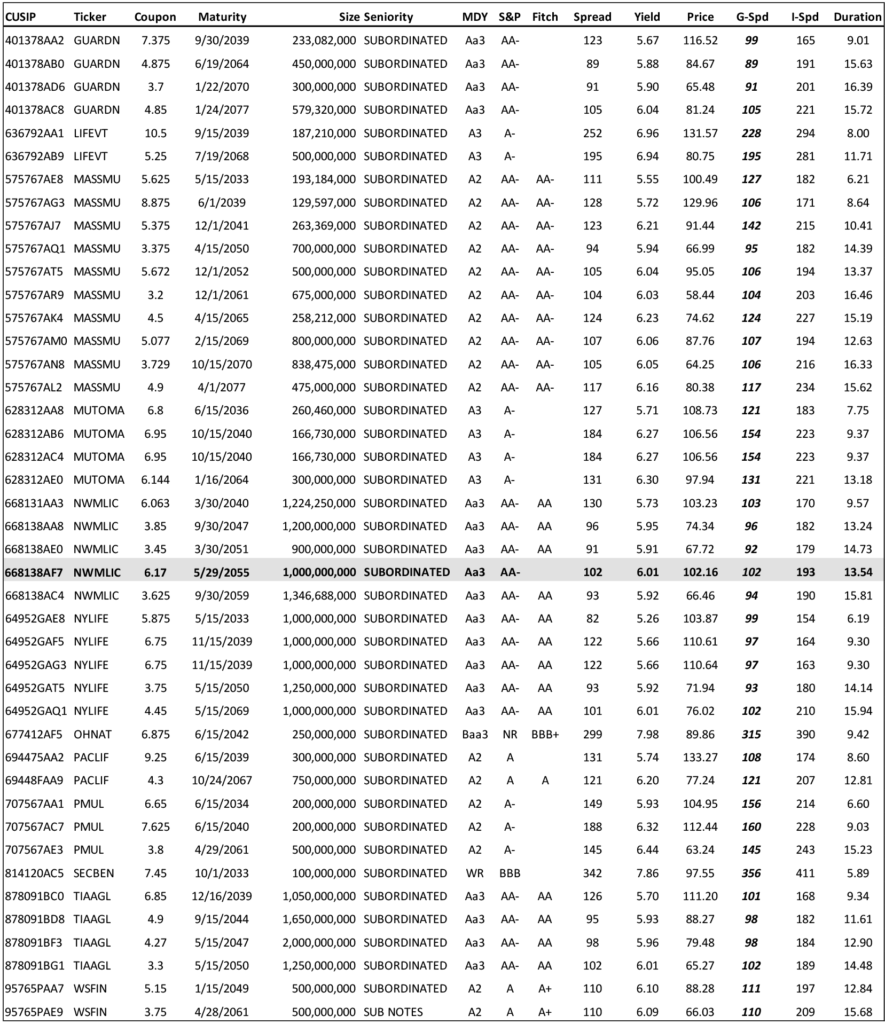
There are now a total of 65 bonds with $300 million or more of par value and 3-year maturity or longer classified as investment grade insurance surplus notes currently outstanding, making it still a relatively niche segment of the broader insurance sector. With few exceptions, these bonds are typically issued through 144a private placement, therefore they are mostly outside of the investment grade index. Secondary market liquidity in surplus notes has recently been ebbing and flowing, mostly in conjunction with 30-year US Treasury rates. When 30-year Treasuries get close to 5%, as has been the case lately, it seems to draw long-end buyers into the market looking for very high-quality paper that can potentially yield over 6%.
From 2017 through 2021 there were waves of issuance that saw as many five to six borrowers in a given year access this unique corner of the corporate bond market. Again, given the attractiveness to total yield buyers, index eligibility is by no means mandatory. That could potentially broaden the field of borrowers to those wishing to issue in sizes below $300 million as primary liquidity picks back up again.
Exhibit 2. Universe of life insurance surplus notes
Note: Issues with a 3-year or longer maturity.
Source: Santander US Capital Markets LLC, Bloomberg/TRACE pricing indications
Background on surplus notes
Public and mutual insurance companies utilize surplus notes offerings to diversify capital and attract different types of investors within the public debt markets. Despite their subordinated classifications within the capital structure, in many cases surplus notes are among the only outstanding debt issues for mutual companies. Therefore, they are often only subordinated to the insurance company’s policyholders from a priority of payment standpoint. Interestingly for the public insurance companies, since the debt is issued directly out of the insurance operating company, it typically maintains structural seniority to most of the senior unsecured debt issued at the parent company level, though remain subordinated to funding agreement-backed (FA-backed) or guaranteed investment contract (GIC) structures at the operating company. Furthermore, since large mutual insurance companies are conservatively managed, and typically well-capitalized, these subordinated issues frequently maintain higher ratings than even the senior debt levels of some of the largest and higher-rated public insurance companies.
Surplus notes are technically hybrid capital – but with limitations
Surplus notes are subordinated to policyholders and all other senior debt instruments outstanding at the operating subsidiary. They are classified as hybrid capital since they technically provide for temporary loss absorption to issuers. While the deals are mostly issued as cumulative, both principal and interest payments must be approved by the insurance company’s state regulators. At the regulator’s discretion, those payments can be delayed without triggering an event of default or cross-default provisions. In the event of a delay in interest payment, interest accrues until regulatory approval is reinstated to the issuer to resume the payments. Since the structures first became prominent roughly 30 to 35 years ago, there are very few instances where a delay in payment was ever implemented among investment grade issuers.
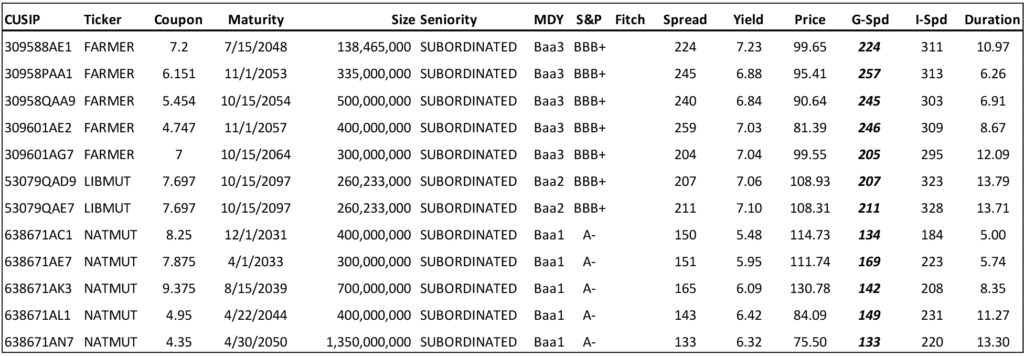
Exhibit 3. Universe of P&C Insurance Surplus Notes (>3 yr maturity)
Source: Santander US Capital Markets LLC, Bloomberg/TRACE pricing indications
Why surplus notes were originally conceived
Mutual insurance companies are mostly owned by the policyholders themselves. As a result, access to public capital markets was traditionally more limited. This new structure gave non-traditional issuers the opportunity to bolster capital levels and enhance financial flexibility. As with principal and interest payments, the actual issuance must also be approved by the state regulator. The structure was largely dormant for some time but re-emerged after the financial crisis in 2009 as insurance companies looked to bolster capital ratio levels and instill confidence in the markets. Issuance has since been sporadic, with several prominent deals coming over the past few years.
Rating agencies’ approach to surplus notes
Moody’s typically rates surplus notes two notches lower than the operating company’s insurance financial strength (IFS) rating for life insurers, and three notches for property & casualty insurers. S&P also rates two and three notches below the operating company financial strength rating as well. For hybrid treatment, the rating agencies will determine the level of equity credit to the issuer based on the maturity and whether or not the issue is cumulative. However, once the issue is within 20 years to maturity—which is true for many of the older, original structures—Moody’s will automatically treat the issue as 100% debt.