By the Numbers
Second-lien seniors offer attractive protection against extension risk
This material is a Marketing Communication and does not constitute Independent Investment Research.
Private-label MBS investors concerned about higher rates and extending cash flows may find ‘AAA’ debt backed by second-lien collateral more attractive than those backed non-QM loans. Second liens are structurally shorter, have more positive convexity and command higher prices, putting issuers’ call options deeper in the money at issuance.
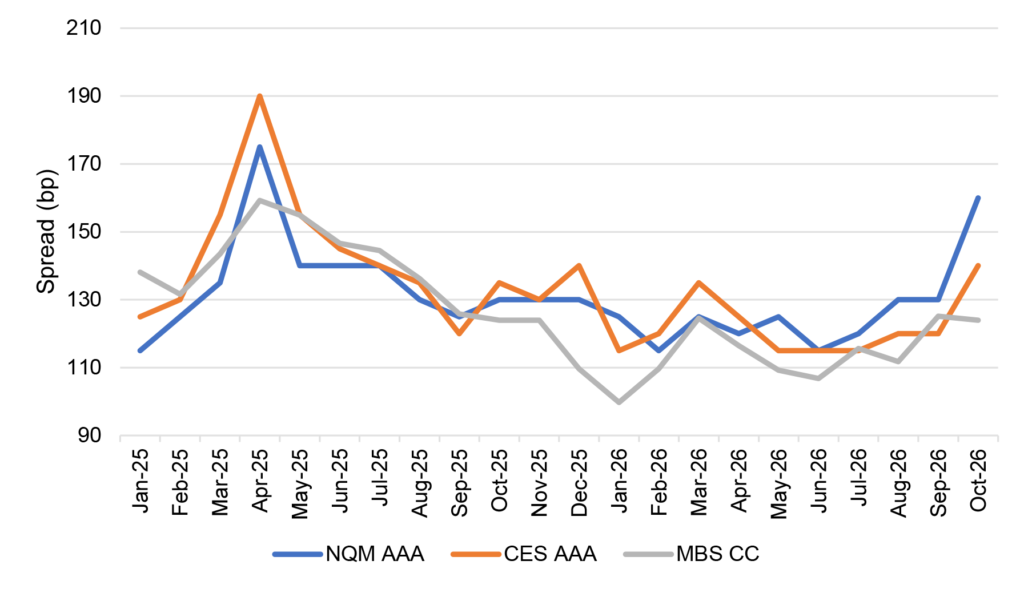
The spike in benchmark rates and volatility has weighed on spreads across agency and private-label MBS to varying degrees. Nominal spreads on current-coupon MBS have held up relatively well and are just 10 bp wider than a month ago. Spreads on private-label AAA-rated securities have fared worse: Non-QM seniors have widened by roughly 30 bp since last month, while senior cash flows backed by second-lien collateral have widened by 20 bp (Exhibit 1). Some of the additional widening in nonagency exposures likely reflects the higher option costs associated with these deals’ call provisions.
Exhibit 1: Private-label spreads widen relative to agencies as option costs rise
Source: Santander US Capital Markets, Bloomberg LP.
Note: Private-label AAA spreads are based on primary market issuance; closed-end second-lien (CES) spreads represent the super-senior class.
But do the loans and structures underlying these two private-label exposures warrant comparable increases in risk premiums? Second-lien AAA-rated securities have carried less extension risk because of their sequential payment structures. Many recently issued non-QM deals have adopted that structure as well. Deals that retain a modified pro rata structure, which distributes principal pro rata to the AAA- through A-rated classes, should trade at wider spreads because of their greater extension risk, all else equal. Higher initial weighted average coupons (WACs) on second-lien transactions should provide senior investors with greater protection against potential interest shortfalls if bond coupons step up after four years without a call. Premiums for potential shortfall risk should therefore be more pronounced in lower-WAC non-QM transactions and relatively muted in second-lien deals.
Comparing prepayments on non-QM loans and second liens
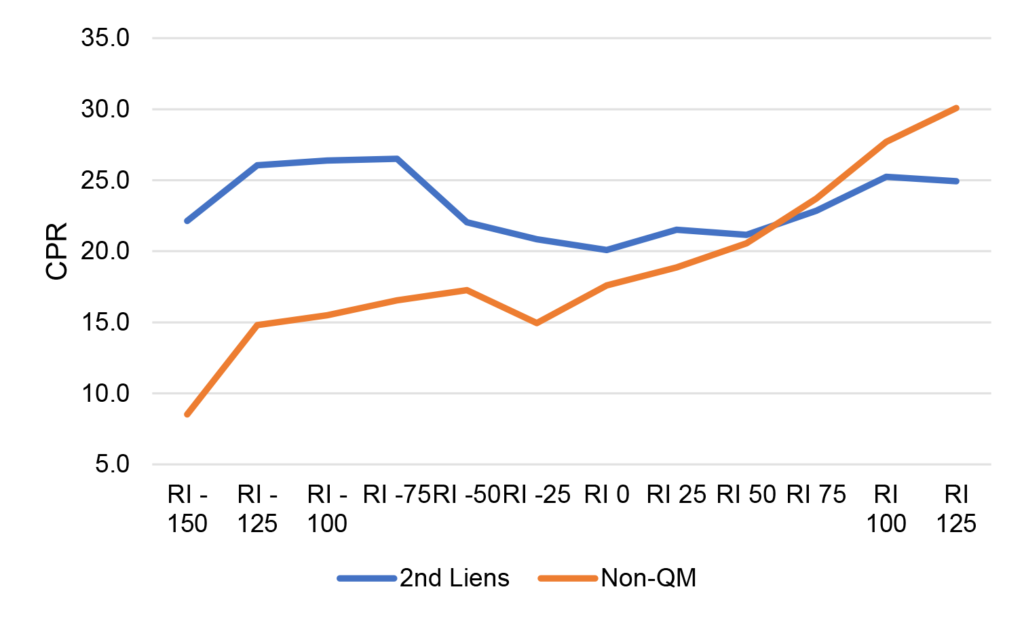
Prepayments across the two cohorts show that second liens have a much flatter prepayment S-curve and better convexity (Exhibit 2). Although at-the-money and overall cohort prepayment speeds have increased over the past year, the S-curve has remained flat. Out-of-the-money speeds have been supported largely by borrowers’ ability to refinance their second liens as their combined loan-to-value (CLTV) ratios decline. Primary second-lien rates follow a relatively steep risk-based pricing curve tied to CLTV. As borrowers’ leverage declines through home price appreciation, amortization of the underlying first lien or both, refinancing incentives should emerge, provided benchmark rates do not rise enough to offset the savings from tighter risk-based pricing.
Exhibit 2: Second liens have a flatter S-curve and better convexity than non-QM loans
Source: Santander US Capital Markets, CoreLogic LP
Deleveraging through amortization can be substantial. The first liens underlying many prime second liens are seasoned conforming loans with low WACs. Low note rates and seasoning allow borrowers to repay substantial amounts of principal each year. This amortization-driven deleveraging should provide meaningful incentives to refinance second liens even amid relatively tepid home price appreciation.
Conversely, in-the-money prepayment speeds are somewhat constrained by these loans’ relatively small balances: Fixed refinancing costs can represent a meaningful share of the outstanding balance. Average balances on securitized second liens are generally less than $100,000, a fraction of those on securitized non-QM first liens. The better convexity profile of second-lien collateral should translate into lower option costs and wider option-adjusted spreads (OAS). It also suggests that if heightened extension risk has driven the recent widening in both asset classes, second-lien spreads may have widened too much and could have greater potential to tighten.
Second-lien deals should be more likely to be called than non-QM deals
Because the asset class is relatively new, few second-lien transactions have entered their call periods. Still, two factors should make second-lien deals more likely to be called than non-QM deals. First, loans securitized in second-lien transactions trade at significantly higher premiums than their non-QM counterparts. Securitized second liens generally trade at six to seven points above par, putting the sponsor’s call option deeper in the money at issuance than the same par call on a non-QM trust, where loans are generally securitized at a premium of two to three points. Second, second liens are structurally shorter than non-QM loans: Most have maximum terms of 20 years, and most securitized loans have 15-year terms. Shorter terms and greater interest-only (IO) exposure in the form of higher premiums give second liens much less interest rate duration than non-QM loans. That shorter duration and greater initial moneyness should allow rates to rise further before a second-lien trust becomes uneconomic to call than would be the case for a non-QM trust.
In addition, most of these transactions have co-sponsors whose equity generally has a shorter investment horizon than that of some permanent-capital non-QM sponsors. That shorter horizon, coupled with a strictly sequential structure that increases an issuer’s cost of funds faster than a modified pro rata non-QM structure, likely gives co-sponsors stronger incentives to call second-lien transactions.
This material is intended only for institutional investors and does not carry all of the independence and disclosure standards of retail debt research reports. In the preparation of this material, the author may have consulted or otherwise discussed the matters referenced herein with one or more of SCM’s trading desks, any of which may have accumulated or otherwise taken a position, long or short, in any of the financial instruments discussed in or related to this material. Further, SCM may act as a market maker or principal dealer and may have proprietary interests that differ or conflict with the recipient hereof, in connection with any financial instrument discussed in or related to this material.
This message, including any attachments or links contained herein, is subject to important disclaimers, conditions, and disclosures regarding Electronic Communications, which you can find at https://portfolio-strategy.apsec.com/sancap-disclaimers-and-disclosures.
Important Disclaimers
Copyright © 2026 Santander US Capital Markets LLC and its affiliates (“SCM”). All rights reserved. SCM is a member of FINRA and SIPC. This material is intended for limited distribution to institutions only and is not publicly available. Any unauthorized use or disclosure is prohibited.
In making this material available, SCM (i) is not providing any advice to the recipient, including, without limitation, any advice as to investment, legal, accounting, tax and financial matters, (ii) is not acting as an advisor or fiduciary in respect of the recipient, (iii) is not making any predictions or projections and (iv) intends that any recipient to which SCM has provided this material is an “institutional investor” (as defined under applicable law and regulation, including FINRA Rule 4512 and that this material will not be disseminated, in whole or part, to any third party by the recipient.
The author of this material is an economist, desk strategist or trader. In the preparation of this material, the author may have consulted or otherwise discussed the matters referenced herein with one or more of SCM’s trading desks, any of which may have accumulated or otherwise taken a position, long or short, in any of the financial instruments discussed in or related to this material. Further, SCM or any of its affiliates may act as a market maker or principal dealer and may have proprietary interests that differ or conflict with the recipient hereof, in connection with any financial instrument discussed in or related to this material.
This material (i) has been prepared for information purposes only and does not constitute a solicitation or an offer to buy or sell any securities, related investments or other financial instruments, (ii) is neither research, a “research report” as commonly understood under the securities laws and regulations promulgated thereunder nor the product of a research department, (iii) or parts thereof may have been obtained from various sources, the reliability of which has not been verified and cannot be guaranteed by SCM, (iv) should not be reproduced or disclosed to any other person, without SCM’s prior consent and (v) is not intended for distribution in any jurisdiction in which its distribution would be prohibited.
In connection with this material, SCM (i) makes no representation or warranties as to the appropriateness or reliance for use in any transaction or as to the permissibility or legality of any financial instrument in any jurisdiction, (ii) believes the information in this material to be reliable, has not independently verified such information and makes no representation, express or implied, with regard to the accuracy or completeness of such information, (iii) accepts no responsibility or liability as to any reliance placed, or investment decision made, on the basis of such information by the recipient and (iv) does not undertake, and disclaims any duty to undertake, to update or to revise the information contained in this material.
Unless otherwise stated, the views, opinions, forecasts, valuations, or estimates contained in this material are those solely of the author, as of the date of publication of this material, and are subject to change without notice. The recipient of this material should make an independent evaluation of this information and make such other investigations as the recipient considers necessary (including obtaining independent financial advice), before transacting in any financial market or instrument discussed in or related to this material.
Important disclaimers for clients in the EU and UK
This publication has been prepared by Trading Desk Strategists within the Sales and Trading functions of Santander US Capital Markets LLC (“SanCap”), the US registered broker-dealer of Santander Corporate & Investment Banking. This communication is distributed in the EEA by Banco Santander S.A., a credit institution registered in Spain and authorised and regulated by the Bank of Spain and the CNMV. Any EEA recipient of this communication that would like to affect any transaction in any security or issuer discussed herein should do so with Banco Santander S.A. or any of its affiliates (together “Santander”). This communication has been distributed in the UK by Banco Santander, S.A.’s London branch, authorised by the Bank of Spain and subject to regulatory oversight on certain matters by the Financial Conduct Authority (FCA) and the Prudential Regulation Authority (PRA).
The publication is intended for exclusive use for Professional Clients and Eligible Counterparties as defined by MiFID II and is not intended for use by retail customers or for any persons or entities in any jurisdictions or country where such distribution or use would be contrary to local law or regulation.
This material is not a product of Santander´s Research Team and does not constitute independent investment research. This is a marketing communication and may contain ¨investment recommendations¨ as defined by the Market Abuse Regulation 596/2014 ("MAR"). This publication has not been prepared in accordance with legal requirements designed to promote the independence of research and is not subject to any prohibition on dealing ahead of the dissemination of investment research. The author, date and time of the production of this publication are as indicated herein.
This publication does not constitute investment advice and may not be relied upon to form an investment decision, nor should it be construed as any offer to sell or issue or invitation to purchase, acquire or subscribe for any instruments referred herein. The publication has been prepared in good faith and based on information Santander considers reliable as of the date of publication, but Santander does not guarantee or represent, express or implied, that such information is accurate or complete. All estimates, forecasts and opinions are current as at the date of this publication and are subject to change without notice. Unless otherwise indicated, Santander does not intend to update this publication. The views and commentary in this publication may not be objective or independent of the interests of the Trading and Sales functions of Santander, who may be active participants in the markets, investments or strategies referred to herein and/or may receive compensation from investment banking and non-investment banking services from entities mentioned herein. Santander may trade as principal, make a market or hold positions in instruments (or related derivatives) and/or hold financial interest in entities discussed herein. Santander may provide market commentary or trading strategies to other clients or engage in transactions which may differ from views expressed herein. Santander may have acted upon the contents of this publication prior to you having received it.
This publication is intended for the exclusive use of the recipient and must not be reproduced, redistributed or transmitted, in whole or in part, without Santander’s consent. The recipient agrees to keep confidential at all times information contained herein.