The Big Idea
Swap spreads and the search for a cause of higher US rates
This material is a Marketing Communication and does not constitute Independent Investment Research.
Ask most analysts or investors to explain higher US rates since March, and heavy US deficits and rising Treasury supply routinely get a nod. But in one place that should be ringing alarm bells if debt supply had caught the market off guard, it is quiet. Swap spreads, the difference between swap and Treasury yields, should narrow with unexpected supply. Instead, they have run flat to wider. If deficits and supply aren’t pushing rates up, a resilient economy and AI may offer better explanations.
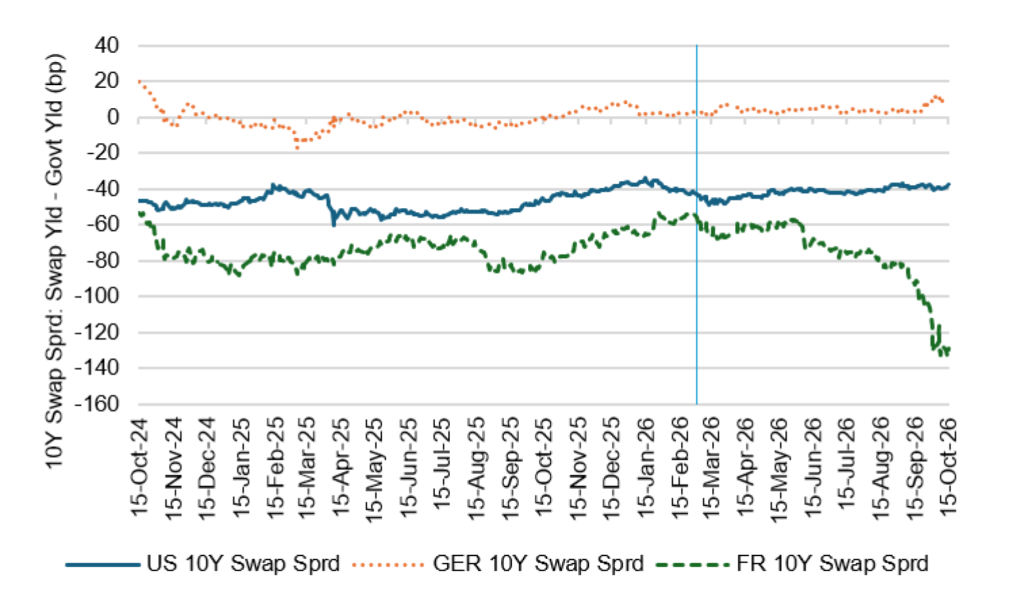
The Congressional Budget Office and other sources have long projected US deficits far into the futures, making it hard to argue that events since March—even the US-Iran war—shocked the market. The deficit this fiscal year has been running ahead of CBO projections but not by enough to tighten swap spreads. In fact, 10-year swap spreads are 6 bp wider since the start of March (Exhibit 1). To add some context, 10-year swap spreads in Germany, which also has widely expected deficits, have widened 7 bp. In France, where fiscal deficits have suddenly become a concern, they have narrowed 73 bp. Swap spreads continue to do their job as bellwether for sovereign debt supply.
Exhibit 1: Wider swap spreads lately in the US and Germany, tighter in France
Source: Bloomberg, Santander US Capital Markets
If federal borrowing is not driving up real and nominal rates, demand for money from an economy that continues to defy the Fed may be. Growth in bonds and loans used to fund US nonfinancial companies is slightly above recent averages (Exhibit 2). Outstanding loans grew 2.1% in the second quarter, above the 1.6% average since late 2021. And bonds grew 1.0%, above the 0.7% average. The demand may be pushing real rates somewhat higher, but growth has probably not moved far enough above trend to explain the surge since March.
Exhibit 2: Broad corporate business demand for money is slightly above average
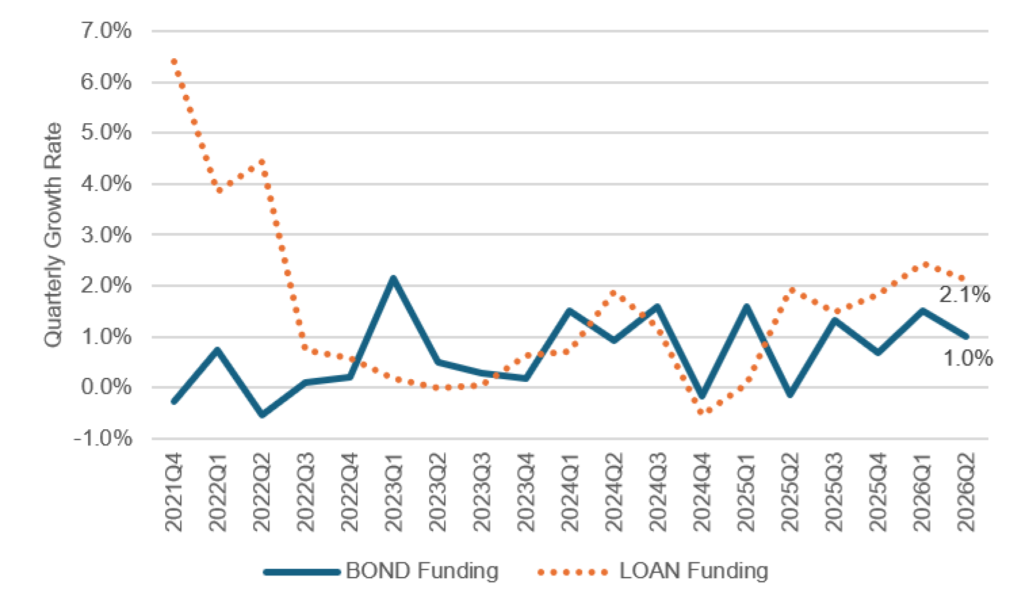
Note: Quarterly growth in bonds and loans used to fund nonfinancial corporate business.
Source: Federal Reserve Financial Accounts of the United States, Santander US Capital Markets
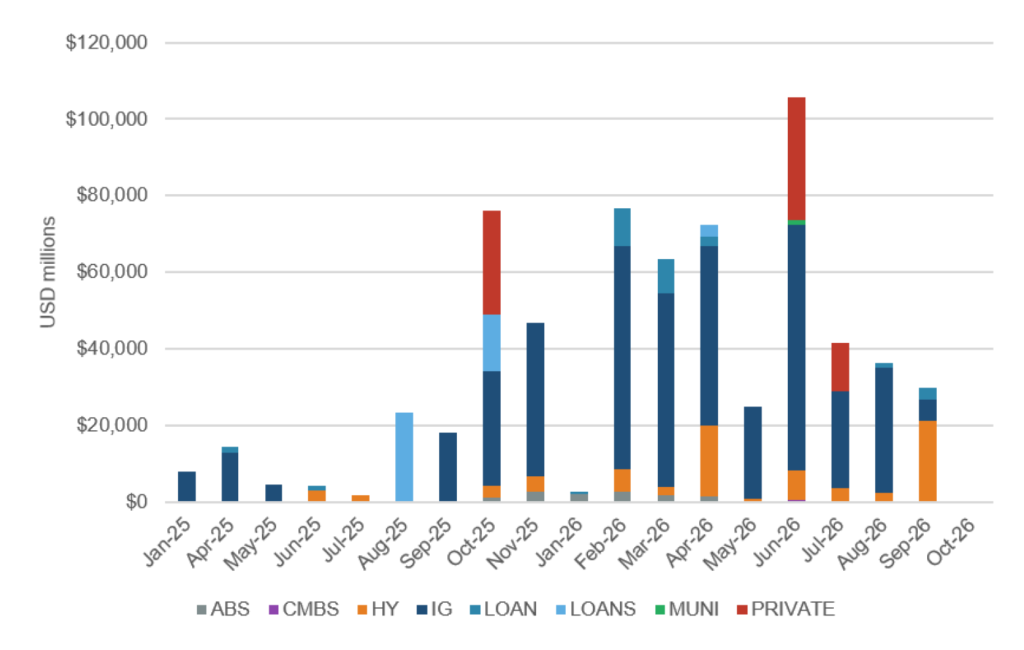
That leaves AI, where both issuance this year and expectations for next year are high. Issuance across markets and currencies totaled $197 billion in 2025 and $454 billion so far this year (Exhibit 3). Equity analysts expect capital investment for AI to reach $800 billion this year and $1.2 trillion next, assuming none of the execution risks—regulation, local opposition, supply of water and electricity, rising costs—get in the way. The AI build has likely exceeded debt market expectations, but whether that surprise alone is enough to drive up real rates as much as we’ve seen since March is hard to tell.
Exhibit 3: Issuance of debt to finance AI has more than doubled this year
Source: Bloomberg, Santander US Capital Markets
For now, the simplest explanation for the surge in US real rates looks like a resilient economy led by AI. That could be the dragon the Fed has to slay, and it may not be easy. It is a parlor game in markets these days to estimate the rise in rates that AI sponsors will need to see before their plans for capital investment are no longer viable. We don’t seem to be there yet. There are some signs that higher rates are about to dissuade some highly leveraged players, with CoreWeave the most recent example. But the biggest investors are Alphabet, Amazon, Meta, Microsoft and Oracle. All except Oracle have solid balance sheets presumably able to withstand higher marginal debt costs. The demand for money and the rise in real rates may not be over.
* * *
The view in rates
The market is pricing another 28 bp of Fed tightening by December and then 45 bp more—for a total of 73 bp—before the end of 2027. Rates reflected expectations for these hikes through September and have stabilized since.
A break in the AI rally could hit credit and the broader economy and lead recession to drag rates lower, but that possibility looks remote. CoreWeave showed some vulnerability within the last week, so highly leveraged balance sheets should be the place to look for AI weakness. However, the AI build among hyperscalers seems almost immune to higher rates for now.
Apart from the AI rally, the market is clearly concerned about the impact of higher rates on other parts of the economy—housing, automotive, other rate-sensitive sectors. The question is the level of rates where those sectors start to noticeably slow.
Key market levels:
- Three-month term SOFR traded late this week at 406 bp, up 1 bp in two weeks
- The 2-year Treasury note traded Friday at 4.76%, down 6 bp in two weeks. The 10-year note traded at 5.09%, down 16 bp in two weeks.
- The Treasury yield flattened sharply in the last two weeks, with 2s10s at 33 bp, down 12 bp. The 5s30s traded late in the week at 52 bp.
- The 10-year inflation breakeven traded Friday at 233 bp, down 3 bp in two weeks. The 5-year, 5-year forward breakeven was 228 bp, down 5 bp. The 10-year real rate ended the week at 277 bp, down 14 bp.
The view in spreads
Higher volatility is dominating spreads with MBS widening sharply and credit weaker. Fundamentals have moved to the sidelines for now. The Bloomberg US investment-grade corporate bond index option-adjusted spread traded late in the week at 83 bp, unchanged in the last two weeks. Nominal par 30-year MBS spreads to a blend of 5- and 10-year Treasury yields were 123 bp, tighter by 3 bp. Par 30-year MBS Treasury option-adjusted spreads closed at 35 bp, tighter by 8 bp in the last two weeks.
The view in credit
Persistent high rates should put pressure on more leveraged balance sheets. Large companies have healthier balance sheets than smaller ones. Middle- and higher-income consumers also carry relatively little debt and have strong liquidity and wealth. Bank lending to nonbank financial institutions, including private debt funds and business development companies, continues to grow. Credit measures for nonbank financial lending remain stronger than those for traditional bank lending, such as commercial and industrial loans.
This material is intended only for institutional investors and does not carry all of the independence and disclosure standards of retail debt research reports. In the preparation of this material, the author may have consulted or otherwise discussed the matters referenced herein with one or more of SCM’s trading desks, any of which may have accumulated or otherwise taken a position, long or short, in any of the financial instruments discussed in or related to this material. Further, SCM may act as a market maker or principal dealer and may have proprietary interests that differ or conflict with the recipient hereof, in connection with any financial instrument discussed in or related to this material.
This message, including any attachments or links contained herein, is subject to important disclaimers, conditions, and disclosures regarding Electronic Communications, which you can find at https://portfolio-strategy.apsec.com/sancap-disclaimers-and-disclosures.
Important Disclaimers
Copyright © 2026 Santander US Capital Markets LLC and its affiliates (“SCM”). All rights reserved. SCM is a member of FINRA and SIPC. This material is intended for limited distribution to institutions only and is not publicly available. Any unauthorized use or disclosure is prohibited.
In making this material available, SCM (i) is not providing any advice to the recipient, including, without limitation, any advice as to investment, legal, accounting, tax and financial matters, (ii) is not acting as an advisor or fiduciary in respect of the recipient, (iii) is not making any predictions or projections and (iv) intends that any recipient to which SCM has provided this material is an “institutional investor” (as defined under applicable law and regulation, including FINRA Rule 4512 and that this material will not be disseminated, in whole or part, to any third party by the recipient.
The author of this material is an economist, desk strategist or trader. In the preparation of this material, the author may have consulted or otherwise discussed the matters referenced herein with one or more of SCM’s trading desks, any of which may have accumulated or otherwise taken a position, long or short, in any of the financial instruments discussed in or related to this material. Further, SCM or any of its affiliates may act as a market maker or principal dealer and may have proprietary interests that differ or conflict with the recipient hereof, in connection with any financial instrument discussed in or related to this material.
This material (i) has been prepared for information purposes only and does not constitute a solicitation or an offer to buy or sell any securities, related investments or other financial instruments, (ii) is neither research, a “research report” as commonly understood under the securities laws and regulations promulgated thereunder nor the product of a research department, (iii) or parts thereof may have been obtained from various sources, the reliability of which has not been verified and cannot be guaranteed by SCM, (iv) should not be reproduced or disclosed to any other person, without SCM’s prior consent and (v) is not intended for distribution in any jurisdiction in which its distribution would be prohibited.
In connection with this material, SCM (i) makes no representation or warranties as to the appropriateness or reliance for use in any transaction or as to the permissibility or legality of any financial instrument in any jurisdiction, (ii) believes the information in this material to be reliable, has not independently verified such information and makes no representation, express or implied, with regard to the accuracy or completeness of such information, (iii) accepts no responsibility or liability as to any reliance placed, or investment decision made, on the basis of such information by the recipient and (iv) does not undertake, and disclaims any duty to undertake, to update or to revise the information contained in this material.
Unless otherwise stated, the views, opinions, forecasts, valuations, or estimates contained in this material are those solely of the author, as of the date of publication of this material, and are subject to change without notice. The recipient of this material should make an independent evaluation of this information and make such other investigations as the recipient considers necessary (including obtaining independent financial advice), before transacting in any financial market or instrument discussed in or related to this material.
Important disclaimers for clients in the EU and UK
This publication has been prepared by Trading Desk Strategists within the Sales and Trading functions of Santander US Capital Markets LLC (“SanCap”), the US registered broker-dealer of Santander Corporate & Investment Banking. This communication is distributed in the EEA by Banco Santander S.A., a credit institution registered in Spain and authorised and regulated by the Bank of Spain and the CNMV. Any EEA recipient of this communication that would like to affect any transaction in any security or issuer discussed herein should do so with Banco Santander S.A. or any of its affiliates (together “Santander”). This communication has been distributed in the UK by Banco Santander, S.A.’s London branch, authorised by the Bank of Spain and subject to regulatory oversight on certain matters by the Financial Conduct Authority (FCA) and the Prudential Regulation Authority (PRA).
The publication is intended for exclusive use for Professional Clients and Eligible Counterparties as defined by MiFID II and is not intended for use by retail customers or for any persons or entities in any jurisdictions or country where such distribution or use would be contrary to local law or regulation.
This material is not a product of Santander´s Research Team and does not constitute independent investment research. This is a marketing communication and may contain ¨investment recommendations¨ as defined by the Market Abuse Regulation 596/2014 ("MAR"). This publication has not been prepared in accordance with legal requirements designed to promote the independence of research and is not subject to any prohibition on dealing ahead of the dissemination of investment research. The author, date and time of the production of this publication are as indicated herein.
This publication does not constitute investment advice and may not be relied upon to form an investment decision, nor should it be construed as any offer to sell or issue or invitation to purchase, acquire or subscribe for any instruments referred herein. The publication has been prepared in good faith and based on information Santander considers reliable as of the date of publication, but Santander does not guarantee or represent, express or implied, that such information is accurate or complete. All estimates, forecasts and opinions are current as at the date of this publication and are subject to change without notice. Unless otherwise indicated, Santander does not intend to update this publication. The views and commentary in this publication may not be objective or independent of the interests of the Trading and Sales functions of Santander, who may be active participants in the markets, investments or strategies referred to herein and/or may receive compensation from investment banking and non-investment banking services from entities mentioned herein. Santander may trade as principal, make a market or hold positions in instruments (or related derivatives) and/or hold financial interest in entities discussed herein. Santander may provide market commentary or trading strategies to other clients or engage in transactions which may differ from views expressed herein. Santander may have acted upon the contents of this publication prior to you having received it.
This publication is intended for the exclusive use of the recipient and must not be reproduced, redistributed or transmitted, in whole or in part, without Santander’s consent. The recipient agrees to keep confidential at all times information contained herein.