The Long and Short
A silver lining in Skydance’s second-lien debt
This material is a Marketing Communication and does not constitute Independent Investment Research.
Skydance’s (SKYD) much-anticipated debt offering has been less than spectacular. The $110 billion merger with Warner Bros. Discovery (WBD) created one of the world’s largest content companies and included $41.4 billion of US dollar notes sold in the investment-grade and high-yield markets. Since launching late last month, SKYD bonds have sharply underperformed the broader credit market, with spreads widening over the past two weeks. The selloff has given cause to reassess the new capital structure and created potential buying opportunities.
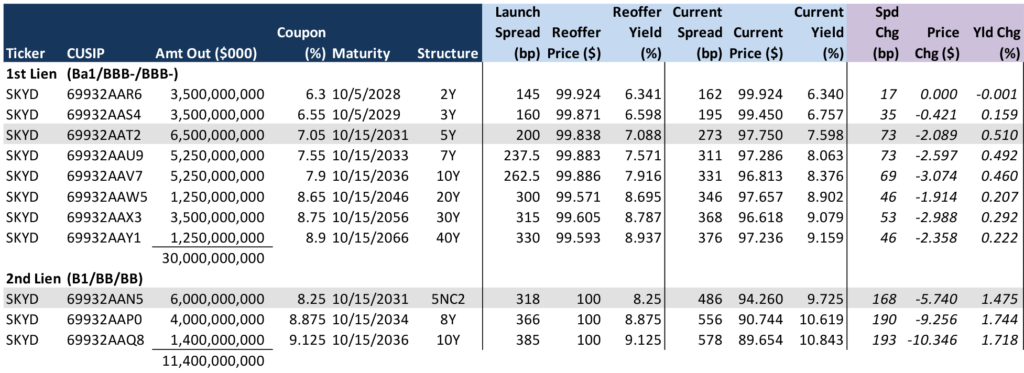
Even a $109 billion order book could not prevent a selloff. On Sept. 30, investors bought $30 billion of first-lien investment-grade debt across eight tranches and $11.4 billion of second-lien high-yield debt across three tranches. Whether the final new-issue concessions were too small or weaker credit markets caused buyer’s remorse, SKYD bonds quickly sold off and have yet to stabilize relative to comparable debt (Exhibit 1).
Exhibit 1: SKYD new issue bond performance has lagged the broad market
Source: Santander US Capital Markets LLC, Bloomberg/TRACE indications only
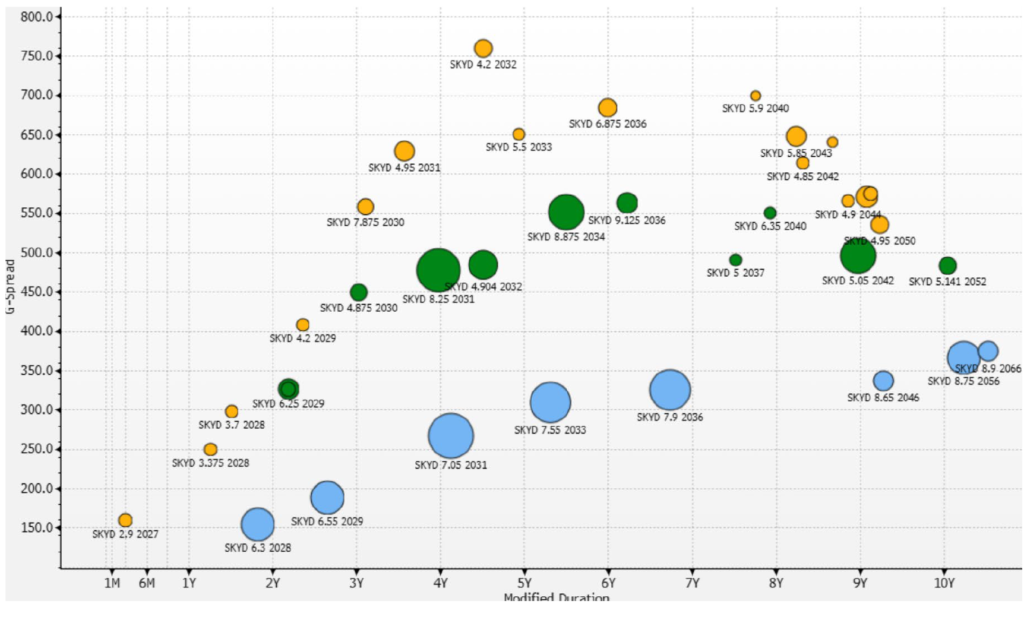
Investment-grade tranches have widened by roughly 50 bp on average since launch. High-yield spreads have widened by more than 180 bp, while prices have fallen about $8 from par on average. Intermediate maturities were hit hardest on a spread basis. Investors also reassessed the structural subordination of the second-lien notes, whose ratings were above those of legacy Paramount debt (B2/B+/BB-). The initial spread gap between the first- and second-lien issues widened by more than 100 bp soon after secondary trading began (Exhibit 2).
Exhibit 2: Current spreads for SKYD: 1st-Lien (blue), 2nd-Lien (green) new issues and legacy Paramount unsecured debt (yellow)
Source: Santander US Capital Markets LLC, Bloomberg/TRACE indications only
The selloff has widened the spread gap between the first-lien five-year notes due in 2031 and the second-lien 2031 notes, which have a 5NC2 call structure, to about 215-220 bp from 115-120 bp at launch. That sharp repricing offers the clearest relative-value opportunity, especially for buy-and-hold investors able to withstand near-term spread volatility. The key questions are how much investors should be paid to move down the capital structure given SKYD’s potential recovery value, and why that premium has changed so much in two weeks.
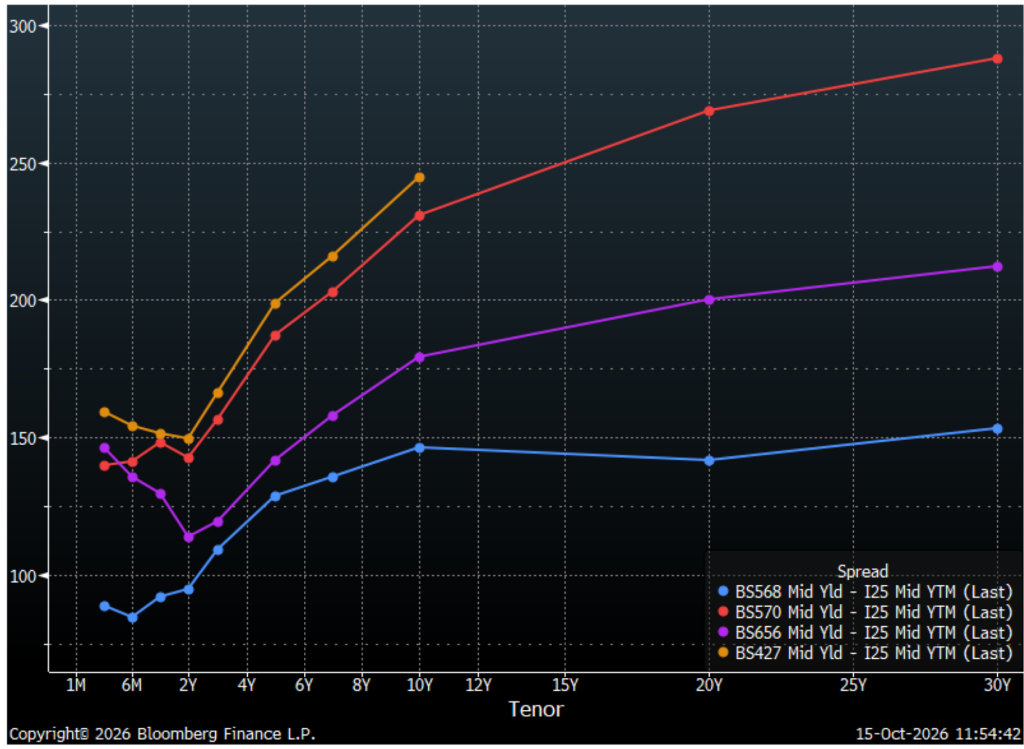
Fair-value credit curves offer a useful starting point (Exhibit 3). Five-year composite BB debt trades at about 187 bp, compared with about 129 basis points for BBB- debt. That implies just a 55-60 bp premium for moving down in ratings. Within communications, BB debt trades at about 199 bp, versus 142 bp for BBB- debt, again a 55-60 bp gap. This simple comparison does not account for the structural elements of liens on company assets or the call structure of the high-yield 2031 notes, but it provides a broad market benchmark for pricing risk.
Exhibit 3. Bloomberg fair value curves: Composite BB (red), Composite BBB- (blue), Communications BB (orange), Communications BBB- (purple)
Source: Santander US Capital Markets LLC, Bloomberg Fair Value Curves
The reality is a little more nuanced. SKYD’s valuation reflects roughly $80 billion of net debt from the acquisition and concern that the company must deliver substantial cost savings to meet its deleveraging goals. Pro forma EBITDA is about $12 billion, and the combined company generates about $70 billion in annual revenue. Before synergies, that implies gross leverage above 7x and net leverage in the mid-6x range. Management targets $6 billion in cost savings, which would reduce gross leverage to about 5x and net leverage to the mid-4x range.
Management aims to reduce net leverage to roughly 3.75x by 2028 and 3.0x within three years of closing. Both targets depend heavily on achieving the full $6 billion annual run-rate of synergies. That makes the liens on company assets important: In a stressed restructuring, first-lien bonds would recover their full value before second-lien bonds receive proceeds. Both liens would fall away if SKYD earned investment-grade underlying ratings from two of the three major rating agencies. The capital structure includes $45 billion of first-priority secured claims and $12.5 billion of second-priority claims.
SKYD’s assets include Warner Bros., Paramount and New Line Cinema film studios; HBO Max, Paramount+ and Discovery+ streaming services; and television networks including CBS, CNN, Discovery, Nickelodeon, TBS and TNT. The company also owns a large library of intellectual property and television production and distribution platforms. Estimating recovery values in a theoretical breakup is difficult, and the company has not reported an official enterprise value for the combined business. The all-cash buyout of WBD shareholders was about $78 billion, gross debt exceeds $80 billion and the current equity market value is just over $35 billion. After adjusting for a relatively small cash balance, that implies an enterprise value of roughly $115 billion, or about 9.6x EBITDA before projected synergies.
Assume the enterprise-value-to-EBITDA multiple fell to 6x, a very low level compared with telecommunications, media and technology peers. Based on the $12 billion of pro forma EBITDA before projected synergies, enterprise value would be about $72 billion. Even at that level, first- and second-lien bondholders could fully recover their holdings in a theoretical restructuring. This is a simplified recovery analysis. Still, the extra 215-220 bp offered by the second-lien high-yield notes due in 2031 appears to compensate investors for moving down the capital structure, given the valuation cushion. The case is stronger because both liens could fall away if the company earns stand-alone investment-grade ratings and given the high likelihood that management will achieve some degree of operating synergies.
This material is intended only for institutional investors and does not carry all of the independence and disclosure standards of retail debt research reports. In the preparation of this material, the author may have consulted or otherwise discussed the matters referenced herein with one or more of SCM’s trading desks, any of which may have accumulated or otherwise taken a position, long or short, in any of the financial instruments discussed in or related to this material. Further, SCM may act as a market maker or principal dealer and may have proprietary interests that differ or conflict with the recipient hereof, in connection with any financial instrument discussed in or related to this material.
This message, including any attachments or links contained herein, is subject to important disclaimers, conditions, and disclosures regarding Electronic Communications, which you can find at https://portfolio-strategy.apsec.com/sancap-disclaimers-and-disclosures.
Important Disclaimers
Copyright © 2026 Santander US Capital Markets LLC and its affiliates (“SCM”). All rights reserved. SCM is a member of FINRA and SIPC. This material is intended for limited distribution to institutions only and is not publicly available. Any unauthorized use or disclosure is prohibited.
In making this material available, SCM (i) is not providing any advice to the recipient, including, without limitation, any advice as to investment, legal, accounting, tax and financial matters, (ii) is not acting as an advisor or fiduciary in respect of the recipient, (iii) is not making any predictions or projections and (iv) intends that any recipient to which SCM has provided this material is an “institutional investor” (as defined under applicable law and regulation, including FINRA Rule 4512 and that this material will not be disseminated, in whole or part, to any third party by the recipient.
The author of this material is an economist, desk strategist or trader. In the preparation of this material, the author may have consulted or otherwise discussed the matters referenced herein with one or more of SCM’s trading desks, any of which may have accumulated or otherwise taken a position, long or short, in any of the financial instruments discussed in or related to this material. Further, SCM or any of its affiliates may act as a market maker or principal dealer and may have proprietary interests that differ or conflict with the recipient hereof, in connection with any financial instrument discussed in or related to this material.
This material (i) has been prepared for information purposes only and does not constitute a solicitation or an offer to buy or sell any securities, related investments or other financial instruments, (ii) is neither research, a “research report” as commonly understood under the securities laws and regulations promulgated thereunder nor the product of a research department, (iii) or parts thereof may have been obtained from various sources, the reliability of which has not been verified and cannot be guaranteed by SCM, (iv) should not be reproduced or disclosed to any other person, without SCM’s prior consent and (v) is not intended for distribution in any jurisdiction in which its distribution would be prohibited.
In connection with this material, SCM (i) makes no representation or warranties as to the appropriateness or reliance for use in any transaction or as to the permissibility or legality of any financial instrument in any jurisdiction, (ii) believes the information in this material to be reliable, has not independently verified such information and makes no representation, express or implied, with regard to the accuracy or completeness of such information, (iii) accepts no responsibility or liability as to any reliance placed, or investment decision made, on the basis of such information by the recipient and (iv) does not undertake, and disclaims any duty to undertake, to update or to revise the information contained in this material.
Unless otherwise stated, the views, opinions, forecasts, valuations, or estimates contained in this material are those solely of the author, as of the date of publication of this material, and are subject to change without notice. The recipient of this material should make an independent evaluation of this information and make such other investigations as the recipient considers necessary (including obtaining independent financial advice), before transacting in any financial market or instrument discussed in or related to this material.
Important disclaimers for clients in the EU and UK
This publication has been prepared by Trading Desk Strategists within the Sales and Trading functions of Santander US Capital Markets LLC (“SanCap”), the US registered broker-dealer of Santander Corporate & Investment Banking. This communication is distributed in the EEA by Banco Santander S.A., a credit institution registered in Spain and authorised and regulated by the Bank of Spain and the CNMV. Any EEA recipient of this communication that would like to affect any transaction in any security or issuer discussed herein should do so with Banco Santander S.A. or any of its affiliates (together “Santander”). This communication has been distributed in the UK by Banco Santander, S.A.’s London branch, authorised by the Bank of Spain and subject to regulatory oversight on certain matters by the Financial Conduct Authority (FCA) and the Prudential Regulation Authority (PRA).
The publication is intended for exclusive use for Professional Clients and Eligible Counterparties as defined by MiFID II and is not intended for use by retail customers or for any persons or entities in any jurisdictions or country where such distribution or use would be contrary to local law or regulation.
This material is not a product of Santander´s Research Team and does not constitute independent investment research. This is a marketing communication and may contain ¨investment recommendations¨ as defined by the Market Abuse Regulation 596/2014 ("MAR"). This publication has not been prepared in accordance with legal requirements designed to promote the independence of research and is not subject to any prohibition on dealing ahead of the dissemination of investment research. The author, date and time of the production of this publication are as indicated herein.
This publication does not constitute investment advice and may not be relied upon to form an investment decision, nor should it be construed as any offer to sell or issue or invitation to purchase, acquire or subscribe for any instruments referred herein. The publication has been prepared in good faith and based on information Santander considers reliable as of the date of publication, but Santander does not guarantee or represent, express or implied, that such information is accurate or complete. All estimates, forecasts and opinions are current as at the date of this publication and are subject to change without notice. Unless otherwise indicated, Santander does not intend to update this publication. The views and commentary in this publication may not be objective or independent of the interests of the Trading and Sales functions of Santander, who may be active participants in the markets, investments or strategies referred to herein and/or may receive compensation from investment banking and non-investment banking services from entities mentioned herein. Santander may trade as principal, make a market or hold positions in instruments (or related derivatives) and/or hold financial interest in entities discussed herein. Santander may provide market commentary or trading strategies to other clients or engage in transactions which may differ from views expressed herein. Santander may have acted upon the contents of this publication prior to you having received it.
This publication is intended for the exclusive use of the recipient and must not be reproduced, redistributed or transmitted, in whole or in part, without Santander’s consent. The recipient agrees to keep confidential at all times information contained herein.