By the Numbers
Hedging cap risk in CMO floaters
This material is a Marketing Communication and does not constitute Independent Investment Research.
The sharp rise in benchmark yields across the curve over the past month has driven spreads wider and prices lower on CMO floaters. Recent underperformance in floaters is mainly attributable to rising valuations on the interest rate caps these bonds are short, rather than to the performance of the mortgage basis. With dim prospects for a near-term relief rally, investors may begin looking to hedge some of the cap risk embedded in their floater portfolios.
Hawkish overtures from Fed Chairman Warsh have pushed front-end benchmark yields higher. Two-year Treasury yields have risen by roughly 75 bps over the past month, implying an additional three hikes in the federal funds rate. At the same time, yields on the long end of the curve have come under pressure from demand for money from both the Treasury and hyperscalers funding aggressive AI buildouts. The pronounced bear flattening of the yield curve has pushed valuations on CMO floaters lower. Elevated front-end rates have increased the likelihood that some of these bonds may ultimately get capped out. Higher long-term rates will likely slow prepayments, leaving more of these bonds susceptible to embedded cap risk.
Deconstructing floater spread duration
Investors who purchase CMO floaters are compensated for multiple dimensions of risk. Like any MBS, floaters carry both basis and prepayment risk. Floater buyers are also somewhat uniquely exposed to cap risk. Some of the spread floater buyers earn comes from shorting an interest rate cap. All of these caps are out of the money, to varying degrees. The further out of the money the cap is relative to spot SOFR rates, the less the bond investor is compensated, and vice versa.
Floaters tend to exhibit nonlinear price convexity. As rates fall and the option on the cap strike moves further out of the money, floater prices will rise, but only to a point, as investors become wary of premium risk on floaters that now carry greater prepayment risk. Conversely, as spot or market-implied future SOFR rates approach the cap strike, bond prices can fall sharply. Given this dynamic, floater investors could look to hedge some of this risk by buying back the cap they are short.
Hedging cap risk
Hedging cap risk can quickly become complex. However, this analysis seeks to answer a more basic question: Does a simple hedge provide adequate protection against the mark-to-market risk posed by the embedded cap?
The analysis pairs 6.5% and 7.0% cap floaters with a corresponding notional amount of six-year bullet caps struck at the cap less the bond’s margin. For example, the cap hedge on the 6.5% cap CMO is struck at 5.2% after deducting the 1.30% stated margin from the 6.5% cap. The analysis compares the immediate change in the floater’s price with the change in the cap’s price after an instantaneous change in rates or in the shape of the yield curve.
Plotting the unhedged change in market value for both the 6.5% and 7.0% cap floaters illustrates price convexity on either side of par. As rates rally, the floaters appreciate by roughly a point. But in a pronounced rally, prepayment risk more than offsets the decrease in the value of the cap the bond is short, limiting valuations (Exhibit 1). Conversely, when rates rise by a comparable amount, the 6.5% cap bond’s value falls by more than six points.
Exhibit 1: Measuring price convexity of CMO floaters
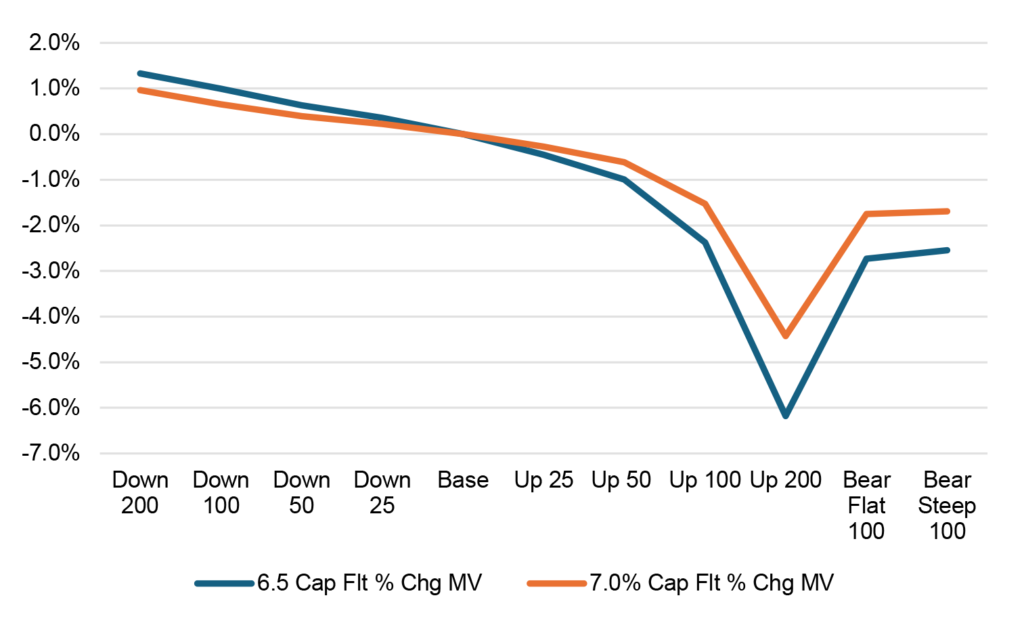
Source: Santander US Capital Markets, YieldBook.
Note: Prices are calculated using a constant OAS methodology and instantaneous curve shifts at a spot horizon.
The floaters are then paired with corresponding cap hedges. The 6.5% cap floater is paired with a cap struck at 5.20%, while the 7.0% cap floater is hedged with a 5.95% cap to account for stated floater margins of 130 bp and 105 bp, respectively. The caps are structured as six-year bullets to closely align with the average life of the floaters at the pricing speed. The notional balances of the hedges are set to match the par balances of the floaters. The change in the floater’s market value is then netted against the change in the cap’s market value.
The caps hedge the change in the floaters’ market value well during instantaneous upward shifts in rates, small rallies and a bear steepening of the yield curve. The paired trade underperforms during sustained rallies, when the caps lose nearly all their value with limited offset from the floater’s price (Exhibit 2). The hedge outperforms in a bear flattener because flattening of the forward curve reduces the likelihood that the cap strike will be hit in the future.
Exhibit 2: Mapping price performance of floaters hedged with caps
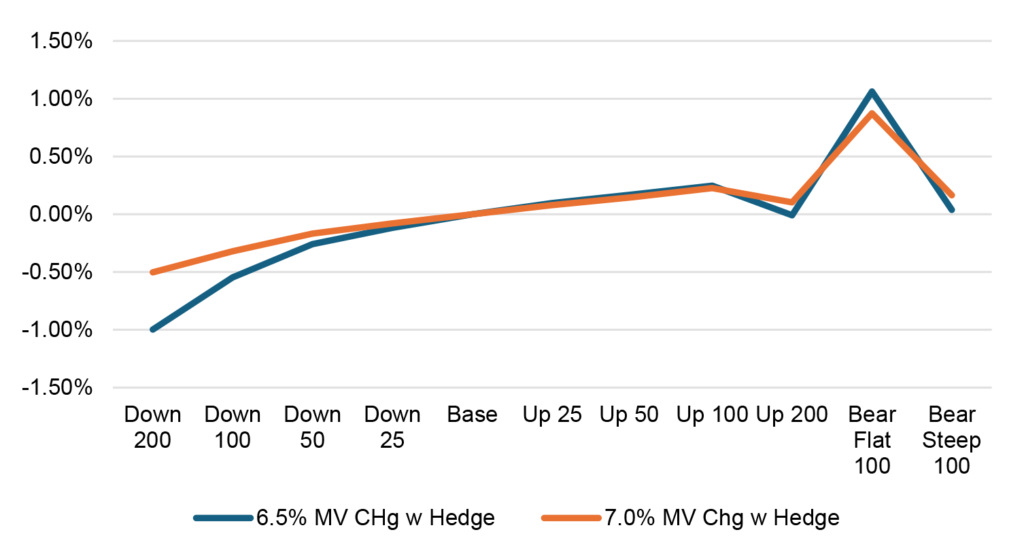
Source: Santander US Capital Markets, YieldBook.
Note: Prices are calculated using a constant OAS methodology and instantaneous curve shifts at a spot horizon.
For the hedge-adjusted return on these profiles, assuming $100 million of notional on each cap, the upfront premiums are $2.94 million and $1.86 million, respectively. Assuming a 130 bp discount margin on the floater and a roughly three-point premium, the annualized hedge premium is roughly 50 bp for the 6.5% cap, resulting in a net margin of roughly 80 bp for the uncapped floater. However, investors will realize this net margin only if the balance of the cap matches that of the floater. In other words, the 80 bp does not account for the option cost associated with the need to delta-hedge the cap notional. In practice, the holder of the CMO floater would enter into an amortizing cap and attempt to match the CMO’s cash flows. The cap would still need to be restruck over time, reducing the hedge- or option-adjusted net spread.
Other considerations
Practical applications of cap hedging can become very complex. Investors can buy and sell options on cap strikes in varying notional amounts to offset some of the premium they pay for their desired hedge. That said, this simplified analysis suggests that a simple, albeit somewhat expensive, hedge can provide investors with substantial protection against further deterioration in the value of CMO portfolios during a sell-off.
This material is intended only for institutional investors and does not carry all of the independence and disclosure standards of retail debt research reports. In the preparation of this material, the author may have consulted or otherwise discussed the matters referenced herein with one or more of SCM’s trading desks, any of which may have accumulated or otherwise taken a position, long or short, in any of the financial instruments discussed in or related to this material. Further, SCM may act as a market maker or principal dealer and may have proprietary interests that differ or conflict with the recipient hereof, in connection with any financial instrument discussed in or related to this material.
This message, including any attachments or links contained herein, is subject to important disclaimers, conditions, and disclosures regarding Electronic Communications, which you can find at https://portfolio-strategy.apsec.com/sancap-disclaimers-and-disclosures.
Important Disclaimers
Copyright © 2026 Santander US Capital Markets LLC and its affiliates (“SCM”). All rights reserved. SCM is a member of FINRA and SIPC. This material is intended for limited distribution to institutions only and is not publicly available. Any unauthorized use or disclosure is prohibited.
In making this material available, SCM (i) is not providing any advice to the recipient, including, without limitation, any advice as to investment, legal, accounting, tax and financial matters, (ii) is not acting as an advisor or fiduciary in respect of the recipient, (iii) is not making any predictions or projections and (iv) intends that any recipient to which SCM has provided this material is an “institutional investor” (as defined under applicable law and regulation, including FINRA Rule 4512 and that this material will not be disseminated, in whole or part, to any third party by the recipient.
The author of this material is an economist, desk strategist or trader. In the preparation of this material, the author may have consulted or otherwise discussed the matters referenced herein with one or more of SCM’s trading desks, any of which may have accumulated or otherwise taken a position, long or short, in any of the financial instruments discussed in or related to this material. Further, SCM or any of its affiliates may act as a market maker or principal dealer and may have proprietary interests that differ or conflict with the recipient hereof, in connection with any financial instrument discussed in or related to this material.
This material (i) has been prepared for information purposes only and does not constitute a solicitation or an offer to buy or sell any securities, related investments or other financial instruments, (ii) is neither research, a “research report” as commonly understood under the securities laws and regulations promulgated thereunder nor the product of a research department, (iii) or parts thereof may have been obtained from various sources, the reliability of which has not been verified and cannot be guaranteed by SCM, (iv) should not be reproduced or disclosed to any other person, without SCM’s prior consent and (v) is not intended for distribution in any jurisdiction in which its distribution would be prohibited.
In connection with this material, SCM (i) makes no representation or warranties as to the appropriateness or reliance for use in any transaction or as to the permissibility or legality of any financial instrument in any jurisdiction, (ii) believes the information in this material to be reliable, has not independently verified such information and makes no representation, express or implied, with regard to the accuracy or completeness of such information, (iii) accepts no responsibility or liability as to any reliance placed, or investment decision made, on the basis of such information by the recipient and (iv) does not undertake, and disclaims any duty to undertake, to update or to revise the information contained in this material.
Unless otherwise stated, the views, opinions, forecasts, valuations, or estimates contained in this material are those solely of the author, as of the date of publication of this material, and are subject to change without notice. The recipient of this material should make an independent evaluation of this information and make such other investigations as the recipient considers necessary (including obtaining independent financial advice), before transacting in any financial market or instrument discussed in or related to this material.
Important disclaimers for clients in the EU and UK
This publication has been prepared by Trading Desk Strategists within the Sales and Trading functions of Santander US Capital Markets LLC (“SanCap”), the US registered broker-dealer of Santander Corporate & Investment Banking. This communication is distributed in the EEA by Banco Santander S.A., a credit institution registered in Spain and authorised and regulated by the Bank of Spain and the CNMV. Any EEA recipient of this communication that would like to affect any transaction in any security or issuer discussed herein should do so with Banco Santander S.A. or any of its affiliates (together “Santander”). This communication has been distributed in the UK by Banco Santander, S.A.’s London branch, authorised by the Bank of Spain and subject to regulatory oversight on certain matters by the Financial Conduct Authority (FCA) and the Prudential Regulation Authority (PRA).
The publication is intended for exclusive use for Professional Clients and Eligible Counterparties as defined by MiFID II and is not intended for use by retail customers or for any persons or entities in any jurisdictions or country where such distribution or use would be contrary to local law or regulation.
This material is not a product of Santander´s Research Team and does not constitute independent investment research. This is a marketing communication and may contain ¨investment recommendations¨ as defined by the Market Abuse Regulation 596/2014 ("MAR"). This publication has not been prepared in accordance with legal requirements designed to promote the independence of research and is not subject to any prohibition on dealing ahead of the dissemination of investment research. The author, date and time of the production of this publication are as indicated herein.
This publication does not constitute investment advice and may not be relied upon to form an investment decision, nor should it be construed as any offer to sell or issue or invitation to purchase, acquire or subscribe for any instruments referred herein. The publication has been prepared in good faith and based on information Santander considers reliable as of the date of publication, but Santander does not guarantee or represent, express or implied, that such information is accurate or complete. All estimates, forecasts and opinions are current as at the date of this publication and are subject to change without notice. Unless otherwise indicated, Santander does not intend to update this publication. The views and commentary in this publication may not be objective or independent of the interests of the Trading and Sales functions of Santander, who may be active participants in the markets, investments or strategies referred to herein and/or may receive compensation from investment banking and non-investment banking services from entities mentioned herein. Santander may trade as principal, make a market or hold positions in instruments (or related derivatives) and/or hold financial interest in entities discussed herein. Santander may provide market commentary or trading strategies to other clients or engage in transactions which may differ from views expressed herein. Santander may have acted upon the contents of this publication prior to you having received it.
This publication is intended for the exclusive use of the recipient and must not be reproduced, redistributed or transmitted, in whole or in part, without Santander’s consent. The recipient agrees to keep confidential at all times information contained herein.