By the Numbers
Non-QM deals likely to be called despite higher rates
This material is a Marketing Communication and does not constitute Independent Investment Research.
Higher benchmark rates have prompted some investors to question whether extension risk is rising. Slower prepayments are part of that concern, but investors are more focused on whether sponsors retain enough economic incentive to call eligible transactions. Many deals still appear to be in-the-money, suggesting call activity could remain elevated.
Recent call activity
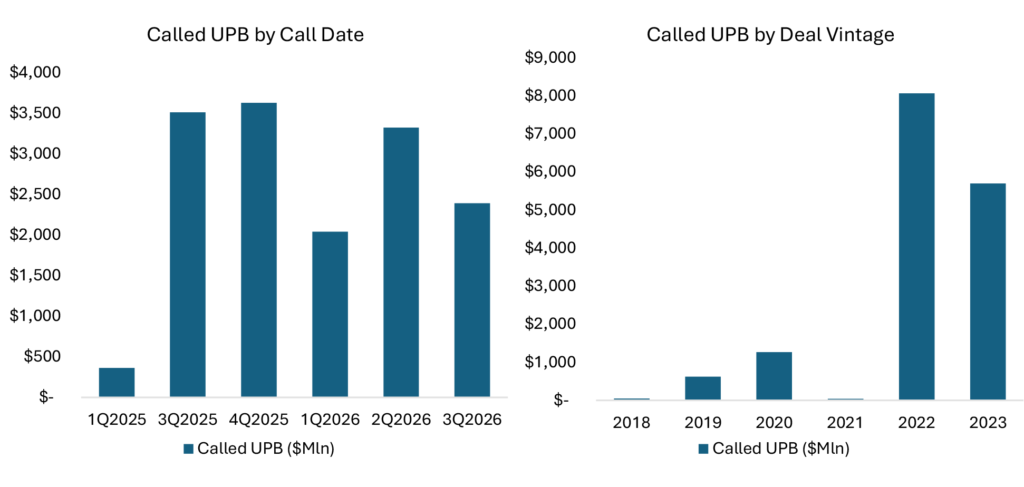
Since the beginning of last year, sponsors of non-QM securitizations have called roughly $15 billion of collateral, split about evenly between last year and the first eight months of this year (Exhibit 1). More than half came from 2022-vintage transactions, with more than $8 billion of loans securitized that year having been called (Exhibit 2). Calls of 2022-vintage deals offer insight into the factors sponsors weigh when deciding whether to exercise a call.
Exhibits 1 and 2: Tracking recent non-QM call activity
Source: Santander US Capital Markets, Intex
Conventional wisdom holds that a call should be exercised when the collateral price is above the option’s par strike price. But sponsors consider several other factors. The 2022 vintage was marked by unfavorable securitization economics as rising rates and widening credit spreads increased issuers’ liability costs, reducing excess spread and the leverage sponsors could achieve through debt issuance. Despite wide variation in asset coupons among loans securitized in 2022, issuers are calling these deals. That suggests the liability side of a transaction can have greater influence on a sponsor’s call decision than the value of the assets.
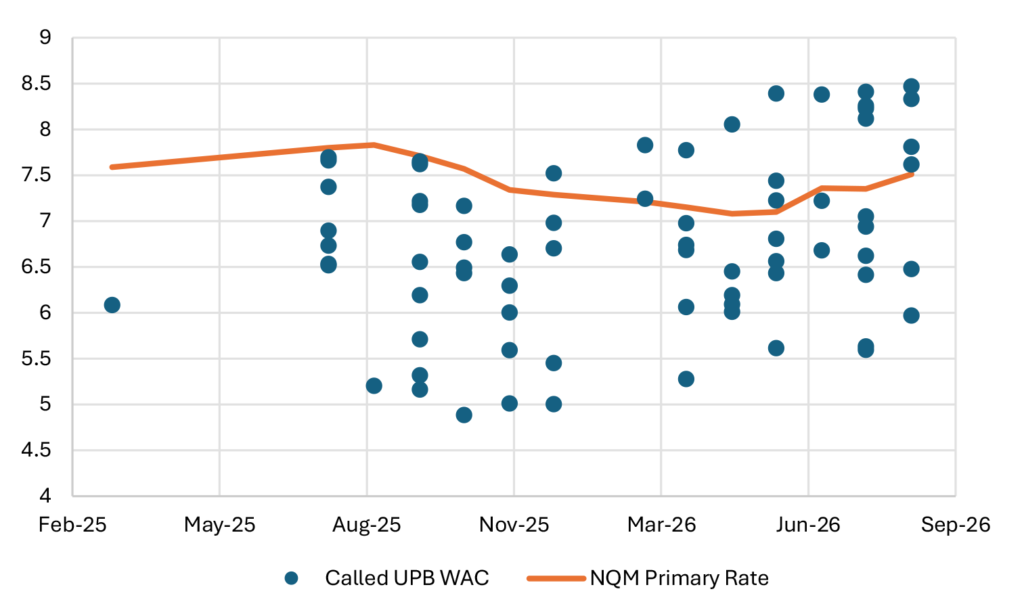
Additional evidence that liabilities can matter more than assets in valuing the call comes from comparing the weighted average coupon, or WAC, on called transactions with an estimated primary non-QM origination rate at the time of the call. The estimated non-QM primary rate is the FHFA Primary Mortgage Market Survey rate plus 100 basis points, roughly consistent with the average spread at origination, or SATO, on loans securitized in non-QM trusts during the observation period. The comparison shows that many deals were out of the money when called (Exhibit 3).
Exhibit 3: Estimating moneyness at time of call
Source: Santander US Capital Markets, Intex, Bloomberg LP
Hedging offers one explanation. At issuance, sponsors can hedge the future value of the asset, potentially with payer swaptions, which give the buyer the option to enter an interest-rate swap at a specified future date at a rate set when the option is priced. For example, if a sponsor estimates the tail, or remaining duration of the collateral at the first call date, at two years, it could enter a three-year/two-year payer swaption. If rates at the call date are above the strike on the swap’s fixed-rate leg, the swap can be in the money even when the collateral is out of the money.
Callability of the outstanding universe
Future callability also reflects the roughly bimodal nature of the outstanding deal universe. Because front-end interest rates reached historic lows in 2020 and 2021, those vintages are likely to remain out of the money for the life of the transactions. Some higher-WAC deals could still be called after senior pro rata tranches are fully paid down and the remaining debt stack carries a net WAC coupon. As a result, the currently callable universe is largely made up of deals issued from 2022 through the first half of 2023.
Based on current benchmark yields and non-QM spreads across the capital structure, the weighted average cost of funds for a non-QM securitization is about 6.15%. The figure can vary by deal and issuer, particularly because of differences in credit enhancement for lower-cost debt at the top of the capital structure. Using 6.15% as a benchmark for current securitizations, call incentive can be estimated as the difference between an outstanding deal’s weighted average debt cost and the prevailing cost of funds.
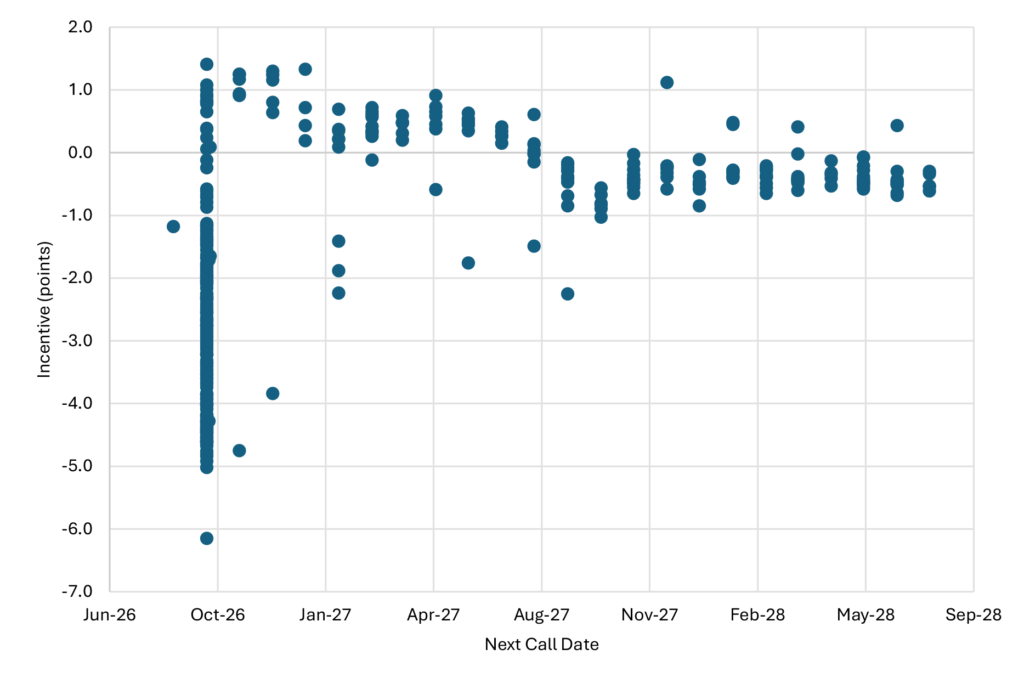
Mapping that incentive against the next call date shows that many currently callable deals retain an incentive to be called despite the recent increase in benchmark rates (Exhibit 4).
Exhibit 4: Mapping call incentive from the liability side of non-QM trusts
Source: Santander US Capital Markets, Intex.
Note: Debt yield for outstanding trusts is calculated as the weighted average coupon of remaining outstanding debt, with no original-issue discount concession for first-loss classes.
The analysis shows that most deals callable over the next year, excluding the 2021 vintage, remain in the money on the liability side. Meaningfully negative call incentives do not emerge until the second half of next year. Even then, an important caveat applies: Deals callable in 2027 and beyond carry step-up coupons on the pro rata portion of the debt stack, covering the AAA through A rated classes.
Because advance rates to single-A classes have generally increased in recent issuance years, much of the outstanding debt will be subject to a coupon step-up four years after issuance. Nearly all trusts are projected to have less than 1 point of negative incentive before that adjustment, which could move call incentives from negative to positive after the step-up is taken into account.
The shape of the yield curve and implied forward benchmark and mortgage rates also matter. If the current curve persists, it suggests that many of these deals could be called because the forward benchmark rates used to price non-QM debt are not materially higher than spot rates.
Investors also consider the type of sponsor. Some have argued that fund sponsors are more likely to call deals than permanent-capital vehicles because funds generally must return capital to limited partners within a defined time horizon. Recent activity is mixed: Invictus has been the most active sponsor, accounting for roughly one-third of called balances, while Annaly Capital Management, a permanent-capital real estate investment trust, ranks second. Calls by both fund sponsors and permanent-capital vehicles suggest that the duration of a sponsor’s equity is not, by itself, a clear predictor of call behavior.
This material is intended only for institutional investors and does not carry all of the independence and disclosure standards of retail debt research reports. In the preparation of this material, the author may have consulted or otherwise discussed the matters referenced herein with one or more of SCM’s trading desks, any of which may have accumulated or otherwise taken a position, long or short, in any of the financial instruments discussed in or related to this material. Further, SCM may act as a market maker or principal dealer and may have proprietary interests that differ or conflict with the recipient hereof, in connection with any financial instrument discussed in or related to this material.
This message, including any attachments or links contained herein, is subject to important disclaimers, conditions, and disclosures regarding Electronic Communications, which you can find at https://portfolio-strategy.apsec.com/sancap-disclaimers-and-disclosures.
Important Disclaimers
Copyright © 2026 Santander US Capital Markets LLC and its affiliates (“SCM”). All rights reserved. SCM is a member of FINRA and SIPC. This material is intended for limited distribution to institutions only and is not publicly available. Any unauthorized use or disclosure is prohibited.
In making this material available, SCM (i) is not providing any advice to the recipient, including, without limitation, any advice as to investment, legal, accounting, tax and financial matters, (ii) is not acting as an advisor or fiduciary in respect of the recipient, (iii) is not making any predictions or projections and (iv) intends that any recipient to which SCM has provided this material is an “institutional investor” (as defined under applicable law and regulation, including FINRA Rule 4512 and that this material will not be disseminated, in whole or part, to any third party by the recipient.
The author of this material is an economist, desk strategist or trader. In the preparation of this material, the author may have consulted or otherwise discussed the matters referenced herein with one or more of SCM’s trading desks, any of which may have accumulated or otherwise taken a position, long or short, in any of the financial instruments discussed in or related to this material. Further, SCM or any of its affiliates may act as a market maker or principal dealer and may have proprietary interests that differ or conflict with the recipient hereof, in connection with any financial instrument discussed in or related to this material.
This material (i) has been prepared for information purposes only and does not constitute a solicitation or an offer to buy or sell any securities, related investments or other financial instruments, (ii) is neither research, a “research report” as commonly understood under the securities laws and regulations promulgated thereunder nor the product of a research department, (iii) or parts thereof may have been obtained from various sources, the reliability of which has not been verified and cannot be guaranteed by SCM, (iv) should not be reproduced or disclosed to any other person, without SCM’s prior consent and (v) is not intended for distribution in any jurisdiction in which its distribution would be prohibited.
In connection with this material, SCM (i) makes no representation or warranties as to the appropriateness or reliance for use in any transaction or as to the permissibility or legality of any financial instrument in any jurisdiction, (ii) believes the information in this material to be reliable, has not independently verified such information and makes no representation, express or implied, with regard to the accuracy or completeness of such information, (iii) accepts no responsibility or liability as to any reliance placed, or investment decision made, on the basis of such information by the recipient and (iv) does not undertake, and disclaims any duty to undertake, to update or to revise the information contained in this material.
Unless otherwise stated, the views, opinions, forecasts, valuations, or estimates contained in this material are those solely of the author, as of the date of publication of this material, and are subject to change without notice. The recipient of this material should make an independent evaluation of this information and make such other investigations as the recipient considers necessary (including obtaining independent financial advice), before transacting in any financial market or instrument discussed in or related to this material.
Important disclaimers for clients in the EU and UK
This publication has been prepared by Trading Desk Strategists within the Sales and Trading functions of Santander US Capital Markets LLC (“SanCap”), the US registered broker-dealer of Santander Corporate & Investment Banking. This communication is distributed in the EEA by Banco Santander S.A., a credit institution registered in Spain and authorised and regulated by the Bank of Spain and the CNMV. Any EEA recipient of this communication that would like to affect any transaction in any security or issuer discussed herein should do so with Banco Santander S.A. or any of its affiliates (together “Santander”). This communication has been distributed in the UK by Banco Santander, S.A.’s London branch, authorised by the Bank of Spain and subject to regulatory oversight on certain matters by the Financial Conduct Authority (FCA) and the Prudential Regulation Authority (PRA).
The publication is intended for exclusive use for Professional Clients and Eligible Counterparties as defined by MiFID II and is not intended for use by retail customers or for any persons or entities in any jurisdictions or country where such distribution or use would be contrary to local law or regulation.
This material is not a product of Santander´s Research Team and does not constitute independent investment research. This is a marketing communication and may contain ¨investment recommendations¨ as defined by the Market Abuse Regulation 596/2014 ("MAR"). This publication has not been prepared in accordance with legal requirements designed to promote the independence of research and is not subject to any prohibition on dealing ahead of the dissemination of investment research. The author, date and time of the production of this publication are as indicated herein.
This publication does not constitute investment advice and may not be relied upon to form an investment decision, nor should it be construed as any offer to sell or issue or invitation to purchase, acquire or subscribe for any instruments referred herein. The publication has been prepared in good faith and based on information Santander considers reliable as of the date of publication, but Santander does not guarantee or represent, express or implied, that such information is accurate or complete. All estimates, forecasts and opinions are current as at the date of this publication and are subject to change without notice. Unless otherwise indicated, Santander does not intend to update this publication. The views and commentary in this publication may not be objective or independent of the interests of the Trading and Sales functions of Santander, who may be active participants in the markets, investments or strategies referred to herein and/or may receive compensation from investment banking and non-investment banking services from entities mentioned herein. Santander may trade as principal, make a market or hold positions in instruments (or related derivatives) and/or hold financial interest in entities discussed herein. Santander may provide market commentary or trading strategies to other clients or engage in transactions which may differ from views expressed herein. Santander may have acted upon the contents of this publication prior to you having received it.
This publication is intended for the exclusive use of the recipient and must not be reproduced, redistributed or transmitted, in whole or in part, without Santander’s consent. The recipient agrees to keep confidential at all times information contained herein.