The Big Idea
Payroll gains point to firmer labor markets
This material is a Marketing Communication and does not constitute Independent Investment Research.
The employment statistics have been especially volatile in recent summers. After soft readings in June and July, payrolls jumped in August, seemingly making up for prior weakness. With the summer behind us, the numbers offer a clearer comparison between 2026 and 2025. They consistently show labor demand has firmed at the margin this year.
Stronger job growth
Payroll gains cooled sharply last year. Overall employment only rose by 10,000 a month, while private sector payrolls increased by 25,000, In late August, the Bureau of Labor Statistics said benchmark revisions for the 12 months ended in March 2026 would be modestly negative. Including that preliminary estimate, total payrolls will likely show gains of less than 5,000 a month in 2025, while private sector gains will likely be trimmed to about 15,000.
Through the first eight months of this year, total payrolls have risen by 80,000 a month, while private sector job growth has averaged 84,000. Benchmark revisions would likely lower those figures by about 2,000 and 5,000, respectively. That would leave both headline and private payroll growth running near 80,000 a month this year.
Two points stand out in the aggregate figures. First, labor demand has picked up significantly from 2025. A variety of other labor market proxies support that assessment. Most notably, initial jobless claims have fallen, signaling fewer layoffs. New filers averaged 226,000 a week last year and is running 211,000 a week year-to-date in 2026. That 15,000 difference may not seem like much, but it works out to around 60,000 to 75,000 a month (15,000 a week times four or five weeks in a month). Coincidentally, that difference between 2025 and 2026 is quite close to the magnitude of the acceleration in payroll gains.
Second, the data support the widely held view that the breakeven pace of job gains—the rate needed to keep up with the underlying growth in the labor force— has fallen to around 50,000 a month. The marked shift toward a tighter immigration policy has helped to limit the rise in the working-age population, reducing the job growth needed to keep the unemployment rate steady over time. It rarely works out quite this neatly, but a modestly lower-than-breakeven pace of payroll gains in 2025 was accompanied by a small rise in the unemployment rate, from 4.1% in December 2024 to a local peak of 4.5% in November. Then, the 80,000 a month clip so far this year, somewhat faster than the presumed breakeven rate, has been associated with a gently declining unemployment rate, back down to 4.1% in July and August.
Together, the major indicators paint a consistent picture. The labor market loosened modestly last year and has tightened somewhat in the first eight months of 2026. Since the FOMC believes that the full-employment level of the unemployment rate is 4.2%, the current situation is close to ideal. It is easy to understand why most Fed officials have declared the full employment box checked and are solely focused on inflation.
Sectoral swings
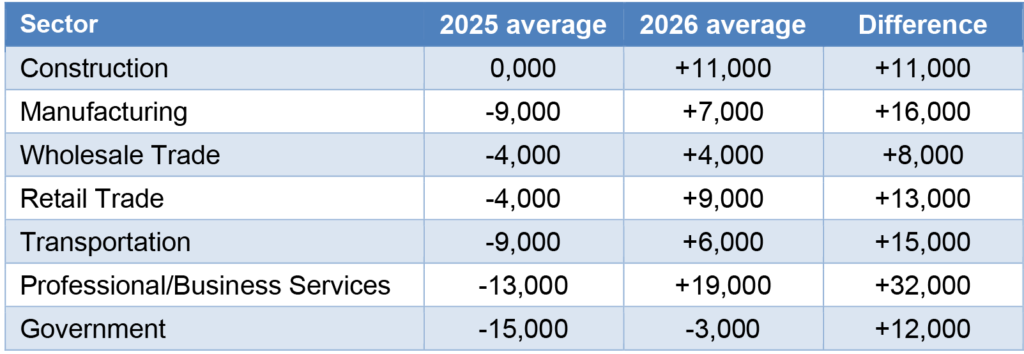
The acceleration in job growth in 2026 has been remarkably broad. Of the 14 major payroll sectors, seven have seen a meaningful acceleration in gains this year versus 2025, three have weakened, and four are little changed. The sectors that have firmed point to broadening economic strength (Exhibit 1).
Exhibit 1: Sectors showing stronger payroll job changes in 2026
Source: BLS.
Construction hiring has picked up, predominantly in the nonresidential sector. Much of this job growth undoubtedly reflects the frenzied building of data centers around the country. The goods sectors of the economy, manufacturing, wholesale trade, retail trade, and transportation, have all flipped from modest declines in 2025 to small gains this year. This likely reflects the improvement in the environment as uncertainty regarding tariff policy has faded. This brightening tracks with various business surveys that have firmed over the course of the year. Even in the services area, professional and business services employment has also gone from contraction in 2025 to solid gains so far this year. About half of the improvement came in the temporary help industry. Finally, the downtrend in government payrolls has abated, as the pace of contraction of federal employees has been reduced sharply.
The three sectors that have seen slowing in 2026 likely reflect structural changes rather than cyclical cooling (Exhibit 2). In the case of information and finance, the story may be related to AI. There have been widespread reports of tech companies reducing their headcounts for certain functions, like entry-level coding, due to the advance of AI capabilities. Similarly, banks and financial firms have been cutting back on headcount, likely reflecting the proliferation of technology. Finally, the robust pace of job gains in the health care sector has cooled somewhat so far this year. This could reflect firms finally catching up in level terms after enduring an acute labor shortage for several years coming out of the pandemic. Whatever the driver is, we can confidently say that it is not evidence of broad economic weakness, as employment in this sector tends to be one of the least closely correlated to the fortunes of the overall economy.
Exhibit 2: Sectors showing weaker payroll job changes in 2026

Source: BLS.
Of the four sectors that have seen little movement in the pace of payroll changes, three are relatively small (mining, utilities, and other services). The fourth might be a bit surprising: leisure and hospitality. After all of the monthly volatility in this sector, with gains of more than 40,000 in March, May, and August, and drops of more than 20,000 in February, June, and July, the net result is an average increase of 5,000 a month compared to +8,000 a month last year.
Conclusion
The major labor market indicators—payroll gains, the unemployment rate and initial jobless claims—all tell a consistent story: the labor market softened modestly last year and has firmed somewhat so far in 2026. The bottom line for the Fed is that the economy is roughly at full employment, right where policymakers want it.
The sectoral breakdown of payrolls shows that many of the most cyclical industries have flipped from job losses in 2025 to modest gains this year, signaling an improvement in the economy’s fortunes. While payroll growth overall is subpar by historical standards, it appears to be running faster than what is needed to keep pace with the growth in the working-age population, as evidenced by the fall in the unemployment rate back down to 4.1%. All signs point to a highly favorable labor market situation.
This material is intended only for institutional investors and does not carry all of the independence and disclosure standards of retail debt research reports. In the preparation of this material, the author may have consulted or otherwise discussed the matters referenced herein with one or more of SCM’s trading desks, any of which may have accumulated or otherwise taken a position, long or short, in any of the financial instruments discussed in or related to this material. Further, SCM may act as a market maker or principal dealer and may have proprietary interests that differ or conflict with the recipient hereof, in connection with any financial instrument discussed in or related to this material.
This message, including any attachments or links contained herein, is subject to important disclaimers, conditions, and disclosures regarding Electronic Communications, which you can find at https://portfolio-strategy.apsec.com/sancap-disclaimers-and-disclosures.
Important Disclaimers
Copyright © 2026 Santander US Capital Markets LLC and its affiliates (“SCM”). All rights reserved. SCM is a member of FINRA and SIPC. This material is intended for limited distribution to institutions only and is not publicly available. Any unauthorized use or disclosure is prohibited.
In making this material available, SCM (i) is not providing any advice to the recipient, including, without limitation, any advice as to investment, legal, accounting, tax and financial matters, (ii) is not acting as an advisor or fiduciary in respect of the recipient, (iii) is not making any predictions or projections and (iv) intends that any recipient to which SCM has provided this material is an “institutional investor” (as defined under applicable law and regulation, including FINRA Rule 4512 and that this material will not be disseminated, in whole or part, to any third party by the recipient.
The author of this material is an economist, desk strategist or trader. In the preparation of this material, the author may have consulted or otherwise discussed the matters referenced herein with one or more of SCM’s trading desks, any of which may have accumulated or otherwise taken a position, long or short, in any of the financial instruments discussed in or related to this material. Further, SCM or any of its affiliates may act as a market maker or principal dealer and may have proprietary interests that differ or conflict with the recipient hereof, in connection with any financial instrument discussed in or related to this material.
This material (i) has been prepared for information purposes only and does not constitute a solicitation or an offer to buy or sell any securities, related investments or other financial instruments, (ii) is neither research, a “research report” as commonly understood under the securities laws and regulations promulgated thereunder nor the product of a research department, (iii) or parts thereof may have been obtained from various sources, the reliability of which has not been verified and cannot be guaranteed by SCM, (iv) should not be reproduced or disclosed to any other person, without SCM’s prior consent and (v) is not intended for distribution in any jurisdiction in which its distribution would be prohibited.
In connection with this material, SCM (i) makes no representation or warranties as to the appropriateness or reliance for use in any transaction or as to the permissibility or legality of any financial instrument in any jurisdiction, (ii) believes the information in this material to be reliable, has not independently verified such information and makes no representation, express or implied, with regard to the accuracy or completeness of such information, (iii) accepts no responsibility or liability as to any reliance placed, or investment decision made, on the basis of such information by the recipient and (iv) does not undertake, and disclaims any duty to undertake, to update or to revise the information contained in this material.
Unless otherwise stated, the views, opinions, forecasts, valuations, or estimates contained in this material are those solely of the author, as of the date of publication of this material, and are subject to change without notice. The recipient of this material should make an independent evaluation of this information and make such other investigations as the recipient considers necessary (including obtaining independent financial advice), before transacting in any financial market or instrument discussed in or related to this material.
Important disclaimers for clients in the EU and UK
This publication has been prepared by Trading Desk Strategists within the Sales and Trading functions of Santander US Capital Markets LLC (“SanCap”), the US registered broker-dealer of Santander Corporate & Investment Banking. This communication is distributed in the EEA by Banco Santander S.A., a credit institution registered in Spain and authorised and regulated by the Bank of Spain and the CNMV. Any EEA recipient of this communication that would like to affect any transaction in any security or issuer discussed herein should do so with Banco Santander S.A. or any of its affiliates (together “Santander”). This communication has been distributed in the UK by Banco Santander, S.A.’s London branch, authorised by the Bank of Spain and subject to regulatory oversight on certain matters by the Financial Conduct Authority (FCA) and the Prudential Regulation Authority (PRA).
The publication is intended for exclusive use for Professional Clients and Eligible Counterparties as defined by MiFID II and is not intended for use by retail customers or for any persons or entities in any jurisdictions or country where such distribution or use would be contrary to local law or regulation.
This material is not a product of Santander´s Research Team and does not constitute independent investment research. This is a marketing communication and may contain ¨investment recommendations¨ as defined by the Market Abuse Regulation 596/2014 ("MAR"). This publication has not been prepared in accordance with legal requirements designed to promote the independence of research and is not subject to any prohibition on dealing ahead of the dissemination of investment research. The author, date and time of the production of this publication are as indicated herein.
This publication does not constitute investment advice and may not be relied upon to form an investment decision, nor should it be construed as any offer to sell or issue or invitation to purchase, acquire or subscribe for any instruments referred herein. The publication has been prepared in good faith and based on information Santander considers reliable as of the date of publication, but Santander does not guarantee or represent, express or implied, that such information is accurate or complete. All estimates, forecasts and opinions are current as at the date of this publication and are subject to change without notice. Unless otherwise indicated, Santander does not intend to update this publication. The views and commentary in this publication may not be objective or independent of the interests of the Trading and Sales functions of Santander, who may be active participants in the markets, investments or strategies referred to herein and/or may receive compensation from investment banking and non-investment banking services from entities mentioned herein. Santander may trade as principal, make a market or hold positions in instruments (or related derivatives) and/or hold financial interest in entities discussed herein. Santander may provide market commentary or trading strategies to other clients or engage in transactions which may differ from views expressed herein. Santander may have acted upon the contents of this publication prior to you having received it.
This publication is intended for the exclusive use of the recipient and must not be reproduced, redistributed or transmitted, in whole or in part, without Santander’s consent. The recipient agrees to keep confidential at all times information contained herein.