By the Numbers
New entrants and AI help lift non-QM MBS volume
This material is a Marketing Communication and does not constitute Independent Investment Research.
Non-QM issuance has already topped last year’s total, and the market could reach $125 billion this year. Several forces are driving the increase. Large non-bank lenders are expanding into the sector with greater scale. High mortgage rates have squeezed agency originations and gain-on-sale margins, pushing lenders to diversify. And artificial intelligence is beginning to streamline the manual underwriting of non-QM loans. These trends and other factors have pushed up originations and issuance.
Non-QM issuance surpasses last year’s total
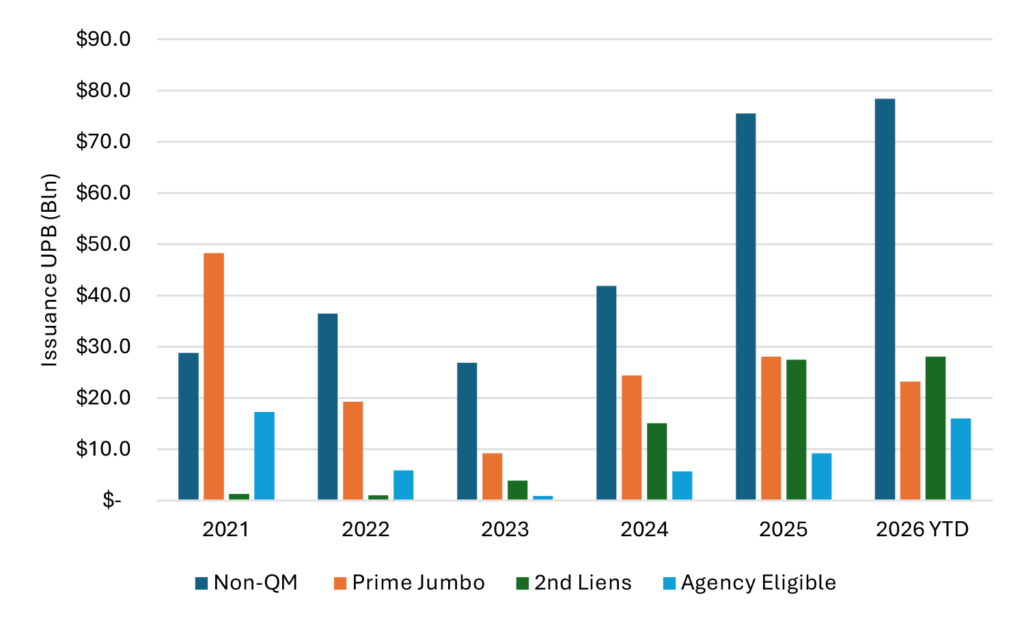
Non-QM issuance reached $78.4 billion through August, about $3 billion above last year’s full-year total. Other sectors have also surpassed last year’s volumes, though on a much smaller scale. Issuance backed by second liens has edged above last year’s total, while private-label deals backed by agency-eligible loans jumped to $16.2 billion through August from $9.2 billion last year. Prime jumbo issuance, by contrast, has lagged, totaling just $23.2 billion this year versus $28.1 billion in 2025 (Exhibit 1).
Exhibit 1: Non-QM issuance rises to $78 billion through August
Source: Santander US Capital Markets, Creditflow
The recent rise in benchmark and primary mortgage rates could slow originations, but securitized volume could still reach $125 billion this year. In recent vintages, fourth-quarter issuance has accounted for an outsized 27% to 29% of annual volume. Assuming $10 billion of issuance in September and a 29% fourth-quarter share, issuance would total roughly $36 billion in the fourth quarter and $125 billion for the year. At a 70% securitization pull-through rate, that would imply approximately $175 billion of loan originations.
Higher mortgage rates remain a headwind, but several other factors support continued growth. Non-QM deals are getting larger: as recently as six months ago, a $1 billion non-QM securitization was unusual; today, such deals are relatively commonplace. Larger transactions are being fueled in part by larger loans, as sponsors seek better execution in non-QM structures than in shifting-interest jumbo deals. Demand has also been strong at the AAA level, although the support appears to reflect greater participation from existing buyers rather than a broader investor base.
More large originators embrace non-QM lending
A key driver of production growth is the expanding presence of large non-bank originators, which bring deep broker and correspondent networks, greater capacity, operational efficiency and economies of scale. Three of last year’s five largest non-QM originators by volume—United Wholesale Mortgage (UWM), CrossCountry Mortgage and Guaranteed Rate—have historically focused primarily on agency lending but have expanded their non-QM businesses. UWM originated roughly $6 billion of non-QM loans last year, up 15% from the prior year, for a 5.5% market share. CrossCountry Mortgage originated $5.7 billion, an increase of nearly 70% from 2024, for a 5.4% share. Guaranteed Rate originated $5.4 billion, up 145%, representing about 5% of the market.
Agency-focused originators historically have been reluctant to invest in the infrastructure required to originate and fund non-QM loans. Many viewed non-QM demand as a temporary result of higher rates and expected a cyclical market in which lower rates would revive refinancing and widen gain-on-sale margins.
Nearly four years of high mortgage rates have likely challenged that assumption and encouraged more lenders to invest in non-QM production channels. Higher rates have weighed not only on agency volumes but also on profitability. Data from the Mortgage Bankers Association show that pre-tax production profits among surveyed independent mortgage bankers were 25 basis points in the second quarter and 16 basis points in the first quarter of this year. Against a historical average of 40 basis points, those results represent shortfalls of roughly 37% and 60%, respectively. Because non-QM lending can generate much wider margins, the sector has become increasingly attractive to agency lenders facing lower volumes and tighter profitability.
A lift from AI
The industry may still be some distance from using AI to approve mortgage applications outright, but originators are already deploying the technology to streamline labor-intensive underwriting workflows. Bank-statement lending is one area where the impact is becoming visible. According to HousingWire, originators including Angel Oak, Sierra Pacific and Logan Circle are using technology from Prudent AI to automate parts of the bank-statement review process. Angel Oak reported a 400% improvement in underwriting productivity after implementing the technology, while Sierra Pacific’s chief operating officer said reviews of 12-month bank-statement loans fell from about an hour to 15–20 minutes.* More broadly, a shortage of experienced manual underwriters has been a constraint on non-QM growth. AI can extend the reach of that expertise by screening documentation for inaccuracies and defects, potentially increasing production capacity and lowering costs for borrowers.
Other factors
Continued home-price appreciation could also support gross originations. Higher property values can make it more difficult for investors to qualify for loans underwritten against borrower income, increasing the appeal of debt-service-coverage-ratio underwriting, which qualifies loans based on a property’s rental income rather than the borrower’s personal income and is a feature of the non-QM market. Rising home values are also giving borrowers more equity to tap. Cash-out refinances have increased in recent years and represented 11% of collateral backing deals last quarter, up from just 4% in the second half of 2024.
*Prudent AI is helping mortgage lenders cater to gig economy workers – HousingWire May 21, 2025
This material is intended only for institutional investors and does not carry all of the independence and disclosure standards of retail debt research reports. In the preparation of this material, the author may have consulted or otherwise discussed the matters referenced herein with one or more of SCM’s trading desks, any of which may have accumulated or otherwise taken a position, long or short, in any of the financial instruments discussed in or related to this material. Further, SCM may act as a market maker or principal dealer and may have proprietary interests that differ or conflict with the recipient hereof, in connection with any financial instrument discussed in or related to this material.
This message, including any attachments or links contained herein, is subject to important disclaimers, conditions, and disclosures regarding Electronic Communications, which you can find at https://portfolio-strategy.apsec.com/sancap-disclaimers-and-disclosures.
Important Disclaimers
Copyright © 2026 Santander US Capital Markets LLC and its affiliates (“SCM”). All rights reserved. SCM is a member of FINRA and SIPC. This material is intended for limited distribution to institutions only and is not publicly available. Any unauthorized use or disclosure is prohibited.
In making this material available, SCM (i) is not providing any advice to the recipient, including, without limitation, any advice as to investment, legal, accounting, tax and financial matters, (ii) is not acting as an advisor or fiduciary in respect of the recipient, (iii) is not making any predictions or projections and (iv) intends that any recipient to which SCM has provided this material is an “institutional investor” (as defined under applicable law and regulation, including FINRA Rule 4512 and that this material will not be disseminated, in whole or part, to any third party by the recipient.
The author of this material is an economist, desk strategist or trader. In the preparation of this material, the author may have consulted or otherwise discussed the matters referenced herein with one or more of SCM’s trading desks, any of which may have accumulated or otherwise taken a position, long or short, in any of the financial instruments discussed in or related to this material. Further, SCM or any of its affiliates may act as a market maker or principal dealer and may have proprietary interests that differ or conflict with the recipient hereof, in connection with any financial instrument discussed in or related to this material.
This material (i) has been prepared for information purposes only and does not constitute a solicitation or an offer to buy or sell any securities, related investments or other financial instruments, (ii) is neither research, a “research report” as commonly understood under the securities laws and regulations promulgated thereunder nor the product of a research department, (iii) or parts thereof may have been obtained from various sources, the reliability of which has not been verified and cannot be guaranteed by SCM, (iv) should not be reproduced or disclosed to any other person, without SCM’s prior consent and (v) is not intended for distribution in any jurisdiction in which its distribution would be prohibited.
In connection with this material, SCM (i) makes no representation or warranties as to the appropriateness or reliance for use in any transaction or as to the permissibility or legality of any financial instrument in any jurisdiction, (ii) believes the information in this material to be reliable, has not independently verified such information and makes no representation, express or implied, with regard to the accuracy or completeness of such information, (iii) accepts no responsibility or liability as to any reliance placed, or investment decision made, on the basis of such information by the recipient and (iv) does not undertake, and disclaims any duty to undertake, to update or to revise the information contained in this material.
Unless otherwise stated, the views, opinions, forecasts, valuations, or estimates contained in this material are those solely of the author, as of the date of publication of this material, and are subject to change without notice. The recipient of this material should make an independent evaluation of this information and make such other investigations as the recipient considers necessary (including obtaining independent financial advice), before transacting in any financial market or instrument discussed in or related to this material.
Important disclaimers for clients in the EU and UK
This publication has been prepared by Trading Desk Strategists within the Sales and Trading functions of Santander US Capital Markets LLC (“SanCap”), the US registered broker-dealer of Santander Corporate & Investment Banking. This communication is distributed in the EEA by Banco Santander S.A., a credit institution registered in Spain and authorised and regulated by the Bank of Spain and the CNMV. Any EEA recipient of this communication that would like to affect any transaction in any security or issuer discussed herein should do so with Banco Santander S.A. or any of its affiliates (together “Santander”). This communication has been distributed in the UK by Banco Santander, S.A.’s London branch, authorised by the Bank of Spain and subject to regulatory oversight on certain matters by the Financial Conduct Authority (FCA) and the Prudential Regulation Authority (PRA).
The publication is intended for exclusive use for Professional Clients and Eligible Counterparties as defined by MiFID II and is not intended for use by retail customers or for any persons or entities in any jurisdictions or country where such distribution or use would be contrary to local law or regulation.
This material is not a product of Santander´s Research Team and does not constitute independent investment research. This is a marketing communication and may contain ¨investment recommendations¨ as defined by the Market Abuse Regulation 596/2014 ("MAR"). This publication has not been prepared in accordance with legal requirements designed to promote the independence of research and is not subject to any prohibition on dealing ahead of the dissemination of investment research. The author, date and time of the production of this publication are as indicated herein.
This publication does not constitute investment advice and may not be relied upon to form an investment decision, nor should it be construed as any offer to sell or issue or invitation to purchase, acquire or subscribe for any instruments referred herein. The publication has been prepared in good faith and based on information Santander considers reliable as of the date of publication, but Santander does not guarantee or represent, express or implied, that such information is accurate or complete. All estimates, forecasts and opinions are current as at the date of this publication and are subject to change without notice. Unless otherwise indicated, Santander does not intend to update this publication. The views and commentary in this publication may not be objective or independent of the interests of the Trading and Sales functions of Santander, who may be active participants in the markets, investments or strategies referred to herein and/or may receive compensation from investment banking and non-investment banking services from entities mentioned herein. Santander may trade as principal, make a market or hold positions in instruments (or related derivatives) and/or hold financial interest in entities discussed herein. Santander may provide market commentary or trading strategies to other clients or engage in transactions which may differ from views expressed herein. Santander may have acted upon the contents of this publication prior to you having received it.
This publication is intended for the exclusive use of the recipient and must not be reproduced, redistributed or transmitted, in whole or in part, without Santander’s consent. The recipient agrees to keep confidential at all times information contained herein.