


The Big Idea
Lots of cash and high yields strengthen the credit bid
Steven Abrahams | September 11, 2026
This material is a Marketing Communication and does not constitute Independent Investment Research.
Here’s what keeps the debt markets humming these days, especially in credit: lots of cash sitting in money funds and bank reserves, lots flowing into bond funds, lots flowing into annuities, lots flowing in from foreign investors. And lots of this money that likes credit better than Treasury debt. High absolute yields are only likely to make the bid for risk stronger. Spreads may be tight everywhere except tech, but that’s the new normal.
Easy financing
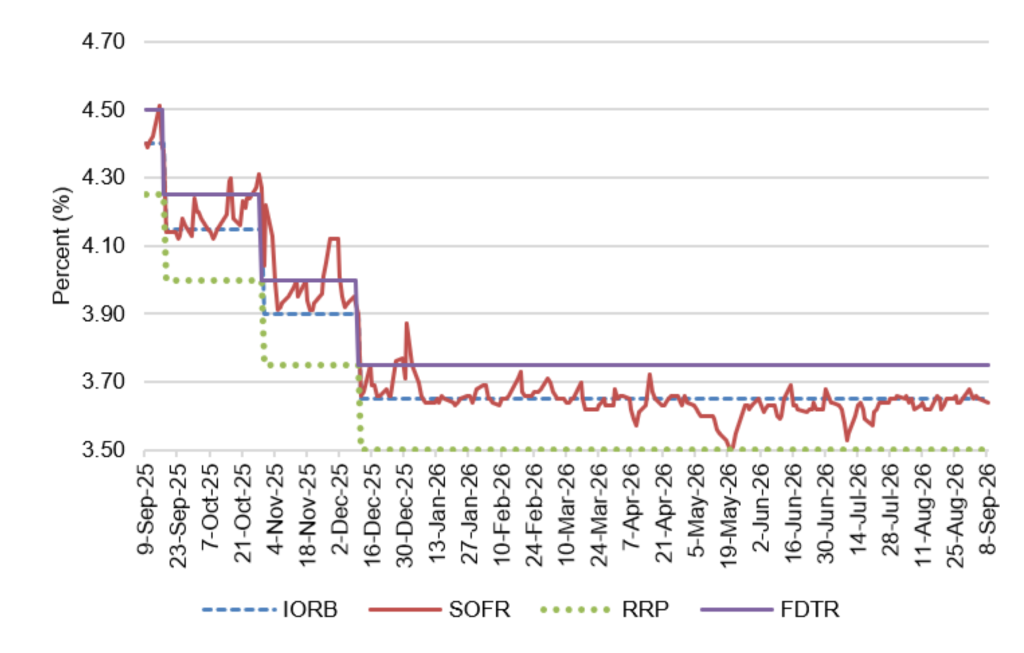
Record cash in money funds and healthy bank reserves are making financing easy, and that sets the foundation for this market. Balances at money funds started September at a record $7.97 trillion. Bank reserves—rising since the Fed started buying T-bills last December—stand at $3.05 trillion. Not all of this flows into repo, but enough of it does to keep SOFR at or below the rate the Fed pays on reserves (Exhibit 1). Along with current repo haircuts running at or below their 1-year average lately and a rising share of triparty repo with 30-day or longer maturities, it adds up to relatively easy money. And easy repo helps markets squeeze out excess spread.
Exhibit 1: SOFR at or below IORB, a sign of easy money:
Source: Bloomberg, Santander US Capital Markets
Strong flows into bond funds
Demand from bond funds keeps getting stoked by another flow of cash. Through August, bond ETFs and active funds added $623 billion in AUM, more than double the amount over the same period last year (Exhibit 2). Although ETFs usually allocate new cash in line with index weightings, active funds tend to allocate heavily to risk assets, especially MBS and structured credit. Current high yields are likely to keep the cash coming and the asset manager bid for risk strong.
Exhibit 2: YTD inflows to bond funds have doubled from last year
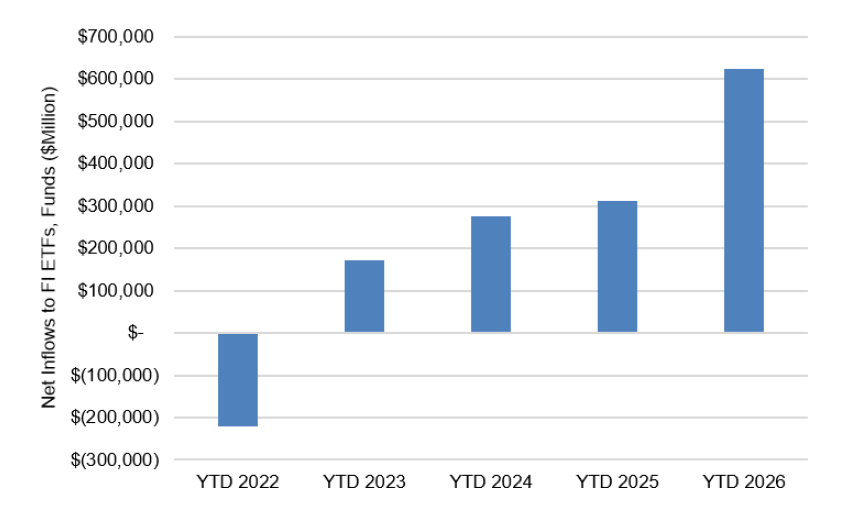
Note: Cumulative inflows to bond ETFs and mutual funds January through August.
Source: ICI, Santander US Capital Markets
Demand from insurers funded by annuities
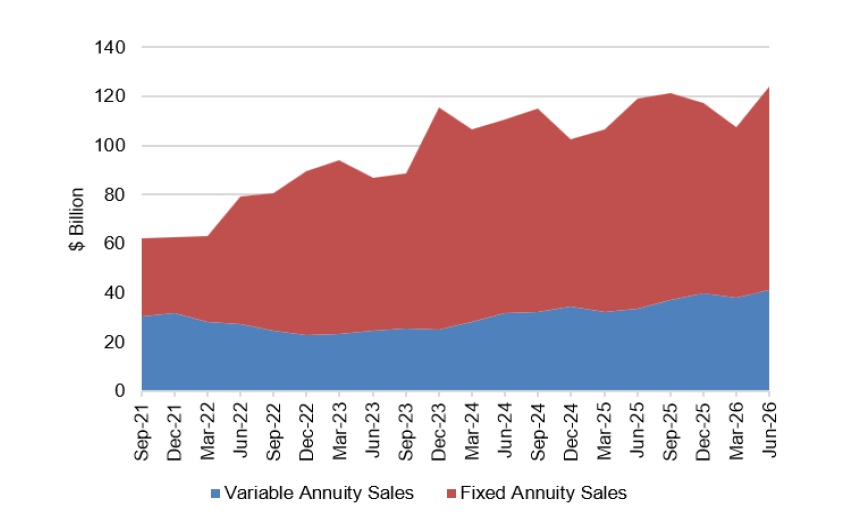
Insurers are getting new investable cash from annuity sales and putting most of it in corporate and structured credit. Fixed annuity sales have jumped around 2.5 times since the Fed started raising interest rates in 2022 (Exhibit 3). Sales through June this year set a new first-half-of-the-year record. Annuity portfolios now make up more than half the assets managed by the average US life insurer, according to LIMRA, an insurance trade association. Insurers broadly attribute the surge to higher yields, raising the possibility that sales will get another boost from this year’s higher interest rates.
Exhibit 3: Annuity sales keep running at record levels
Source: LIMRA, Santander US Capital Markets
Heavy foreign buying of corporate and structured credit
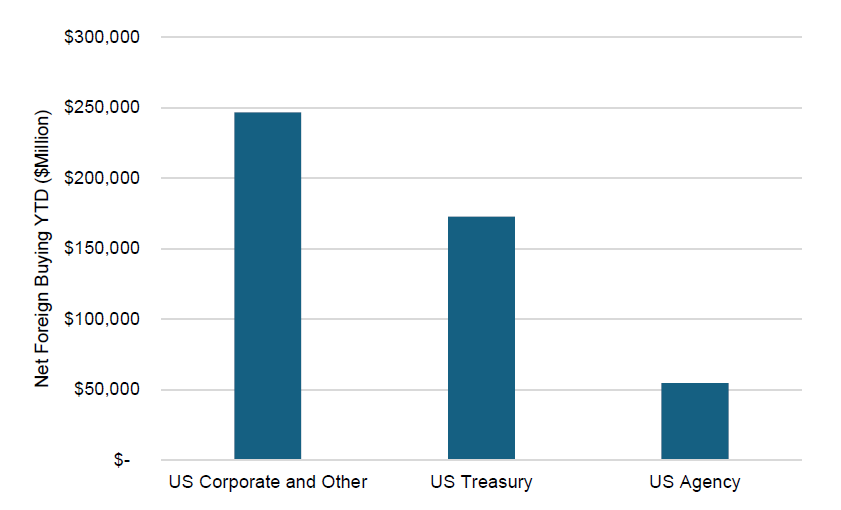
Foreign cash also is hitting US debt markets with $922 billion in net buying through June, according to Treasury, most of it in corporate and structured credit. Foreign portfolios bought $247 billion in credit, $173 billion in Treasury debt and $55 billion in agency debt and MBS (Exhibit 4). Foreign portfolios cover a lot of territory from central banks, commercial banks, insurers, money managers and hedge funds, so it is hard to pinpoint where this demand may go next. But the appetite for credit is clear.
Exhibit 4: Foreign demand for US debt has favored corporate, structured credit
Source: Treasury International Capital System, Santander US Capital Markets
Tight spreads in most places imply demand is keeping pace with supply
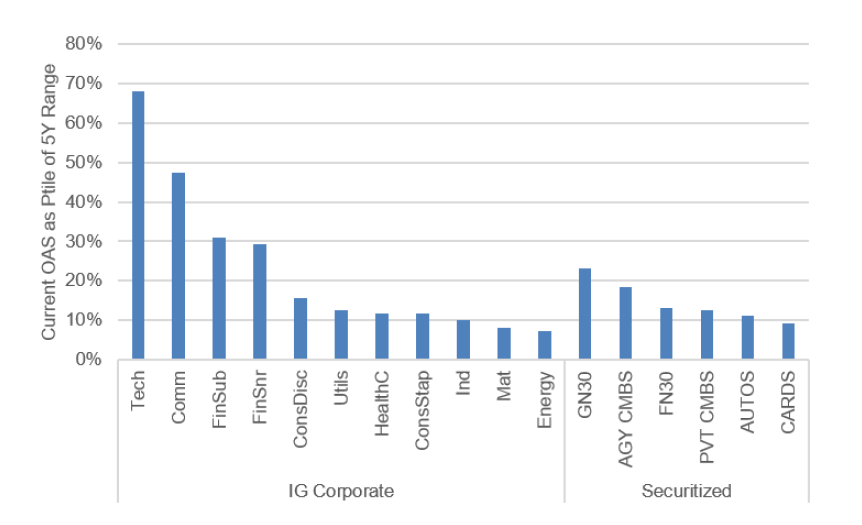
All of this adds up to steady demand for risk assets, corporate and structured credit especially, making current tight spreads no surprise. Every major category of investment grade credit or securitized products is trading at a spread well below the median of the last five years except for technology, with communications just below the median (Exhibit 5). The outsized supply in tech largely explains the wide spreads there, and communications includes Meta and SpaceX, which are also issuing heavy amounts of debt to fund AI and other projects.
Exhibit 5: Tight spreads in most debt sectors implies plenty of demand
Source: Bloomberg, Santander US Capital Markets
This is not to ignore fundamentals. Growth continues, the economy has been resilient. Spreads should be on the tight side.
Outright cash and inflows create ballast for the risk markets. Even though rising real rates have created volatility in the long end of the yield curve, the bid from portfolios that need risk assets have kept spreads much more stable. That is the new normal. If higher absolute rates turn up the volume of flows into mutual funds and annuities, the bid for risk could get stronger
* * *
The view in rates
The market is pricing 41 bp of Fed tightening by the end of 2026 and another 41 bp by September 2027. Implied tightening next year is the latest twist in market opinion. A hawkish Jackson Hole speech by Fed Chair Warsh and a hot August CPI has convinced investors that the Fed will need to tighten more than just a little bit to finally bring inflation down to the 2% target. That should put a floor on the front end of the curve at 4.00% into 2028.
The 10-year Treasury note will likely spend more time above 4.40% than below it for the rest of the year with a floor of 4.25% well into 2027. Technology companies’ and government demand for cash is likely to keep longer-term rates high even if the Fed dampens inflation. If anything, tech demand to borrow is likely to get even higher next year and put more pressure on real rates. A break in the AI rally could hit credit and the broader economy and lead recession to take rates through these floors, but that possibility looks remote.
Key market levels:
- Three-month term SOFR traded Friday at 386 bp, up 13 bp since mid-August.
- The 2-year Treasury note traded Friday at 4.63%, up 39 bp since mid-August. The 10-year note traded at 4.96%, up 23 bp despite Treasury Secretary Bessent’s recent Treasury buybacks and warnings to investors not to trade against him in the yen markets.
- The Treasury yield curve traded Friday with the 2s10s spread at 33 bp, 16 bp flatter since mid-August, and 5s10s spread at 57 bp, 28 bp flatter.
- The 10-year inflation breakeven traded Friday at 236 bp, up 3 bp since mid-August. The 5-year, 5-year forward breakeven was 230 bp, down 2 bp. The 10-year real rate ended the week at 260 bp, up 20 bp.
The view in spreads
The supply-demand balance looks neutral to bullish for corporate and structured credit—except for technology—and neutral to negative for MBS. Fixed income ETFs and mutual funds keep seeing strong inflows and investing the new cash in risk assets. Insurers continue to issue annuities and buy corporate and structured credit. Foreign investors are buying more US credit than government debt. But credit markets face heavy financing needs for capital investment in technology. MBS net supply remains low, but the expected steady demand from Fannie Mae and Freddie Mac has not materialized. Carry will likely drive returns. Stay overweight MBS and favor higher coupons to add carry and reduce spread duration. Stay overweight corporate credit overall but underweight technology.
The Bloomberg US investment-grade corporate bond index option-adjusted spread traded Friday at 78 bp, 2 bp tighter since mid-August. Nominal par 30-year MBS spreads to a blend of 5- and 10-year Treasury yields were 115 bp, 3 bp wider. Par 30-year MBS Treasury option-adjusted spreads closed at 30 bp, wider by 6 bp through mid-August.
The view in credit
The picture here remains surprisingly steady. Most credit is fundamentally sound, although persistent high rates should put pressure on more leveraged balance sheets. Large companies have healthier balance sheets than smaller ones. Middle- and higher-income consumers also carry relatively little debt and have strong liquidity and wealth. Bank lending to nonbank financial institutions, including private debt funds and business development companies, continues to grow. Regulators remain focused on this lending, which could eventually tighten private credit markets. For now, however, credit measures for nonbank financial lending remain stronger than those for traditional bank lending, such as commercial and industrial loans.