The Big Idea
Come on, baby, let’s do the twist
This material is a Marketing Communication and does not constitute Independent Investment Research.
US Treasury Secretary Scott Bessent wants lower US rates and has been working on it lately. Buy back longer debt, issue less of it, help prop up the yen so Japan doesn’t have to sell its US Treasuries. These things are in play. But as my colleague Stephen Stanley also points out, a growing federal deficit leaves Bessent funding more with Treasury bills. And the more he uses bills, the faster the days of somewhat predictable funding costs fade into the rearview mirror.
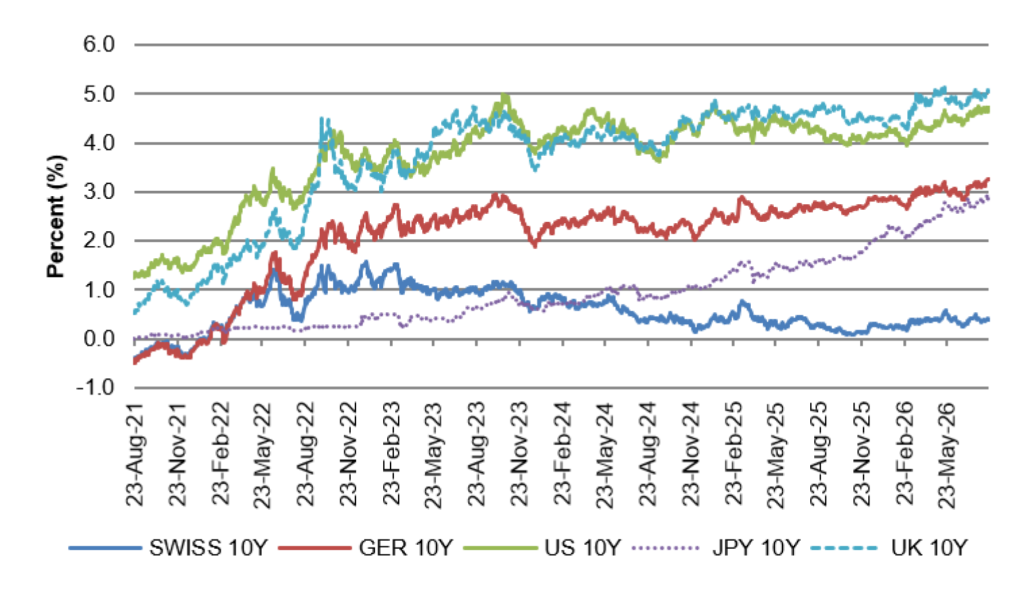
Bessent is fighting powerful forces. Longer rates are rising worldwide roughly in line with fiscal balances. The International Monetary Fund shows the US with a 2025 primary fiscal deficit at 3.67% of GDP, Germany’s at 2.83%, the UK’s at 1.23% and Japan’s at 0.9%. All have seen longer rates rise (Exhibit 1). Only Switzerland has seen longer rates fall or hold steady. It also happens to be the only benchmark country with a 2025 fiscal surplus at 0.3% of GDP. The debt needed to fund these governments also now has to compete with a surge in longer technology company debt issued to help build AI (see here, here and here).
Exhibit 1: Longer rates rise roughly in line with fiscal balances
Source: Bloomberg, Santander US Capital Markets
Bessent may need to go full Operation Twist—way beyond where he is now—to win this one, but it would likely come at the cost of predictability in US interest expense. In the nearly two decades ending in mid-2025, the standard deviation of new T-bill yields was more than twice that of 30-year bonds and more than 1.3 times that of 10-year notes (Exhibit 2). Even though T-bills have cost less on average than the longest debt, they occasionally have cost more. Yields on 3-month bills topped 30-year bonds from November 2022 through December 2024. At its peak in July 2023, 3-month yields ran 157 bp above the bonds. Rolling over T-bills would leave the government at the whim of all the forces that determine short rates.
Exhibit 2: T-bill may have lower average cost, but much higher volatility
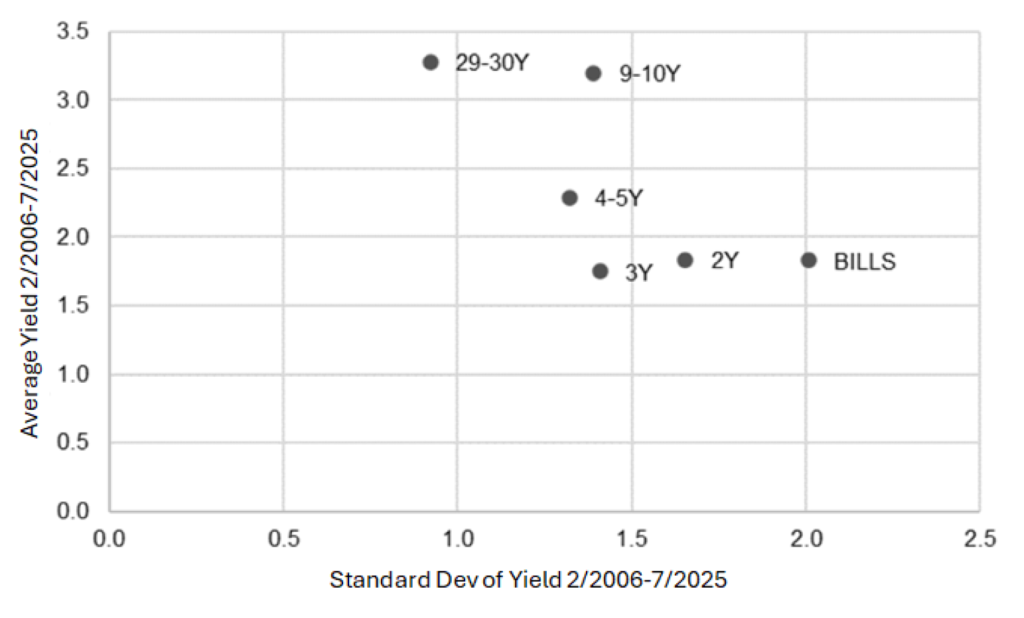
Note: Yields based on Treasury auction results from February 2006 to July 2025. Prices on bills are converted into bond-equivalent yields.
Source: Treasury Securities Auction Data, Santander US Capital Markets.
Of course, one of the biggest forces determining short rates is the Fed. Raising the share of T-bills needed to fund the government would make the Fed an increasing influence on interest expense. Fed policy would end up raising the cost of federal spending in hot economies and lowering it in cool ones. That could create a new channel for monetary policy and give the Fed even more power than it has now, an ironic outcome for an administration that has tried to narrow the Fed’s scope.
Of course, we are far from full Operation Twist for now, and Bessent almost certainly realizes the risks of going in that direction. But he has sent signals in recent weeks that it is a possibility. And the market has to take that possibility seriously, no matter how remote. Bessent, in fact, is counting on it.
* * *
The view in rates
The market is pricing 27 bp of Fed tightening by the end of 2026 and a steady Fed beyond. That should put a floor on the front end of the curve at 4.00% well into 2027. The 10-year Treasury note will likely spend more time above 4.40% than below it for the rest of the year with a floor of 4.25% well into 2027. A recession could break through those floors, but that possibility is remote. Technology companies’ and government demand for cash is likely to keep longer-term rates high.
Key market levels:
- Three-month term SOFR was set Friday at 374 bp, unchanged in a week.
- The 2-year Treasury note traded Friday at 4.24%, up 7 bp in a week. The 10-year note traded at 4.73%, up 4 bp despite Bessent’s signals of Treasury buybacks.
- The Treasury yield curve traded Friday with the 2s10s spread at 49 bp, 3 bp flatter on the week, and 5s10s spread at 85 bp, 5 bp flatter.
- The 10-year inflation breakeven traded Friday at 233 bp, up 5 bp in a week. The 5-year, 5-year forward breakeven was 232 bp, up 1 bp. The 10-year real rate ended the week at 240 bp, down 1 bp.
The view in spreads
The supply-demand balance looks neutral to negative for MBS, neutral for corporate debt overall and especially weak for technology debt. MBS net supply remains low, but the expected steady demand from Fannie Mae and Freddie Mac has not appeared. Insurers continue to issue annuities and buy corporate and structured credit, but credit markets face heavy financing needs for capital investment. In risk assets. Carry will likely drive returns. Stay overweight MBS and favor higher coupons to add carry and reduce spread duration. Stay overweight corporate credit overall but underweight technology.
The Bloomberg US investment-grade corporate bond index option-adjusted spread traded Friday at 80 bp, 2 bp wider on the week. Nominal par 30-year MBS spreads to a blend of 5- and 10-year Treasury yields were 112 bp, 3 bp wider. Par 30-year MBS treasury option-adjusted spreads closed at 24 bp, wider by 1 bp on the week.
The view in credit
Most credit is fundamentally sound, although persistent high rates should put pressure on more leveraged balance sheets. Large companies have healthier balance sheets than smaller ones. Middle- and higher-income consumers also carry relatively little debt and have strong liquidity and wealth. Bank lending to nonbank financial institutions, including private debt funds and business development companies, continues to grow. Regulators remain focused on this lending, which could eventually tighten private credit markets. For now, however, credit measures for nonbank financial lending remain stronger than those for traditional bank lending, such as commercial and industrial loans.
This material is intended only for institutional investors and does not carry all of the independence and disclosure standards of retail debt research reports. In the preparation of this material, the author may have consulted or otherwise discussed the matters referenced herein with one or more of SCM’s trading desks, any of which may have accumulated or otherwise taken a position, long or short, in any of the financial instruments discussed in or related to this material. Further, SCM may act as a market maker or principal dealer and may have proprietary interests that differ or conflict with the recipient hereof, in connection with any financial instrument discussed in or related to this material.
This message, including any attachments or links contained herein, is subject to important disclaimers, conditions, and disclosures regarding Electronic Communications, which you can find at https://portfolio-strategy.apsec.com/sancap-disclaimers-and-disclosures.
Important Disclaimers
Copyright © 2026 Santander US Capital Markets LLC and its affiliates (“SCM”). All rights reserved. SCM is a member of FINRA and SIPC. This material is intended for limited distribution to institutions only and is not publicly available. Any unauthorized use or disclosure is prohibited.
In making this material available, SCM (i) is not providing any advice to the recipient, including, without limitation, any advice as to investment, legal, accounting, tax and financial matters, (ii) is not acting as an advisor or fiduciary in respect of the recipient, (iii) is not making any predictions or projections and (iv) intends that any recipient to which SCM has provided this material is an “institutional investor” (as defined under applicable law and regulation, including FINRA Rule 4512 and that this material will not be disseminated, in whole or part, to any third party by the recipient.
The author of this material is an economist, desk strategist or trader. In the preparation of this material, the author may have consulted or otherwise discussed the matters referenced herein with one or more of SCM’s trading desks, any of which may have accumulated or otherwise taken a position, long or short, in any of the financial instruments discussed in or related to this material. Further, SCM or any of its affiliates may act as a market maker or principal dealer and may have proprietary interests that differ or conflict with the recipient hereof, in connection with any financial instrument discussed in or related to this material.
This material (i) has been prepared for information purposes only and does not constitute a solicitation or an offer to buy or sell any securities, related investments or other financial instruments, (ii) is neither research, a “research report” as commonly understood under the securities laws and regulations promulgated thereunder nor the product of a research department, (iii) or parts thereof may have been obtained from various sources, the reliability of which has not been verified and cannot be guaranteed by SCM, (iv) should not be reproduced or disclosed to any other person, without SCM’s prior consent and (v) is not intended for distribution in any jurisdiction in which its distribution would be prohibited.
In connection with this material, SCM (i) makes no representation or warranties as to the appropriateness or reliance for use in any transaction or as to the permissibility or legality of any financial instrument in any jurisdiction, (ii) believes the information in this material to be reliable, has not independently verified such information and makes no representation, express or implied, with regard to the accuracy or completeness of such information, (iii) accepts no responsibility or liability as to any reliance placed, or investment decision made, on the basis of such information by the recipient and (iv) does not undertake, and disclaims any duty to undertake, to update or to revise the information contained in this material.
Unless otherwise stated, the views, opinions, forecasts, valuations, or estimates contained in this material are those solely of the author, as of the date of publication of this material, and are subject to change without notice. The recipient of this material should make an independent evaluation of this information and make such other investigations as the recipient considers necessary (including obtaining independent financial advice), before transacting in any financial market or instrument discussed in or related to this material.
Important disclaimers for clients in the EU and UK
This publication has been prepared by Trading Desk Strategists within the Sales and Trading functions of Santander US Capital Markets LLC (“SanCap”), the US registered broker-dealer of Santander Corporate & Investment Banking. This communication is distributed in the EEA by Banco Santander S.A., a credit institution registered in Spain and authorised and regulated by the Bank of Spain and the CNMV. Any EEA recipient of this communication that would like to affect any transaction in any security or issuer discussed herein should do so with Banco Santander S.A. or any of its affiliates (together “Santander”). This communication has been distributed in the UK by Banco Santander, S.A.’s London branch, authorised by the Bank of Spain and subject to regulatory oversight on certain matters by the Financial Conduct Authority (FCA) and the Prudential Regulation Authority (PRA).
The publication is intended for exclusive use for Professional Clients and Eligible Counterparties as defined by MiFID II and is not intended for use by retail customers or for any persons or entities in any jurisdictions or country where such distribution or use would be contrary to local law or regulation.
This material is not a product of Santander´s Research Team and does not constitute independent investment research. This is a marketing communication and may contain ¨investment recommendations¨ as defined by the Market Abuse Regulation 596/2014 ("MAR"). This publication has not been prepared in accordance with legal requirements designed to promote the independence of research and is not subject to any prohibition on dealing ahead of the dissemination of investment research. The author, date and time of the production of this publication are as indicated herein.
This publication does not constitute investment advice and may not be relied upon to form an investment decision, nor should it be construed as any offer to sell or issue or invitation to purchase, acquire or subscribe for any instruments referred herein. The publication has been prepared in good faith and based on information Santander considers reliable as of the date of publication, but Santander does not guarantee or represent, express or implied, that such information is accurate or complete. All estimates, forecasts and opinions are current as at the date of this publication and are subject to change without notice. Unless otherwise indicated, Santander does not intend to update this publication. The views and commentary in this publication may not be objective or independent of the interests of the Trading and Sales functions of Santander, who may be active participants in the markets, investments or strategies referred to herein and/or may receive compensation from investment banking and non-investment banking services from entities mentioned herein. Santander may trade as principal, make a market or hold positions in instruments (or related derivatives) and/or hold financial interest in entities discussed herein. Santander may provide market commentary or trading strategies to other clients or engage in transactions which may differ from views expressed herein. Santander may have acted upon the contents of this publication prior to you having received it.
This publication is intended for the exclusive use of the recipient and must not be reproduced, redistributed or transmitted, in whole or in part, without Santander’s consent. The recipient agrees to keep confidential at all times information contained herein.