By the Numbers
Agency-eligible loans increasingly flow to private-label securities
This material is a Marketing Communication and does not constitute Independent Investment Research.
Mortgage lenders are increasingly bypassing Fannie Mae and Freddie Mac to package agency-eligible loans into private-label securities, a sign that private markets offer some originators better economics than the government-sponsored enterprises. Issuance has reached $13 billion this year, nearly twice the total for all of last year and the most since 2021. Issuers have different motives. Some retain deeply subordinated credit bonds, effectively insuring themselves against potential losses. Others seek higher prices than GSE execution offers because of possible mispricing of credit risk or convexity. The private-label market also could provide larger originators a backstop if structural changes tied to GSE privatization weaken to-be-announced, or TBA, prices.
Agency-eligible PLS issuance surges
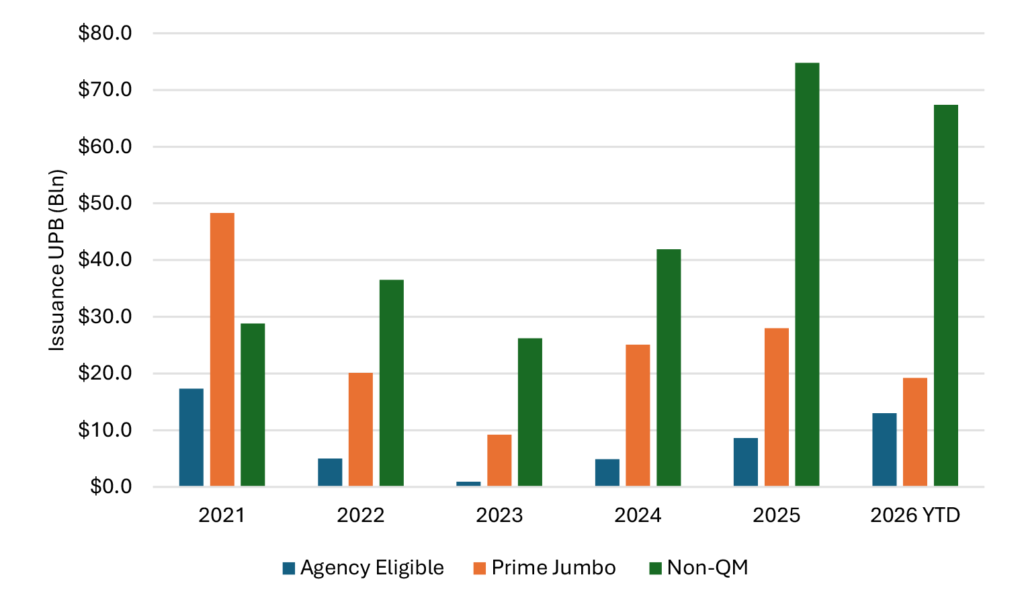
Through the first seven months of 2026, private-label issuance backed by loans underwritten to GSE delivery standards has topped $13 billion, well ahead of recent years. The last time securitizations backed by agency-eligible collateral exceeded that mark was 2021, when more than $17 billion in agency loans were sold in the private-label market (Exhibit 1). But the market has changed sharply in five years. The earlier increase came after former Federal Housing Finance Agency Director Mark Calabria moved to cap the volume of investor and second home loans an originator could deliver to the GSEs. Those limits forced some originators to use the private-label market for loans above the cap. Originators and securitization sponsors face no such restrictions today; they are choosing the private-label channel.
Exhibit 1: Agency-eligible PLS issuance is highest since 2021
Source: Santander US Capital Markets, CreditFlow
Why would an originator bypass the GSEs?
Mortgage originators look for best execution. For GSE-eligible loans, private-label financing generally makes sense only if it produces a higher price than TBA or specified-pool execution. A key factor is the amount and cost of required credit enhancement. Although private-label markets can price credit risk precisely and efficiently, that is only one part of the calculation. Sponsors also must weigh specified-pool premiums, ‘AAA’ spreads, the value of excess interest and issuance costs.
Sponsors evaluating GSE and private-label execution also must consider:
- The TBA dollar roll. “Specialness” in the dollar roll — when the financing cost implied by the difference between spot and forward-month TBA contract prices is below market rates — can alter the economics. A special dollar roll affects both TBA and specified-pool execution. Specified-pool premiums tend to fall as the corresponding TBA roll strengthens.
- The structure of credit enhancement. For loans delivered to the GSEs, credit enhancement is funded through the loan’s interest as a continuing guarantee fee. In private-label mortgage-backed securities, it is funded through principal subordination. As valuations of a loan’s principal and interest components change, so does the best execution.
- Market depth. Heavy private-label issuance has widened spreads, particularly at the top of the capital structure, where the investor base for AAA securities remains relatively thin.
Is private-label execution more profitable?
Comparing private-label and agency execution depends on several assumptions. The cost of private-label credit enhancement — measured as the average spread at which the credit-sensitive portion of the capital structure is sold — can vary and be difficult to determine. Rating agency and legal expenses, accounting costs, and structuring and placement fees also vary. On the agency side, loan-level price adjustments, or LLPAs, and coupon buy-up or buy-down multiples can affect execution.
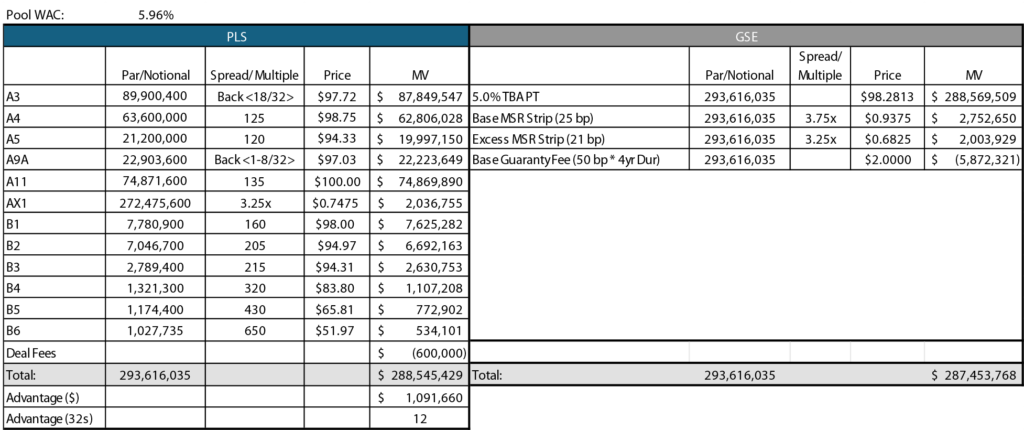
With those caveats, a simplified review of a recent transaction, CHASE 2026-AGY1, suggests a modest advantage for sponsors that securitize agency-conforming loans in private-label trusts. The private-label analysis uses widely distributed prices for the syndicated portion of the capital structure, estimates for the auctioned subordinate and interest-only bonds, and a conservative estimate of transaction costs. It excludes structuring and placement fees (Exhibit 2).
Exhibit 2: Comparing agency and private-label execution
Source: Santander US Capital Markets, Creditflow, Bloomberg LP
The agency analysis uses the TBA price on the deal’s pricing date, 25 bp of base servicing valued at 3.75 times the coupon, and 21 bp of excess servicing valued at 3.25 times the coupon. It then subtracts a 50 bp base guarantee fee over an assumed four-year duration for the underlying loan pool. The analysis does not estimate LLPA delivery charges, which could reach 50 bp or more at the loan level because just under 45% of the pool has a loan-to-value ratio of 80% or greater. The estimated 12/32-point PLS advantage therefore could increase after LLPAs. Applying a half-point LLPA over four years to 40% of the pool would raise the PLS advantage above 1 percentage point, though structuring and placement fees could partly offset it.
Why issuers are choosing private-label execution
Whether this year’s surge is temporary or lasting should depend largely on relative economics. As long as private-label markets offer better execution or greater flexibility than the GSE channel, sponsors will have more reason to bypass the traditional agency market. Higher prices in the far less liquid private-label market could indicate that originators pay too much in agency MBS to insure against credit losses, receive too little for their loans’ convexity in current TBA pricing, or both. Private-label securitization also lets sponsors retain credit-sensitive parts of the capital structure, insure their own credit risk and generate leveraged returns. It also provides a backstop to the TBA market if structural changes tied to GSE privatization weaken TBA prices.
This material is intended only for institutional investors and does not carry all of the independence and disclosure standards of retail debt research reports. In the preparation of this material, the author may have consulted or otherwise discussed the matters referenced herein with one or more of SCM’s trading desks, any of which may have accumulated or otherwise taken a position, long or short, in any of the financial instruments discussed in or related to this material. Further, SCM may act as a market maker or principal dealer and may have proprietary interests that differ or conflict with the recipient hereof, in connection with any financial instrument discussed in or related to this material.
This message, including any attachments or links contained herein, is subject to important disclaimers, conditions, and disclosures regarding Electronic Communications, which you can find at https://portfolio-strategy.apsec.com/sancap-disclaimers-and-disclosures.
Important Disclaimers
Copyright © 2026 Santander US Capital Markets LLC and its affiliates (“SCM”). All rights reserved. SCM is a member of FINRA and SIPC. This material is intended for limited distribution to institutions only and is not publicly available. Any unauthorized use or disclosure is prohibited.
In making this material available, SCM (i) is not providing any advice to the recipient, including, without limitation, any advice as to investment, legal, accounting, tax and financial matters, (ii) is not acting as an advisor or fiduciary in respect of the recipient, (iii) is not making any predictions or projections and (iv) intends that any recipient to which SCM has provided this material is an “institutional investor” (as defined under applicable law and regulation, including FINRA Rule 4512 and that this material will not be disseminated, in whole or part, to any third party by the recipient.
The author of this material is an economist, desk strategist or trader. In the preparation of this material, the author may have consulted or otherwise discussed the matters referenced herein with one or more of SCM’s trading desks, any of which may have accumulated or otherwise taken a position, long or short, in any of the financial instruments discussed in or related to this material. Further, SCM or any of its affiliates may act as a market maker or principal dealer and may have proprietary interests that differ or conflict with the recipient hereof, in connection with any financial instrument discussed in or related to this material.
This material (i) has been prepared for information purposes only and does not constitute a solicitation or an offer to buy or sell any securities, related investments or other financial instruments, (ii) is neither research, a “research report” as commonly understood under the securities laws and regulations promulgated thereunder nor the product of a research department, (iii) or parts thereof may have been obtained from various sources, the reliability of which has not been verified and cannot be guaranteed by SCM, (iv) should not be reproduced or disclosed to any other person, without SCM’s prior consent and (v) is not intended for distribution in any jurisdiction in which its distribution would be prohibited.
In connection with this material, SCM (i) makes no representation or warranties as to the appropriateness or reliance for use in any transaction or as to the permissibility or legality of any financial instrument in any jurisdiction, (ii) believes the information in this material to be reliable, has not independently verified such information and makes no representation, express or implied, with regard to the accuracy or completeness of such information, (iii) accepts no responsibility or liability as to any reliance placed, or investment decision made, on the basis of such information by the recipient and (iv) does not undertake, and disclaims any duty to undertake, to update or to revise the information contained in this material.
Unless otherwise stated, the views, opinions, forecasts, valuations, or estimates contained in this material are those solely of the author, as of the date of publication of this material, and are subject to change without notice. The recipient of this material should make an independent evaluation of this information and make such other investigations as the recipient considers necessary (including obtaining independent financial advice), before transacting in any financial market or instrument discussed in or related to this material.
Important disclaimers for clients in the EU and UK
This publication has been prepared by Trading Desk Strategists within the Sales and Trading functions of Santander US Capital Markets LLC (“SanCap”), the US registered broker-dealer of Santander Corporate & Investment Banking. This communication is distributed in the EEA by Banco Santander S.A., a credit institution registered in Spain and authorised and regulated by the Bank of Spain and the CNMV. Any EEA recipient of this communication that would like to affect any transaction in any security or issuer discussed herein should do so with Banco Santander S.A. or any of its affiliates (together “Santander”). This communication has been distributed in the UK by Banco Santander, S.A.’s London branch, authorised by the Bank of Spain and subject to regulatory oversight on certain matters by the Financial Conduct Authority (FCA) and the Prudential Regulation Authority (PRA).
The publication is intended for exclusive use for Professional Clients and Eligible Counterparties as defined by MiFID II and is not intended for use by retail customers or for any persons or entities in any jurisdictions or country where such distribution or use would be contrary to local law or regulation.
This material is not a product of Santander´s Research Team and does not constitute independent investment research. This is a marketing communication and may contain ¨investment recommendations¨ as defined by the Market Abuse Regulation 596/2014 ("MAR"). This publication has not been prepared in accordance with legal requirements designed to promote the independence of research and is not subject to any prohibition on dealing ahead of the dissemination of investment research. The author, date and time of the production of this publication are as indicated herein.
This publication does not constitute investment advice and may not be relied upon to form an investment decision, nor should it be construed as any offer to sell or issue or invitation to purchase, acquire or subscribe for any instruments referred herein. The publication has been prepared in good faith and based on information Santander considers reliable as of the date of publication, but Santander does not guarantee or represent, express or implied, that such information is accurate or complete. All estimates, forecasts and opinions are current as at the date of this publication and are subject to change without notice. Unless otherwise indicated, Santander does not intend to update this publication. The views and commentary in this publication may not be objective or independent of the interests of the Trading and Sales functions of Santander, who may be active participants in the markets, investments or strategies referred to herein and/or may receive compensation from investment banking and non-investment banking services from entities mentioned herein. Santander may trade as principal, make a market or hold positions in instruments (or related derivatives) and/or hold financial interest in entities discussed herein. Santander may provide market commentary or trading strategies to other clients or engage in transactions which may differ from views expressed herein. Santander may have acted upon the contents of this publication prior to you having received it.
This publication is intended for the exclusive use of the recipient and must not be reproduced, redistributed or transmitted, in whole or in part, without Santander’s consent. The recipient agrees to keep confidential at all times information contained herein.