

The Big Idea
The dramatic shift at the Fed
Stephen Stanley | June 26, 2026
This material is a Marketing Communication and does not constitute Independent Investment Research.
A new Chair of the Fed has led to a sea change in the approach of the Federal Open Market Committee. Several details from the June FOMC led to a noticeable shift in the assessment of the policy outlook. There were three key developments that point toward a more hawkish path for the federal funds rate target—the dots, inflation projections and commitment to mandate.
Ascending dots
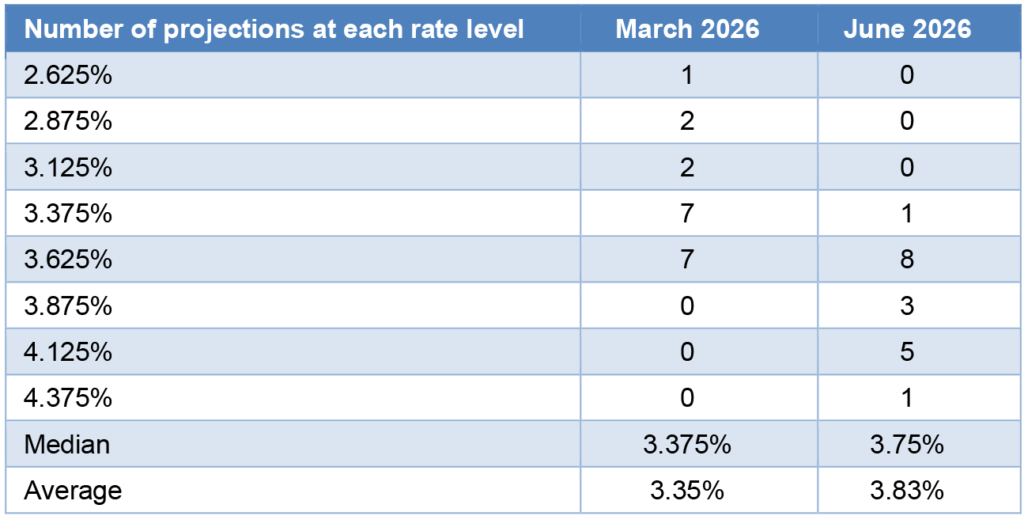
The consensus expectation going into the June FOMC meeting was that the median “dot,” the policy projections from FOMC participants, for 2026 would move up from calling for a single rate cut this year to no change in policy. However, the rise in the dots was significantly greater than anticipated (Exhibit 1).
Exhibit 1: FOMC Dot Projections for 2026
Source: Federal Reserve.
As the table shows, in March, the committee was split between those who thought that the Fed should remain on hold all year (the seven most hawkish officials) and those who thought the Fed should cut modestly (a majority of 12). Seven of the 12 projecting easing called for a single quarter-point cut, while five were expecting multiple cuts (the 2.625% dot belonged to Governor Miran, who is no longer on the FOMC). In March, not a single one of the 19 participants projected a rate hike this year.
In advance of the June FOMC meeting, I suspected that there would be a few doves calling for a rate cut or maybe two this year, a majority calling for no change, and a handful, maybe up to half a dozen, looking for a single rate hike.
Instead, the projections moved higher by significantly more than that. Of the 18 submissions, half called for a rate hike or hikes and half did not. Of the nine who did not expect an increase, eight called for no change, while a single “lonesome dove” forecast a rate cut. In contrast, of the nine projecting tightening, six called for multiple moves. There were three policymakers expecting a single rate hike, five looking for two moves, and one official calling for three hikes (there are only four more FOMC meetings this year).
As a result, the median dot moved from 3.375% to 3.75% (the middle two dots were split, with one at 3.625% and the other at 3.875%). Moreover, the average of the dots jumped by nearly 50 basis points in June, from 3.35% in March to 3.83%.
It is a little ironic that the shift in the dot projections reflects the views of the rest of the committee, not Chair Warsh. Warsh does not believe that the SEP projections in their current format are helpful and declined to offer his own forecasts.
Inflation projections
The increased urgency exhibited by the surprisingly large shift in the dot projections likely reflects two other developments from the June FOMC meeting. The first one is a sharp upward move in the FOMC inflation projections. The median inflation estimates for 2026, for both headline and core PCE inflation, were revised markedly. The Q4/Q4 expected advance for headline inflation went from 2.7% in March all the way to 3.6% in June. In my view, this may be a bit too much, though to be fair, as I write, I have the benefit of about 10 extra days, during which oil and gasoline prices have fallen significantly. The June Blue Chip Economic Survey, conducted in early June, had a median forecast of 3.7%. After the May PCE figures were released on Thursday, my estimate is only 3.1%, as I seem to have a much more optimistic assumption about the path of energy prices than most Fed officials and other private sector economists.
Similarly, the median FOMC projection for the core PCE deflator for 2026 on a Q4/Q4 basis jumped from 2.7% in March to 3.3%. This is in line with the June Blue Chip consensus and marginally below my estimate of 3.4%.
Given that Fed officials have extensively discussed temporary factors elevating inflation, most notably tariff-related passthrough and more recently the ripple effects of the energy price shock, it is not necessarily shocking that inflation estimates for this year are far above the 2% inflation target.
However, the upward movement for core inflation in 2027 was an even more telling development. The median FOMC projection for core PCE inflation next year moved from 2.2% in March to 2.5% in June. Again, the Fed’s forecasts are not that different from the private sector consensus. The June Blue Chip Economic Survey median was 2.3%, and I am currently calling for 2.4%. Nonetheless, I would judge the assessment of an overshoot of half a percentage point for core inflation next year, by which time the temporary factors noted just above should have dissipated, as a statement that the current policy stance is not getting the job done with regard to inflation.
Commitment to the mandate
The final striking feature of the June FOMC meeting was Chair Warsh’s heightened embrace of the Fed’s commitment to hitting its inflation target. Warsh noted that the Fed has missed the inflation target for five straight years. And I would add that it has not even been close. The lowest reading over the past five years has been 2.6%. He has consistently argued over the years that the Fed’s commitment to price stability is its most important job. And he has been clear that achieving 2% inflation is within the Fed’s power.
In contrast, for better or worse, Chair Powell and numerous other Fed officials have spent the past five years offering reasons why elevated inflation would taper off soon, once temporary factors subsided. A less charitable characterization would call this a litany of excuses as to why the inflation misses were not the Fed’s fault. The dialogue had begun to remind me of the Fed commentary in the 1970s. Those policymakers also constantly offered reasons for high inflation that were outside of the stance of monetary policy, and the Fed in that era never quite did enough to get prices under control.
In any case, Warsh emphatically declared that the FOMC takes its inflation mandate seriously, that it is capable of hitting its target, and that it will. Couple that with the projection that the five straight years of misses are likely to extend to six (2026) and probably seven (2027), and the obvious conclusion is that Warsh and the Fed intend to act forcefully, likely sooner rather than later.
Changing Fed call
On the back of these themes revealed at the June FOMC meeting, I made a significant change to my Fed call. I came into 2026 expecting the Fed to be on hold all of this year and to raise rates by 50 basis points in 2027. This forecast was driven by a set of economic estimates that called for well above-trend real GDP growth in both 2026 and 2027, a firming labor market, and stubbornly high underlying inflation. In contrast, the consensus at the time, including within the FOMC, was that real economic growth would be in line with trend, that the unemployment rate would be stuck around 4.5%, and that inflation would settle back to 2% once the temporary boost from tariff costs dissipated. As a result, the prevailing view was that the FOMC would ease modestly over the next two years, bringing the funds rate target in line with estimates of the longer-run neutral rate of around 3%. The median FOMC dots as late as March had one ease this year and one more next year.
The presumed inflationary impact of the Middle East conflict shifted thinking in the financial markets. Even before the June FOMC meeting, notwithstanding a sense that Kevin Warsh would probably lean dovishly, fed funds futures were beginning to price in some chance of a rate hike before year-end.
The renewed urgency with which Warsh signaled the Fed would attack inflation convinced me that the patience of policymakers has been exhausted. As a result, I look for the FOMC to accelerate the timetable of the modest rate-hiking needed to bring inflation to heel. I moved the two quarter-point hikes that I had previously penciled in for next year to September and December of this year, bringing the fed funds rate targets to 4.125% by year-end. I then have the Fed holding at that restrictive policy stance for all of 2027 in an effort to wring inflation pressures out of the economy.
Chair Warsh’s antipathy toward forward guidance leaves economists and financial market participants flying blind when it comes to the near-term policy outlook. The norm in the Yellen and Powell years had become that the FOMC would signal its intentions, particularly when it was looking to raise rates, well in advance in hopes of avoiding a disruptive surprise. Now, we are all left to guess about the committee’s intentions. The case that I have laid out here could just as easily justify immediate rate hikes, say in July and September, rather than my projection of September and December. I do not rule that out. There are two reasons that I expect the Fed to be slightly more cautious. First, officials may want to wait for the end of the 60-day period of the Memorandum of Understanding between the U.S. and Iran to see how developments evolve in the Middle East. Second, energy prices have already begun to come off sharply, and the next couple of monthly headline inflation readings are likely to be quite benign. Policymakers may want to see how, if at all, the reversal of energy prices impacts core inflation.
These factors point to the Fed acting soon but not necessarily urgently. Nonetheless, I would not be shocked by a July rate hike. I would also not rule out more rate hikes than what I currently have penciled in if inflation pressures prove harder to root out than I expect. The bottom line is that the Warsh FOMC appears to be very different than the Powell FOMC.