By the Numbers
Flatter yield curve could weigh on bank demand for MBS
This material is a Marketing Communication and does not constitute Independent Investment Research.
Bond investors showed some surprise at the hawkish tone of by the newly minted Federal Reserve Chair Kevin Warsh at his inaugural meeting this month. That surprise translated into a further bear flattening of the yield curve. The pronounced, continued flattening of the curve could further translate into weaker depository demand for pools. But past isn’t always prologue, and floating rate CMOs may continue to find favor with banks.
In the wake of the June FOMC, yields on the front end of the curve came under pressure, with 2-year yields higher by roughly 15 bp. The selloff pushed the spread between 2-and 10-year rates tighter by roughly 13 bp to just a 29 bp yield differential between the two benchmarks, the tightest it has been in more than a year. Spreads between 5- and 30-year yields tightened as well, falling from 78 bp to 65 bp. A flatter yield curve has historically spelled weaker bank demand for MBS from depositories as a flatter curve squeezes the net interest margin (NIM) between assets and liabilities, particularly in the securities book where wholesale bond purchases are more likely to be funded with liabilities with a higher beta to short-term rates than their book of core deposits.
The shape of the yield curve has been related to bank demand
Historically, the shape of the yield curve has been related to bank demand for MBS. Like any levered MBS investor, depositories can generate a better return on equity when asset yields substantially outstrip funding and hedging costs. Given the fact that banks often run a meaningful gap between the duration of their assets and liabilities, banks generally buy more when the curve is steep and less when the curve is flat (Exhibit 1).
Exhibit 1: Bank demand increases as the yield curve steepens
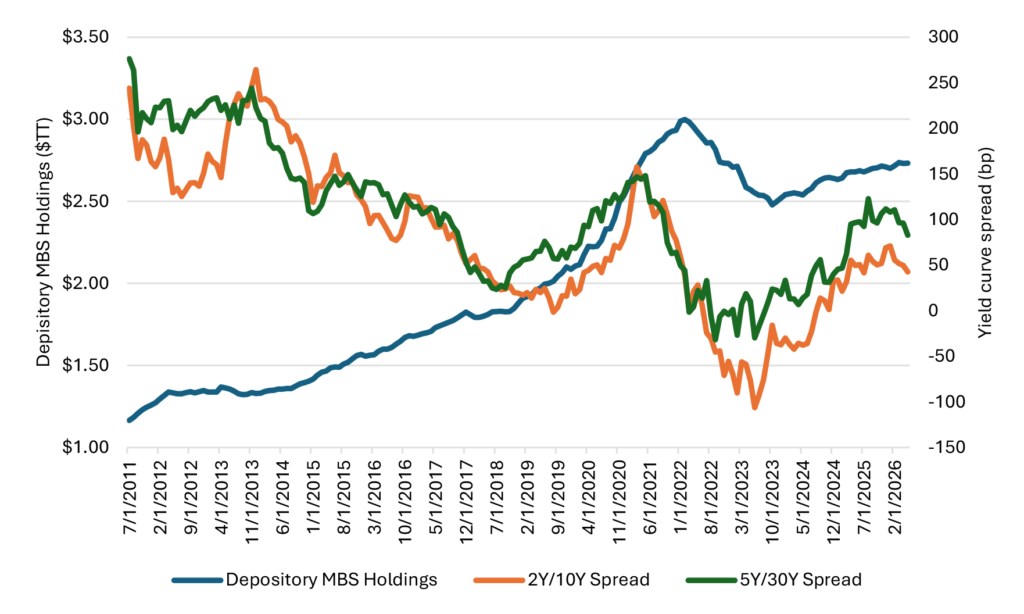
Source: Santander US Capital Markets, Federal Reserve H.8, Bloomberg LP
Admittedly, the shape of the yield curve is not the sole deciding factor that drives MBS demand from depositories. The absolute level of rates will play a role as well as there is a strong negative correlation between the level of rates and deposit growth, meaning that as rates fall, deposit growth tends to accelerate. This is largely attributable to the fact that depositors are more inclined to keep cash on deposit at a bank if the return on investing that cash is relatively low or the prospects of investments being worth less in the future is high.
Additional factors matter as well. The level of systemic liquidity has certainly helped shape bank demand in the past as evidenced during the Covid experience, where the Federal Reserve pumped upwards of $7 trillion of excess liquidity into the system. Most of the Covid liquidity found its way to bank balance sheets in the from of deposits and excess reserves, which banks invested in MBS against the backdrop of heightened economic uncertainty. That drove lending and credit availability to levels not seen since the aftermath of the Global Financial Crisis.
The counterpoint: Why banks may continue to buy…
Depositories’ MBS holdings have significantly retrenched from peak. In the third quarter of 2021, banks owned nearly 40% of the outstanding float of MBS. At the end of the first quarter, they owned slightly more than 30%, in line with pre-Covid readings. So while bank demand may not be particularly robust, it appears likely that, at a minimum, it will keep pace with any further growth in the MBS market (Exhibit 2).
Exhibit 2: Banks hold roughly 30% of all outstanding MBS, consistent with longer term trends
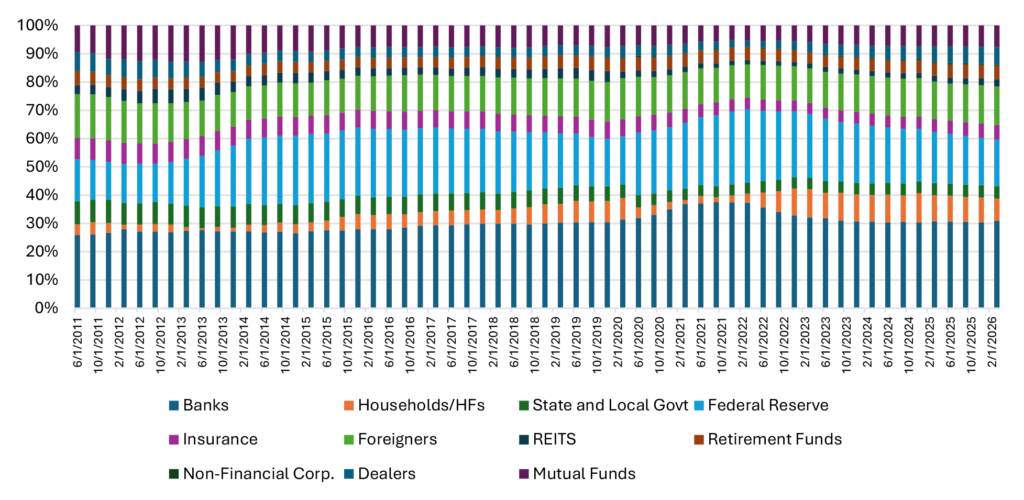
Source: Santander US Capital Markets, Federal Reserve Z.1. Flow of Funds Report
The role of banks’ investment portfolios has changed drastically in the wake of the failures of Silicon Valley, Signature and other smaller depositories in the first quarter of 2023. Larger depositories now view the investment portfolio more as a source of liquidity and interest rate management than a critical driver of earnings. Portfolios have been significantly de-risked, holding substantially more floating-rate and convex exposures than they did in the runup to these bank failures. Given this, the current paradigm of a front-end bear flattening of the yield curve may, somewhat counterintuitively, keep bank demand elevated, particularly for floating rate CMOs which could outperform pass-throughs if the curve flattens further.
This material is intended only for institutional investors and does not carry all of the independence and disclosure standards of retail debt research reports. In the preparation of this material, the author may have consulted or otherwise discussed the matters referenced herein with one or more of SCM’s trading desks, any of which may have accumulated or otherwise taken a position, long or short, in any of the financial instruments discussed in or related to this material. Further, SCM may act as a market maker or principal dealer and may have proprietary interests that differ or conflict with the recipient hereof, in connection with any financial instrument discussed in or related to this material.
This message, including any attachments or links contained herein, is subject to important disclaimers, conditions, and disclosures regarding Electronic Communications, which you can find at https://portfolio-strategy.apsec.com/sancap-disclaimers-and-disclosures.
Important Disclaimers
Copyright © 2026 Santander US Capital Markets LLC and its affiliates (“SCM”). All rights reserved. SCM is a member of FINRA and SIPC. This material is intended for limited distribution to institutions only and is not publicly available. Any unauthorized use or disclosure is prohibited.
In making this material available, SCM (i) is not providing any advice to the recipient, including, without limitation, any advice as to investment, legal, accounting, tax and financial matters, (ii) is not acting as an advisor or fiduciary in respect of the recipient, (iii) is not making any predictions or projections and (iv) intends that any recipient to which SCM has provided this material is an “institutional investor” (as defined under applicable law and regulation, including FINRA Rule 4512 and that this material will not be disseminated, in whole or part, to any third party by the recipient.
The author of this material is an economist, desk strategist or trader. In the preparation of this material, the author may have consulted or otherwise discussed the matters referenced herein with one or more of SCM’s trading desks, any of which may have accumulated or otherwise taken a position, long or short, in any of the financial instruments discussed in or related to this material. Further, SCM or any of its affiliates may act as a market maker or principal dealer and may have proprietary interests that differ or conflict with the recipient hereof, in connection with any financial instrument discussed in or related to this material.
This material (i) has been prepared for information purposes only and does not constitute a solicitation or an offer to buy or sell any securities, related investments or other financial instruments, (ii) is neither research, a “research report” as commonly understood under the securities laws and regulations promulgated thereunder nor the product of a research department, (iii) or parts thereof may have been obtained from various sources, the reliability of which has not been verified and cannot be guaranteed by SCM, (iv) should not be reproduced or disclosed to any other person, without SCM’s prior consent and (v) is not intended for distribution in any jurisdiction in which its distribution would be prohibited.
In connection with this material, SCM (i) makes no representation or warranties as to the appropriateness or reliance for use in any transaction or as to the permissibility or legality of any financial instrument in any jurisdiction, (ii) believes the information in this material to be reliable, has not independently verified such information and makes no representation, express or implied, with regard to the accuracy or completeness of such information, (iii) accepts no responsibility or liability as to any reliance placed, or investment decision made, on the basis of such information by the recipient and (iv) does not undertake, and disclaims any duty to undertake, to update or to revise the information contained in this material.
Unless otherwise stated, the views, opinions, forecasts, valuations, or estimates contained in this material are those solely of the author, as of the date of publication of this material, and are subject to change without notice. The recipient of this material should make an independent evaluation of this information and make such other investigations as the recipient considers necessary (including obtaining independent financial advice), before transacting in any financial market or instrument discussed in or related to this material.
Important disclaimers for clients in the EU and UK
This publication has been prepared by Trading Desk Strategists within the Sales and Trading functions of Santander US Capital Markets LLC (“SanCap”), the US registered broker-dealer of Santander Corporate & Investment Banking. This communication is distributed in the EEA by Banco Santander S.A., a credit institution registered in Spain and authorised and regulated by the Bank of Spain and the CNMV. Any EEA recipient of this communication that would like to affect any transaction in any security or issuer discussed herein should do so with Banco Santander S.A. or any of its affiliates (together “Santander”). This communication has been distributed in the UK by Banco Santander, S.A.’s London branch, authorised by the Bank of Spain and subject to regulatory oversight on certain matters by the Financial Conduct Authority (FCA) and the Prudential Regulation Authority (PRA).
The publication is intended for exclusive use for Professional Clients and Eligible Counterparties as defined by MiFID II and is not intended for use by retail customers or for any persons or entities in any jurisdictions or country where such distribution or use would be contrary to local law or regulation.
This material is not a product of Santander´s Research Team and does not constitute independent investment research. This is a marketing communication and may contain ¨investment recommendations¨ as defined by the Market Abuse Regulation 596/2014 ("MAR"). This publication has not been prepared in accordance with legal requirements designed to promote the independence of research and is not subject to any prohibition on dealing ahead of the dissemination of investment research. The author, date and time of the production of this publication are as indicated herein.
This publication does not constitute investment advice and may not be relied upon to form an investment decision, nor should it be construed as any offer to sell or issue or invitation to purchase, acquire or subscribe for any instruments referred herein. The publication has been prepared in good faith and based on information Santander considers reliable as of the date of publication, but Santander does not guarantee or represent, express or implied, that such information is accurate or complete. All estimates, forecasts and opinions are current as at the date of this publication and are subject to change without notice. Unless otherwise indicated, Santander does not intend to update this publication. The views and commentary in this publication may not be objective or independent of the interests of the Trading and Sales functions of Santander, who may be active participants in the markets, investments or strategies referred to herein and/or may receive compensation from investment banking and non-investment banking services from entities mentioned herein. Santander may trade as principal, make a market or hold positions in instruments (or related derivatives) and/or hold financial interest in entities discussed herein. Santander may provide market commentary or trading strategies to other clients or engage in transactions which may differ from views expressed herein. Santander may have acted upon the contents of this publication prior to you having received it.
This publication is intended for the exclusive use of the recipient and must not be reproduced, redistributed or transmitted, in whole or in part, without Santander’s consent. The recipient agrees to keep confidential at all times information contained herein.