The Long and Short
Verizon shifts to hybrids in cap structure
This material is a Marketing Communication and does not constitute Independent Investment Research.
Verizon Communications (VZ: Baa1/BBB+/A-) made its first foray into the US dollar hybrid market launching two tranches of junior subordinated debt this week. The deal contained new features to entice a broader audience of investors with potential extension risk concerns. While most recent new issues have provided coupon floors, these new structures give issuers further incentives to redeem bonds at the first call date. Revisiting pricing models can help see how the new bonds figure into the landscape and improve security selection across the segment’s various cohorts.
Two hot inflation reports over the past week have contributed to further upward pressure on base rates in recent trading sessions. The conflict in Iran and related oil price spikes have stoked inflation concerns for the past two months, with investors pricing in the higher likelihood of future rate hikes. The environment has had various knock-on effects that require close consideration when valuing callable hybrid securities. More recently, credit spreads have persistently moved tighter, despite ongoing geopolitical and risk and private credit concerns. Similarly, the aggregate spread between junior subordinated hybrid securities to commensurate senior bullet securities has only gotten tighter over the past several months.
With rate uncertainty, non-bank hybrid investors continue to target higher-quality structures featuring either high back-end protection or the coupon floors of newer securities to seek out negative convexity. This continues to create relative value opportunities in some of the more aged vintages, where moderate call protection coincides with the most attractive spread and yield compensation.
Verizon appears to be prioritizing their capital structure with emphasis on hybrid securities while cleaning up some of their older legacy senior unsecured debt obligations through exchange offer. The company has already launched hybrid deals in other currencies. On Monday, VZ priced a $4 billion two-tranche hybrid debt deal: a $2 billion 32NC7 at 6.05% versus initial price talk of 6.50%, and a $2 billion 30NC10 at 6.2% versus IPT of 6.625%. Most issuers opt for a 30NC5 tranche, but VZ appeared to choose the 32NC7 to enhance the duration of 50% equity credit from the rating agencies while also providing investors with a longer fixed-rate period and more spread duration than usual. Instead of a typical coupon floor at the first call date, the 32NC7s contain a +25 bp coupon step in year 12 plus an additional 75 bp in year 27 for +100 bp cumulative. The 30NC10 tranche contains a +25 bp step up in year 10. Both VZ tranches have performed extremely well since launch.
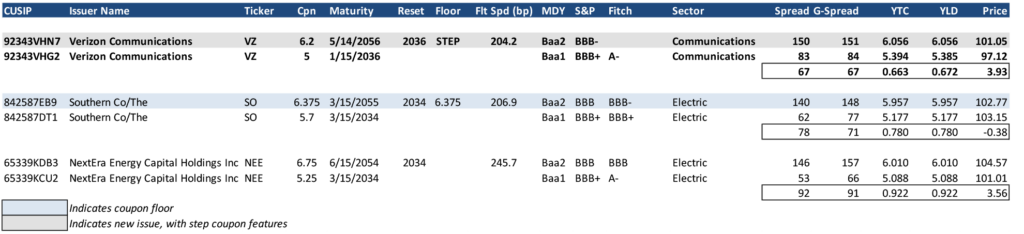
To get a sense of how the market is valuing the new step features, exhibit 1 below presents the new 30NC10 hybrid versus a VZ senior unsecured 10-year bullet. Those bonds are compared with a similarly rated Southern Co (SO: hybrid rating – Baa2/BBB/BBB-) 30NC10 with a coupon floor and a NextEra Energy (NEE: hybrid rating – Baa2/BBB/BBB) with a more onerous back-end floating rate but no floor. The VZ hybrid is currently trading at a roughly +67 bp discount to the VZ 10-year bullet. Meanwhile the SO 30NC10 with a coupon floor is also trading at a commensurate low-70s bp discount to the SO senior bullet (note: one-year difference in final maturity). The more aged NEE 30NC10 with a +245.7 bp back-end and no floor is trading at a little more than 90 bp discount to senior bullets, or about +25 bp discount versus either of the other two structures (note: 2054 maturity). The implication from this small sample set is that the new step features on the VZ bonds are valued similarly to traditional coupon floors, despite providing more incentive to the issuer to call the bonds at first call date. This suggests the new VZ hybrids may be slightly undervalued despite their sharp increase in price in the first week of trading.
Exhibit 1. New VZ 30NC 10 vs Senior 10-year bullets – and comparable NEE relationships
Source: Santander US Capital Markets LLC, Bloomberg/TRACE YAS price indications only
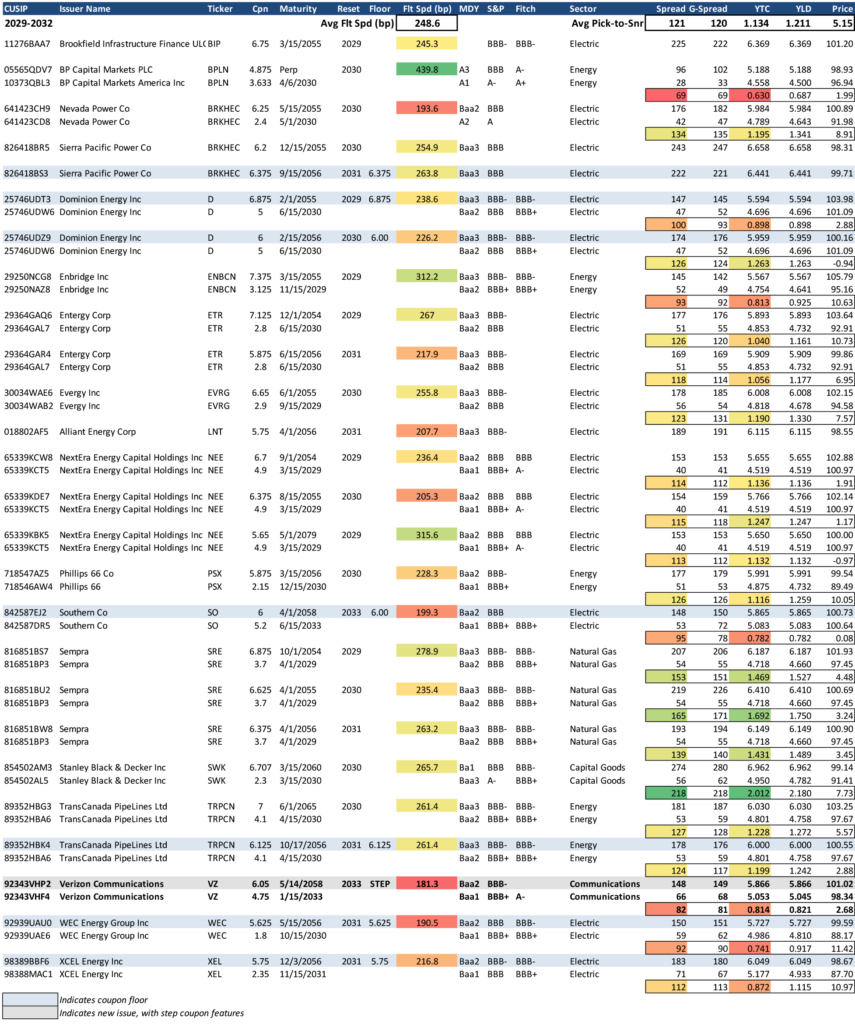
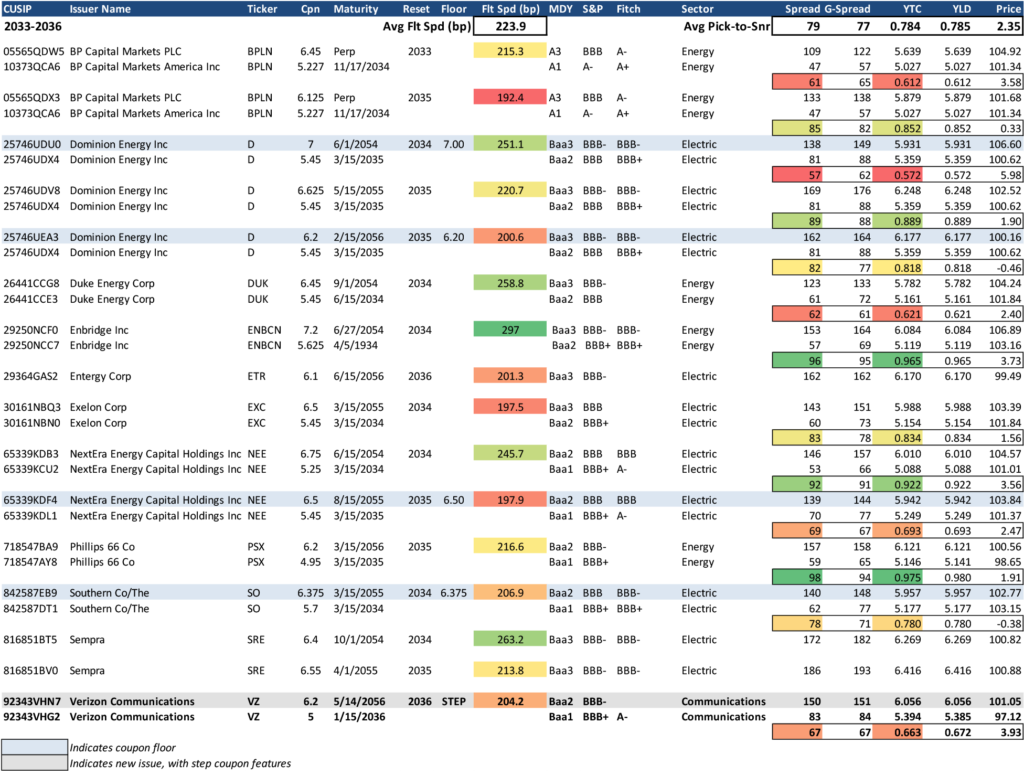
In the two exhibits below, the color scale in the middle indicates how the back-end floating rates compare to the other bonds in group, with the highest spread—affording the most call protection—depicted in green and the lowest in red. Similarly, on the right side of the study, there are another two color scales that depict the spread and yield-to-call picks available relative to senior bullet securities. The greater spread and yield picks are depicted in green with the lower in red. Not surprisingly, higher call protection generally translates to lower spread and yield picks relative to bullets. Please note there are hybrid bonds included in the study that do not have senior comparable securities.
Exhibit 1 lists investment grade non-bank hybrids with roughly 5-year calls (2029-2032) relative to similar 5-year bullet senior securities. This represents the largest segment of the investment grade hybrid universe. Bonds with coupon floors are highlighted in blue and new issues are indicated in gray. Average spread pick for hybrids relative to seniors for this cohort is currently around +120 bp. Aged vintage bonds without call protection that appear attractively valued versus new structures include:
- SRE 6.875% ‘54s (+278.9 bp back-end)
- SRE 6.625% ‘55 (+235.4 bp back-end)
- SRE 6.375% ‘56 (+263.2 bp back-end)
- SWK 6.707% ‘60 (+265.7 bp back-end)
Exhibit 2. 5-year Call IG-Rated Non-Bank Hybrids vs Senior Bullets
Source: Santander US Capital Markets LLC, Bloomberg/TRACE YAS price indications only
The second IG segment in exhibit 2 lists securities with roughly 10-year calls (2034-2036) relative to similar 10-year bullet senior securities. Once again, the recent issues with coupon floors on the back-end are highlighted in blue. Average spread pick for hybrids relative to seniors for this cohort is currently around +75-80 bp. Aged vintage bonds without call protection that appear attractively valued versus new structures include:
- D 6.625% ‘55 (+220.7 bp back-end)
- ENBCN 7.2% ‘54 (+297 bp back-end)
- NEE 6.75% ’54 (+245.7 bp back-end)
Exhibit 3. 10-year Call IG-Rated Non-Bank Hybrids vs Senior Bullets
Source: Santander US Capital Markets LLC, Bloomberg/TRACE YAS price indications only
This material is intended only for institutional investors and does not carry all of the independence and disclosure standards of retail debt research reports. In the preparation of this material, the author may have consulted or otherwise discussed the matters referenced herein with one or more of SCM’s trading desks, any of which may have accumulated or otherwise taken a position, long or short, in any of the financial instruments discussed in or related to this material. Further, SCM may act as a market maker or principal dealer and may have proprietary interests that differ or conflict with the recipient hereof, in connection with any financial instrument discussed in or related to this material.
This message, including any attachments or links contained herein, is subject to important disclaimers, conditions, and disclosures regarding Electronic Communications, which you can find at https://portfolio-strategy.apsec.com/sancap-disclaimers-and-disclosures.
Important Disclaimers
Copyright © 2026 Santander US Capital Markets LLC and its affiliates (“SCM”). All rights reserved. SCM is a member of FINRA and SIPC. This material is intended for limited distribution to institutions only and is not publicly available. Any unauthorized use or disclosure is prohibited.
In making this material available, SCM (i) is not providing any advice to the recipient, including, without limitation, any advice as to investment, legal, accounting, tax and financial matters, (ii) is not acting as an advisor or fiduciary in respect of the recipient, (iii) is not making any predictions or projections and (iv) intends that any recipient to which SCM has provided this material is an “institutional investor” (as defined under applicable law and regulation, including FINRA Rule 4512 and that this material will not be disseminated, in whole or part, to any third party by the recipient.
The author of this material is an economist, desk strategist or trader. In the preparation of this material, the author may have consulted or otherwise discussed the matters referenced herein with one or more of SCM’s trading desks, any of which may have accumulated or otherwise taken a position, long or short, in any of the financial instruments discussed in or related to this material. Further, SCM or any of its affiliates may act as a market maker or principal dealer and may have proprietary interests that differ or conflict with the recipient hereof, in connection with any financial instrument discussed in or related to this material.
This material (i) has been prepared for information purposes only and does not constitute a solicitation or an offer to buy or sell any securities, related investments or other financial instruments, (ii) is neither research, a “research report” as commonly understood under the securities laws and regulations promulgated thereunder nor the product of a research department, (iii) or parts thereof may have been obtained from various sources, the reliability of which has not been verified and cannot be guaranteed by SCM, (iv) should not be reproduced or disclosed to any other person, without SCM’s prior consent and (v) is not intended for distribution in any jurisdiction in which its distribution would be prohibited.
In connection with this material, SCM (i) makes no representation or warranties as to the appropriateness or reliance for use in any transaction or as to the permissibility or legality of any financial instrument in any jurisdiction, (ii) believes the information in this material to be reliable, has not independently verified such information and makes no representation, express or implied, with regard to the accuracy or completeness of such information, (iii) accepts no responsibility or liability as to any reliance placed, or investment decision made, on the basis of such information by the recipient and (iv) does not undertake, and disclaims any duty to undertake, to update or to revise the information contained in this material.
Unless otherwise stated, the views, opinions, forecasts, valuations, or estimates contained in this material are those solely of the author, as of the date of publication of this material, and are subject to change without notice. The recipient of this material should make an independent evaluation of this information and make such other investigations as the recipient considers necessary (including obtaining independent financial advice), before transacting in any financial market or instrument discussed in or related to this material.
Important disclaimers for clients in the EU and UK
This publication has been prepared by Trading Desk Strategists within the Sales and Trading functions of Santander US Capital Markets LLC (“SanCap”), the US registered broker-dealer of Santander Corporate & Investment Banking. This communication is distributed in the EEA by Banco Santander S.A., a credit institution registered in Spain and authorised and regulated by the Bank of Spain and the CNMV. Any EEA recipient of this communication that would like to affect any transaction in any security or issuer discussed herein should do so with Banco Santander S.A. or any of its affiliates (together “Santander”). This communication has been distributed in the UK by Banco Santander, S.A.’s London branch, authorised by the Bank of Spain and subject to regulatory oversight on certain matters by the Financial Conduct Authority (FCA) and the Prudential Regulation Authority (PRA).
The publication is intended for exclusive use for Professional Clients and Eligible Counterparties as defined by MiFID II and is not intended for use by retail customers or for any persons or entities in any jurisdictions or country where such distribution or use would be contrary to local law or regulation.
This material is not a product of Santander´s Research Team and does not constitute independent investment research. This is a marketing communication and may contain ¨investment recommendations¨ as defined by the Market Abuse Regulation 596/2014 ("MAR"). This publication has not been prepared in accordance with legal requirements designed to promote the independence of research and is not subject to any prohibition on dealing ahead of the dissemination of investment research. The author, date and time of the production of this publication are as indicated herein.
This publication does not constitute investment advice and may not be relied upon to form an investment decision, nor should it be construed as any offer to sell or issue or invitation to purchase, acquire or subscribe for any instruments referred herein. The publication has been prepared in good faith and based on information Santander considers reliable as of the date of publication, but Santander does not guarantee or represent, express or implied, that such information is accurate or complete. All estimates, forecasts and opinions are current as at the date of this publication and are subject to change without notice. Unless otherwise indicated, Santander does not intend to update this publication. The views and commentary in this publication may not be objective or independent of the interests of the Trading and Sales functions of Santander, who may be active participants in the markets, investments or strategies referred to herein and/or may receive compensation from investment banking and non-investment banking services from entities mentioned herein. Santander may trade as principal, make a market or hold positions in instruments (or related derivatives) and/or hold financial interest in entities discussed herein. Santander may provide market commentary or trading strategies to other clients or engage in transactions which may differ from views expressed herein. Santander may have acted upon the contents of this publication prior to you having received it.
This publication is intended for the exclusive use of the recipient and must not be reproduced, redistributed or transmitted, in whole or in part, without Santander’s consent. The recipient agrees to keep confidential at all times information contained herein.