The Big Idea
AI buildout accelerates
This material is a Marketing Communication and does not constitute Independent Investment Research.
Business investment in the first three quarters of last year came entirely from technology outlays while spending on all other types of capital goods and services declined. Since then, the economic data point to an accelerating AI boom that is propelling business spending in particular and economic growth more broadly so far in 2026.
Breakdown of business fixed investment
In the GDP accounts, business fixed investment is divided into three main components: structures, equipment, and intellectual property. The structures piece, the smallest of the three, has been sliding in real terms for nine consecutive quarters going back to the beginning of 2024. In contrast, outlays for equipment and intellectual property posted solid gains last year.
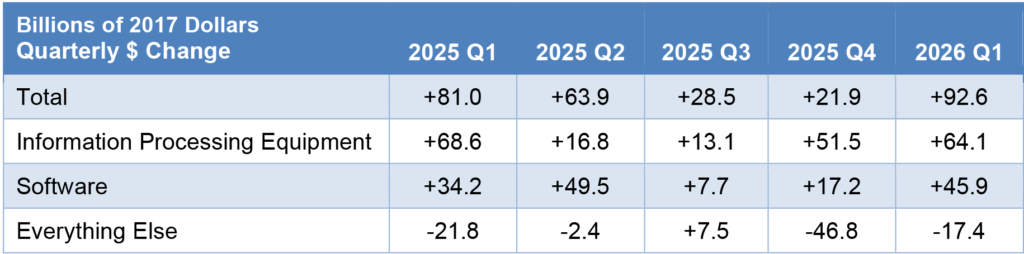
Those increases, however, were narrowly focused. In fact, in four of the past quarters, the “information processing equipment” line item within equipment and the “software” line item within intellectual property more than accounted for the overall rise in real business investment (Exhibit 1).
Exhibit 1: Real business fixed investment quarterly changes
Source: BEA.
To be sure, not all technology outlays since the start of 2025 were directly related to AI, but it is safe to assume that most of them were. Firms have gone on a binge of acquiring computer hardware and software in support of the AI buildout. The first quarter GDP figures released on April 30 make clear that this spending spree is still gathering speed, as both the IP equipment and software categories posted massive rises.
The flip side of the AI-related strength is the lack of growth for more old-fashioned investment goods, like buildings, industrial equipment and so on. In my view, the tepid performance for non-AI investment last year and in early 2026 was driven primarily by uncertainty regarding the policy outlook, most notably the unpredictable tariffs situation. As firms gain a clearer sense of the general direction of tariffs policy, I would expect investment appetite to improve more broadly. The underlying atmosphere benefits from substantial tax changes enacted last year, such as the reinstatement of full expensing for investment and of the research and development tax credit, and a vigorous push toward deregulation in a variety of industries, including banking and finance. This combination of policy changes produced a similar, albeit short-lived, burst in business investment in late 2017 and early 2018, so there is empirical backing for such a response.
Having said that, the uncertainty generated by the Middle East conflict, particularly the lack of clarity regarding the path of energy prices, offers another reason for business executives who have been cautiously delaying their investment plans to continue holding off, in hopes that the hostilities will end in a few months and the outlook for energy prices will clear up.
Positive signs
One could look at business fixed investment and notice that technology investment was quite strong in the first quarter of 2025 and then moderated in subsequent quarters. Was the pop in the first quarter of this year just a one-off? Here, the monthly data offer further reason for optimism.
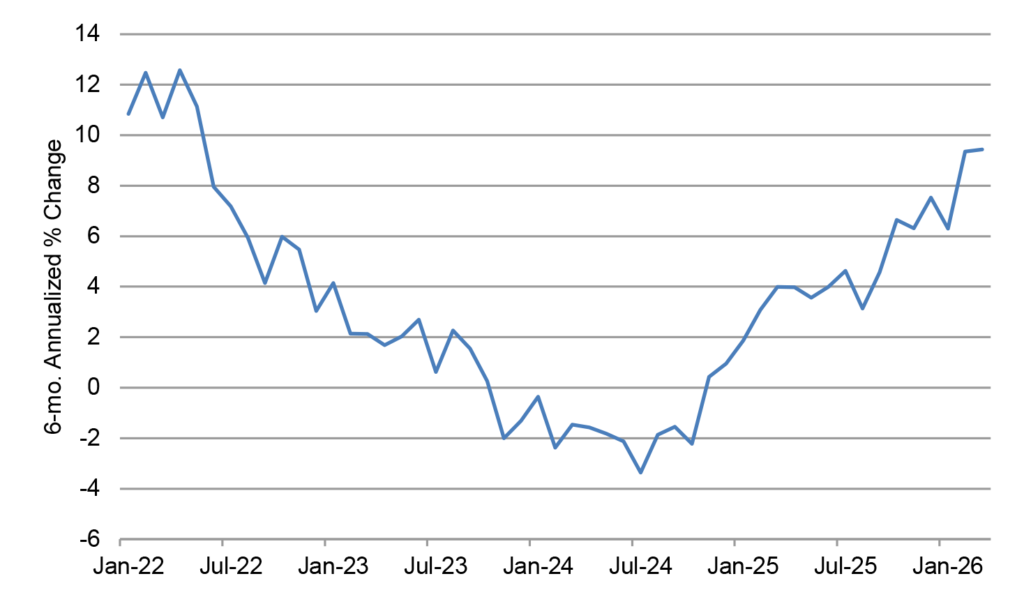
The March durable goods report released on April 29 revealed explosive gains in February and March for core capital goods shipments, a decent proxy for the equipment component within the GDP accounts. The monthly increases in February and March were 1.3% and 1.2%, respectively—and these are not annualized figures. Notice the six-month annualized rate of advance for core capital goods shipments approaching 10% (Exhibit 2).
Exhibit 2: Core capital goods shipments
Source: Census Bureau.
Since September, the monthly advances have been 0.8% or higher in five of the last seven months after the measure posted anemic growth in the first two thirds of last year.
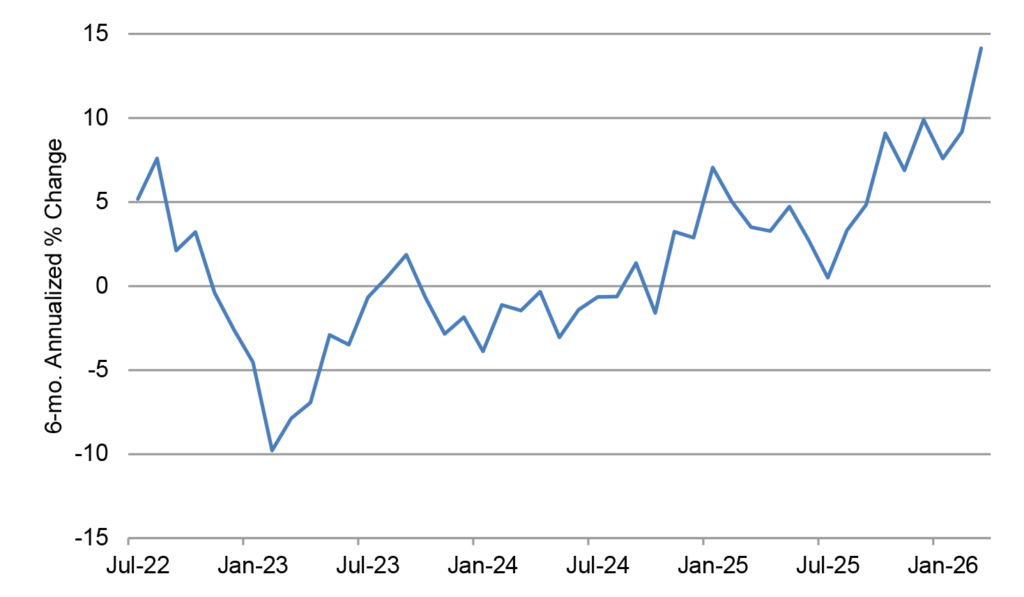
There has also been an impressive surge in core capital goods orders, which represent a more forward-looking perspective (Exhibit 3). After posting six straight monthly increases of ½% or better to end 2025, core capital goods orders dipped by 0.3% in January. However, they rebounded violently, posting gains of 1.6% in February and 3.3% in March. The latter was the largest monthly rise since June 2020. The resulting six-month annualized advance of more than 14% was also the strongest since the post-pandemic reopening period.
Exhibit 3: Core capital goods orders
Source: Census Bureau.
The blowout gains in core capital goods orders in February and March point to a continuation of the outsized real business fixed investment growth seen in the first quarter. Indeed, recent first quarter earnings announcements by several of the mega technology corporations confirms that the rapid uptrend in AI-related outlays is likely to continue for a while. Moreover, if the policy and geopolitical outlooks ever clear up by enough to entice a broadening of investment activity, then the sector may drive a sharply stronger-than-consensus pace of real GDP growth, as I expect for 2026 and perhaps 2027 as well.
This material is intended only for institutional investors and does not carry all of the independence and disclosure standards of retail debt research reports. In the preparation of this material, the author may have consulted or otherwise discussed the matters referenced herein with one or more of SCM’s trading desks, any of which may have accumulated or otherwise taken a position, long or short, in any of the financial instruments discussed in or related to this material. Further, SCM may act as a market maker or principal dealer and may have proprietary interests that differ or conflict with the recipient hereof, in connection with any financial instrument discussed in or related to this material.
This message, including any attachments or links contained herein, is subject to important disclaimers, conditions, and disclosures regarding Electronic Communications, which you can find at https://portfolio-strategy.apsec.com/sancap-disclaimers-and-disclosures.
Important Disclaimers
Copyright © 2026 Santander US Capital Markets LLC and its affiliates (“SCM”). All rights reserved. SCM is a member of FINRA and SIPC. This material is intended for limited distribution to institutions only and is not publicly available. Any unauthorized use or disclosure is prohibited.
In making this material available, SCM (i) is not providing any advice to the recipient, including, without limitation, any advice as to investment, legal, accounting, tax and financial matters, (ii) is not acting as an advisor or fiduciary in respect of the recipient, (iii) is not making any predictions or projections and (iv) intends that any recipient to which SCM has provided this material is an “institutional investor” (as defined under applicable law and regulation, including FINRA Rule 4512 and that this material will not be disseminated, in whole or part, to any third party by the recipient.
The author of this material is an economist, desk strategist or trader. In the preparation of this material, the author may have consulted or otherwise discussed the matters referenced herein with one or more of SCM’s trading desks, any of which may have accumulated or otherwise taken a position, long or short, in any of the financial instruments discussed in or related to this material. Further, SCM or any of its affiliates may act as a market maker or principal dealer and may have proprietary interests that differ or conflict with the recipient hereof, in connection with any financial instrument discussed in or related to this material.
This material (i) has been prepared for information purposes only and does not constitute a solicitation or an offer to buy or sell any securities, related investments or other financial instruments, (ii) is neither research, a “research report” as commonly understood under the securities laws and regulations promulgated thereunder nor the product of a research department, (iii) or parts thereof may have been obtained from various sources, the reliability of which has not been verified and cannot be guaranteed by SCM, (iv) should not be reproduced or disclosed to any other person, without SCM’s prior consent and (v) is not intended for distribution in any jurisdiction in which its distribution would be prohibited.
In connection with this material, SCM (i) makes no representation or warranties as to the appropriateness or reliance for use in any transaction or as to the permissibility or legality of any financial instrument in any jurisdiction, (ii) believes the information in this material to be reliable, has not independently verified such information and makes no representation, express or implied, with regard to the accuracy or completeness of such information, (iii) accepts no responsibility or liability as to any reliance placed, or investment decision made, on the basis of such information by the recipient and (iv) does not undertake, and disclaims any duty to undertake, to update or to revise the information contained in this material.
Unless otherwise stated, the views, opinions, forecasts, valuations, or estimates contained in this material are those solely of the author, as of the date of publication of this material, and are subject to change without notice. The recipient of this material should make an independent evaluation of this information and make such other investigations as the recipient considers necessary (including obtaining independent financial advice), before transacting in any financial market or instrument discussed in or related to this material.
Important disclaimers for clients in the EU and UK
This publication has been prepared by Trading Desk Strategists within the Sales and Trading functions of Santander US Capital Markets LLC (“SanCap”), the US registered broker-dealer of Santander Corporate & Investment Banking. This communication is distributed in the EEA by Banco Santander S.A., a credit institution registered in Spain and authorised and regulated by the Bank of Spain and the CNMV. Any EEA recipient of this communication that would like to affect any transaction in any security or issuer discussed herein should do so with Banco Santander S.A. or any of its affiliates (together “Santander”). This communication has been distributed in the UK by Banco Santander, S.A.’s London branch, authorised by the Bank of Spain and subject to regulatory oversight on certain matters by the Financial Conduct Authority (FCA) and the Prudential Regulation Authority (PRA).
The publication is intended for exclusive use for Professional Clients and Eligible Counterparties as defined by MiFID II and is not intended for use by retail customers or for any persons or entities in any jurisdictions or country where such distribution or use would be contrary to local law or regulation.
This material is not a product of Santander´s Research Team and does not constitute independent investment research. This is a marketing communication and may contain ¨investment recommendations¨ as defined by the Market Abuse Regulation 596/2014 ("MAR"). This publication has not been prepared in accordance with legal requirements designed to promote the independence of research and is not subject to any prohibition on dealing ahead of the dissemination of investment research. The author, date and time of the production of this publication are as indicated herein.
This publication does not constitute investment advice and may not be relied upon to form an investment decision, nor should it be construed as any offer to sell or issue or invitation to purchase, acquire or subscribe for any instruments referred herein. The publication has been prepared in good faith and based on information Santander considers reliable as of the date of publication, but Santander does not guarantee or represent, express or implied, that such information is accurate or complete. All estimates, forecasts and opinions are current as at the date of this publication and are subject to change without notice. Unless otherwise indicated, Santander does not intend to update this publication. The views and commentary in this publication may not be objective or independent of the interests of the Trading and Sales functions of Santander, who may be active participants in the markets, investments or strategies referred to herein and/or may receive compensation from investment banking and non-investment banking services from entities mentioned herein. Santander may trade as principal, make a market or hold positions in instruments (or related derivatives) and/or hold financial interest in entities discussed herein. Santander may provide market commentary or trading strategies to other clients or engage in transactions which may differ from views expressed herein. Santander may have acted upon the contents of this publication prior to you having received it.
This publication is intended for the exclusive use of the recipient and must not be reproduced, redistributed or transmitted, in whole or in part, without Santander’s consent. The recipient agrees to keep confidential at all times information contained herein.