The Big Idea
Five things to watch this week
This material is a Marketing Communication and does not constitute Independent Investment Research.
The possibility of the US-Iran war moving from military to civilian infrastructure has raised risks in the debt markets. Visions of high oil prices for longer pushed 10-year yields to 4.39% over the weekend and led the fed funds futures market to consider the possibility that the Fed’s next move could be a hike. This has just added to the steady rise in MBS duration during the war. Sustained higher rates also could bring fresh attention to private debt. Bond market bulls might need any tentative signs of softer labor to help their cause.
Five things to watch this week:
#1. The Hormuz ultimatum and the risk of higher yields
President Trump’s 48-hour ultimatum over the weekend for Iran to fully open the strait or face obliteration of its power plants roused the debt markets and US allies and brought a stay in the president’s plans. But apparent disagreement about whether the US and Iran are actually negotiating an offramp should keep rates and spreads volatile. Nevertheless, it is tempting to think the weekend has set an upper bound on rates and spreads.
A strike at power plants would move the fight from military to civilian infrastructure, and Iran has reportedly warned it will completely close the strait if civilian infrastructure is hit and lay mines across the Persian Gulf. The country also could try to hit civilian and energy infrastructure in neighboring countries. This could keep energy supply limited and prices high for longer. US allies in the Middle East have reportedly expressed concerns about escalating the fight.
Oil and, consequently, rates have responded. The front futures contract for Brent crude hit $111 Sunday night but has dropped to $101 as of mid-Monday after the president extended his ultimatum. US 10-year yields touched 4.39% over the weekend but have dropped back to 4.36% through mid-day.
The market will need to watch the messaging from the administration this week. The president on Monday said the US was negotiating with Iran and would hold off from hitting infrastructure for five days. Iran has denied negotiations.
The intriguing possibility here is that the rapid rise in oil and US yields marks a threshold in administration thinking, similar to the effect of higher rates, wider credit spreads and lower equity prices after Liberation Day. Liquidity has high value in this market, but at least a small portion of it should go to work at current yields and spreads.
#2. Post-FOMC policy trajectory and the dot plot under siege
Following the March 18 FOMC, the Fed path implied in the futures market for the balance of 2026 implied one 25 bp cut. But futures over the weekend showed fed funds 8 bp higher in December, although that has settled back to 2 bp higher as of mid-Monday. The market clearly is willing to consider the possibility of a hike if Middle East energy infrastructure gets hit and oil prices stay higher for longer.
It will be worth watching Fed messaging this week for any hints of changing policy views. Governor Barr speaks Tuesday on the economic outlook, Jefferson speaks Thursday on the US economy and Daly and Paulson speak on monetary policy on Friday.
#3. Higher Treasury yields and MBS negative convexity
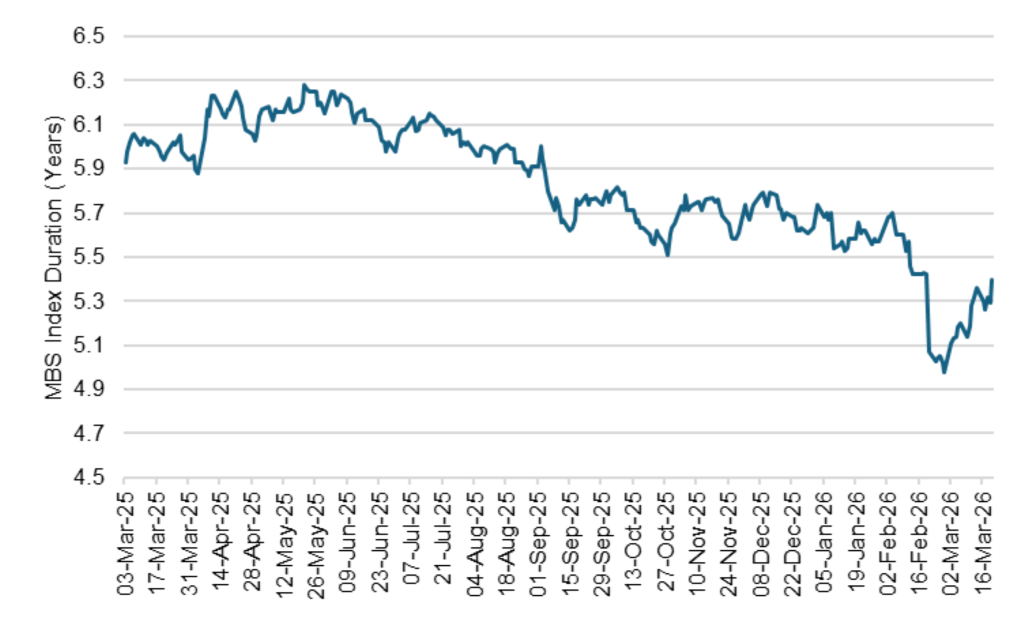
The US-Iran war has brought MBS negative convexity back. The duration of the Bloomberg MBS index has extended more than 0.4 years over the course of the war (Exhibit 1). Duration is still shorter than it was for most of the last year, but the whipsaw in the last month has put a spotlight on MBS negative convexity.
Exhibit 1: MBS index duration has extended during the war
Source: Bloomberg, Santander US Capital Markets
The things to watch in the market here:
- Stronger preferences among banks for MBS with some kind of prepayment protection, whether it comes from CMO structure or the underlying pass-through collateral. This plays to PAC structures, loan balance or New York collateral or similar solutions. Banks still have clear memories of the rising rates of 2022 and 2023 and the impact of negative convexity on unrealized portfolio losses.
- Wider spreads on MBS derivates from the higher cost of hedging. The combination of rising rates, higher volatility and wider MBS spreads has made hedging complex and expensive. The buyers will need more spread to pay for it.
#4. Fresh attention to private credit vulnerabilities
Higher rates and continued concern about software companies should keep pressure on credit spreads. The likelihood of no Fed cuts or even a hike means highly leveraged balance sheets get no interest rate relief this year. This is despite the absence of stress so far in most credit statistics. S&P statistics through late last year show most high yield and leveraged loan credit improving, Fitch default numbers show that, too. Private software debt tracked by Fitch showed a February trailing 12-month default rate of 1.8%, down from 6.7% a year ago. But the issue with private credit is less about trailing facts than future fears that AI will undermine software businesses. The new prospects or flat or even higher rates should amplify this.
#5. Any signs of labor softening
Beyond any de-escalation in the Middle East, the market will need signs of a softer labor market to believe the Fed might cut this year. The market will get data from ADP this week along with initial and continuing job claims, but the next employment report only comes on April 3. Maybe Fedspeak will includes hints of views on labor. This may be the only source bullish news, if any, for rates markets this week.
This material is intended only for institutional investors and does not carry all of the independence and disclosure standards of retail debt research reports. In the preparation of this material, the author may have consulted or otherwise discussed the matters referenced herein with one or more of SCM’s trading desks, any of which may have accumulated or otherwise taken a position, long or short, in any of the financial instruments discussed in or related to this material. Further, SCM may act as a market maker or principal dealer and may have proprietary interests that differ or conflict with the recipient hereof, in connection with any financial instrument discussed in or related to this material.
This message, including any attachments or links contained herein, is subject to important disclaimers, conditions, and disclosures regarding Electronic Communications, which you can find at https://portfolio-strategy.apsec.com/sancap-disclaimers-and-disclosures.
Important Disclaimers
Copyright © 2026 Santander US Capital Markets LLC and its affiliates (“SCM”). All rights reserved. SCM is a member of FINRA and SIPC. This material is intended for limited distribution to institutions only and is not publicly available. Any unauthorized use or disclosure is prohibited.
In making this material available, SCM (i) is not providing any advice to the recipient, including, without limitation, any advice as to investment, legal, accounting, tax and financial matters, (ii) is not acting as an advisor or fiduciary in respect of the recipient, (iii) is not making any predictions or projections and (iv) intends that any recipient to which SCM has provided this material is an “institutional investor” (as defined under applicable law and regulation, including FINRA Rule 4512 and that this material will not be disseminated, in whole or part, to any third party by the recipient.
The author of this material is an economist, desk strategist or trader. In the preparation of this material, the author may have consulted or otherwise discussed the matters referenced herein with one or more of SCM’s trading desks, any of which may have accumulated or otherwise taken a position, long or short, in any of the financial instruments discussed in or related to this material. Further, SCM or any of its affiliates may act as a market maker or principal dealer and may have proprietary interests that differ or conflict with the recipient hereof, in connection with any financial instrument discussed in or related to this material.
This material (i) has been prepared for information purposes only and does not constitute a solicitation or an offer to buy or sell any securities, related investments or other financial instruments, (ii) is neither research, a “research report” as commonly understood under the securities laws and regulations promulgated thereunder nor the product of a research department, (iii) or parts thereof may have been obtained from various sources, the reliability of which has not been verified and cannot be guaranteed by SCM, (iv) should not be reproduced or disclosed to any other person, without SCM’s prior consent and (v) is not intended for distribution in any jurisdiction in which its distribution would be prohibited.
In connection with this material, SCM (i) makes no representation or warranties as to the appropriateness or reliance for use in any transaction or as to the permissibility or legality of any financial instrument in any jurisdiction, (ii) believes the information in this material to be reliable, has not independently verified such information and makes no representation, express or implied, with regard to the accuracy or completeness of such information, (iii) accepts no responsibility or liability as to any reliance placed, or investment decision made, on the basis of such information by the recipient and (iv) does not undertake, and disclaims any duty to undertake, to update or to revise the information contained in this material.
Unless otherwise stated, the views, opinions, forecasts, valuations, or estimates contained in this material are those solely of the author, as of the date of publication of this material, and are subject to change without notice. The recipient of this material should make an independent evaluation of this information and make such other investigations as the recipient considers necessary (including obtaining independent financial advice), before transacting in any financial market or instrument discussed in or related to this material.
Important disclaimers for clients in the EU and UK
This publication has been prepared by Trading Desk Strategists within the Sales and Trading functions of Santander US Capital Markets LLC (“SanCap”), the US registered broker-dealer of Santander Corporate & Investment Banking. This communication is distributed in the EEA by Banco Santander S.A., a credit institution registered in Spain and authorised and regulated by the Bank of Spain and the CNMV. Any EEA recipient of this communication that would like to affect any transaction in any security or issuer discussed herein should do so with Banco Santander S.A. or any of its affiliates (together “Santander”). This communication has been distributed in the UK by Banco Santander, S.A.’s London branch, authorised by the Bank of Spain and subject to regulatory oversight on certain matters by the Financial Conduct Authority (FCA) and the Prudential Regulation Authority (PRA).
The publication is intended for exclusive use for Professional Clients and Eligible Counterparties as defined by MiFID II and is not intended for use by retail customers or for any persons or entities in any jurisdictions or country where such distribution or use would be contrary to local law or regulation.
This material is not a product of Santander´s Research Team and does not constitute independent investment research. This is a marketing communication and may contain ¨investment recommendations¨ as defined by the Market Abuse Regulation 596/2014 ("MAR"). This publication has not been prepared in accordance with legal requirements designed to promote the independence of research and is not subject to any prohibition on dealing ahead of the dissemination of investment research. The author, date and time of the production of this publication are as indicated herein.
This publication does not constitute investment advice and may not be relied upon to form an investment decision, nor should it be construed as any offer to sell or issue or invitation to purchase, acquire or subscribe for any instruments referred herein. The publication has been prepared in good faith and based on information Santander considers reliable as of the date of publication, but Santander does not guarantee or represent, express or implied, that such information is accurate or complete. All estimates, forecasts and opinions are current as at the date of this publication and are subject to change without notice. Unless otherwise indicated, Santander does not intend to update this publication. The views and commentary in this publication may not be objective or independent of the interests of the Trading and Sales functions of Santander, who may be active participants in the markets, investments or strategies referred to herein and/or may receive compensation from investment banking and non-investment banking services from entities mentioned herein. Santander may trade as principal, make a market or hold positions in instruments (or related derivatives) and/or hold financial interest in entities discussed herein. Santander may provide market commentary or trading strategies to other clients or engage in transactions which may differ from views expressed herein. Santander may have acted upon the contents of this publication prior to you having received it.
This publication is intended for the exclusive use of the recipient and must not be reproduced, redistributed or transmitted, in whole or in part, without Santander’s consent. The recipient agrees to keep confidential at all times information contained herein.