The Big Idea
Out-of-consensus calls on Latin American sovereigns in 2026
This material is a Marketing Communication and does not constitute Independent Investment Research.
Investment prospects for any new year usually get framed against performance the year before. That sets up 2026 in Latin American sovereigns against historically tight credit spreads and strong emerging markets index returns. The challenge comes in finding misalignments or idiosyncratic opportunities and ways to cushion asymmetric downside risk. The best prospects come from finding quality carry, positioning for upgrades and trading the risk of positive and negative events. Argentina, Costa Rica and the Bahamas are on the favorites list along with Panama, Colombia and Ecuador.
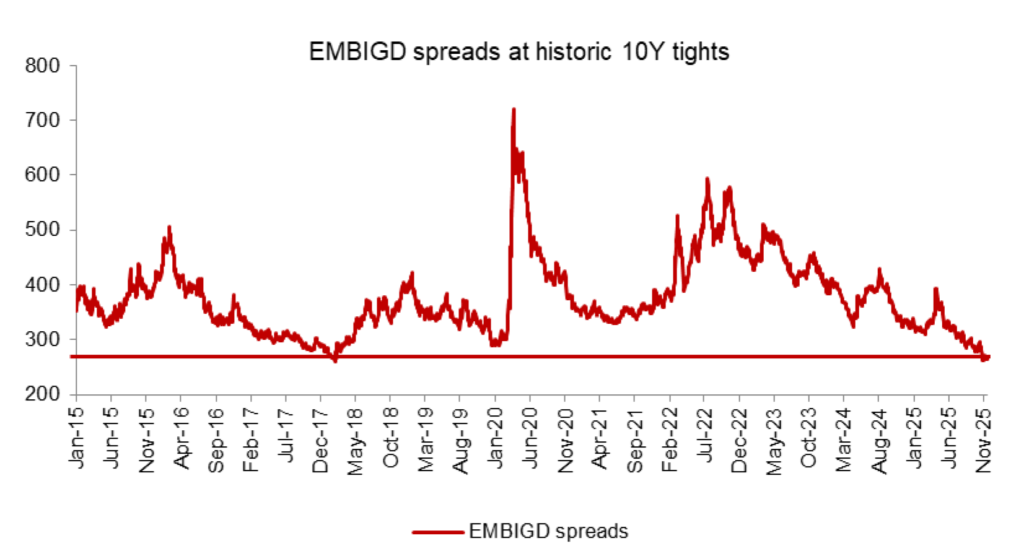
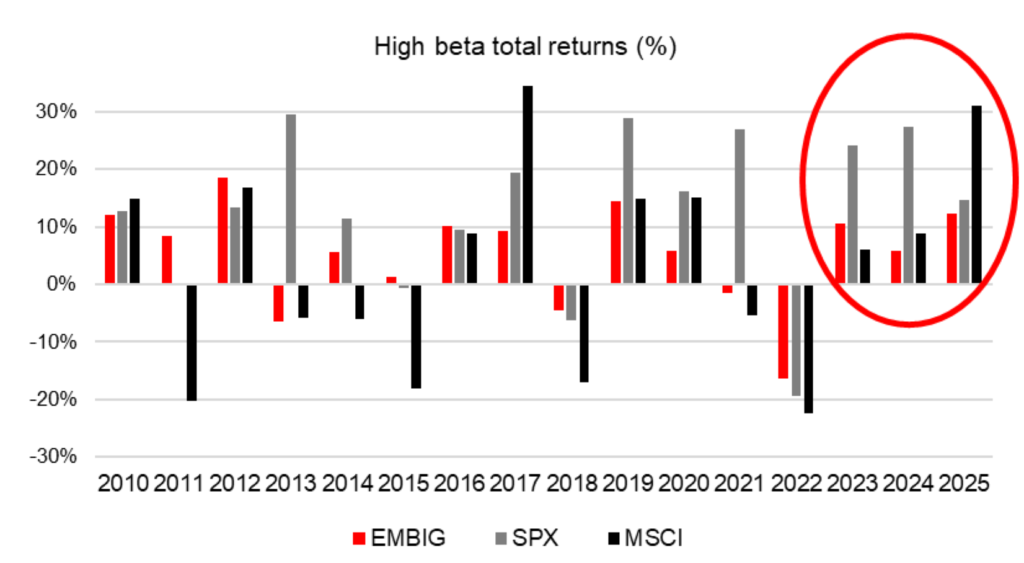
Spreads on benchmark emerging markets indices are now at the tightest levels in 10 years, and total returns this year are running near 12% (Exhibit 1A, 1B). There are no obvious excess return trades. Emerging markets have relied on carry, and there’s risk of a reversal for capital losses. Supply-and-demand technicals are increasingly important heading into next year as are country-specific attributes to cushion adverse shocks. It all leads to a few investment themes:
- Quality carry. High conviction carry and low beta carry trades.
- Potential capital gains from rating upgrade trades, and
- The volatility trade of positive and negative event risks.
Exhibit 1A: Emerging market spreads at the tightest levels in 10 years
Source: Bloomberg.
Exhibit 1B: Emerging markets post double-digit returns this year
Source: Bloomberg.
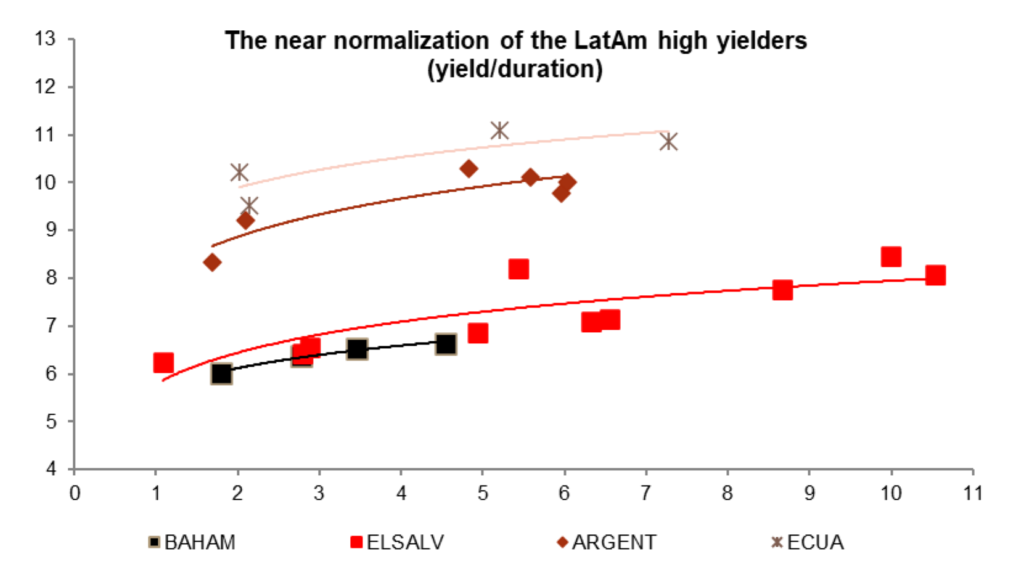
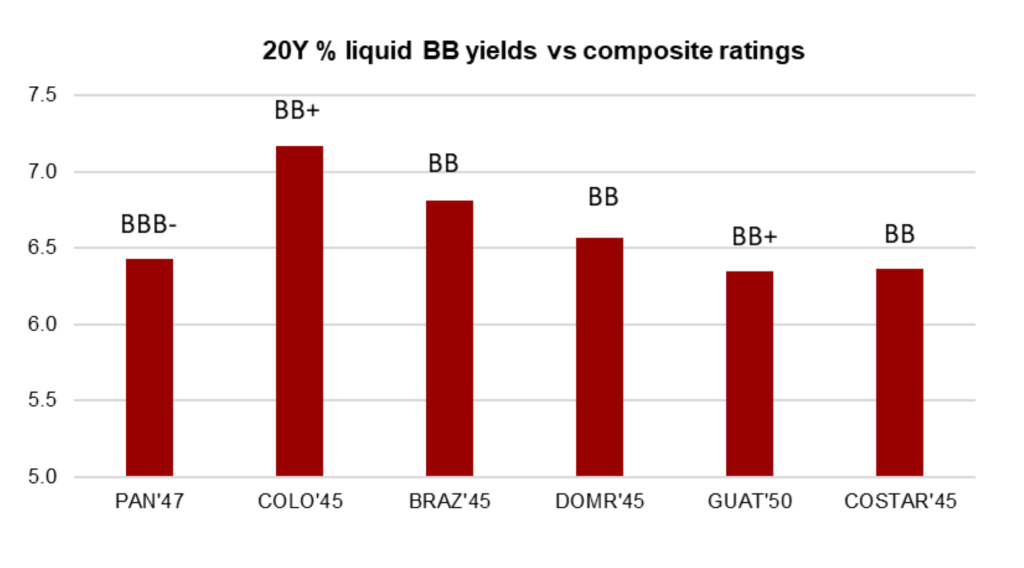
There are no obvious outliers in Latin American sovereigns. Argentina was the last distressed credit to normalize spreads with all ‘CCC/B’ credits now trading at single-digit yields (Exhibit 2A). That makes credit risk differentiation increasingly important (Exhibit 2B). It becomes an exercise in picking favorites that are either less correlated with general market direction or that benefit from positive credit momentum. This should help performance in a risk-averse market or maybe even add to capital gains in a stable-to-improving risk environment.
Exhibit 2A: The spread normalization of the high yielding credits
Source: Bloomberg.
Exhibit 2B: Spread convergence among ‘BB’ credits
Source: Bloomberg.
On the favorites list
Investors should also be able to trade event risk around International Monetary Fund program compliance (El Salvador, Argentina, and Ecuador) and election cycles (Bahamas, Costa Rica, and Colombia). This argues for an activist investment strategy and not just position for a repeat of the one-way spread compression and surging external demand that followed Liberation Day. The trades:
#1: Argentina, the high conviction carry trade. Argentina could still pick up gains into yearend as yields fully normalize into single digits. It was a roller coaster approaching the country’s election this year, but positive results triggered recovery to new spread lows. Argentina remains a top pick among the high yielders in Latin America for a few reasons: momentum on economic reform, a backstop from the US to immunize against external risks and, ultimately, a likely shift from economic stabilization to growth led by foreign direct investment. The shorter tenors should do the best with a base case for a slow grind tighter toward spreads closer to ‘B’ credits and bullish curve steepening.
#2: Costa Rica could be the fast-track investment grade candidate after elections. There is a clear path and potential momentum after elections in Costa Rica. Costa Rica offers several benefits: low sensitivity to overall market sentiment (low stock of bonds, IMF Flexible Credit Line, deep local markets) as well as upside from an investment grade ratings (convergence with Paraguay). The elections next year could allow for much stronger governability, less political fragmentation and a stronger reform agenda. This may allow progress on constitutional reforms needed for flexible external financing and as a catalyst for a Fitch investment grade rating.
#3: Bahamas as the misaligned BB credit. The Bahamas made the full transition from ‘B’ to ‘BB’ this year after moving from a fiscal deficit of 12% of GDP at the peak of pandemic to 0.5% of GDP in FY2024-2025. This fiscal year it should become the only country in the region to adopt tax reform and to post a nominal fiscal surplus. The track record of fiscal discipline and potential tax revenues approaching 25% of GDP could allow for faster reduction in debt ratios below 70% of GDP and potential for further upgrades. The Bahamas also is unique for offering the highest yield among BB credits, even wider than Colombia. The illiquidity of the country’s debt lowers correlation to global financial markets while the higher credit ratings and stronger fiscal liquidity and solvency metrics should also lower the vulnerability to external shocks. The curve should benefit from bull steepening with most value in the intermediate tenors.
Event trades
Event trades should focus on the liquid ‘BB’ credits like Panama and Colombia and high yielding ‘B’ Ecuador with a focus on elections, IMF relations, new issuance and ultimately, fiscal consolidation. These credits should all be sensitive to market risk. Dominican Republic offers stable ‘BB’ fundamentals and a defensive option against market-sensitive ‘BB’ credits like Colombia and Panama. Both of these credits have large external funding programs and are at critical junctures to tackle their large fiscal deficits. There are several moving parts with a particularly high dependence on external capital for Panama.
Funding for Colombia and Panama looks manageable with favorable external risk and good incremental demand from alternative sources. However, both credits need to pivot towards fiscal consolidation and debt sustainability. The general elections offer that possibility for Colombia with early signs of a moderate political and economic transition. Colombia elections are probably the most important event risk to monitor next year. The commitment to fiscal consolidation should determine the debt’s liquidity penalty and policy risk premium. Panama now has another six months to defend its investment grade rating. Legislative cooperation on fiscal reform creates a path to a lower structural deficit. This nevertheless looks challenging with tight spread differences sensitive to any disappointment on fiscal reform, fiscal laxity or any external shocks that undermine the country’s large gross funding needs.
Ecuador is typically vulnerable to volatility on the stop-and-go path to a lower central government fiscal deficit and lower structural liquidity risk. IMF relations remain the critical event risk to monitor for Ecuador. There has been significant progress lately under the effective track record of President Daniel Noboa. This should provide some breathing room on IMF relations with low near-term external funding needs and prospects for debt liability management. The high yields on Ecuador’s debt should also benefit from investors seeking carry returns; however, it’ll be important to still monitor fiscal targets into next year amid declining policy flexibility. The recent ‘no’ vote on the referendum to host a US military base and other political reforms was a reminder of political and policy risk premia. There are still multiple fronts to tackle including security issues and growth constraints under the structural populism of the political and social sectors. This should argue for a stubborn credit risk premium relative to other high yielders like Argentina and a much slower credit spread compression depending on fiscal consolidation.
This material is intended only for institutional investors and does not carry all of the independence and disclosure standards of retail debt research reports. In the preparation of this material, the author may have consulted or otherwise discussed the matters referenced herein with one or more of SCM’s trading desks, any of which may have accumulated or otherwise taken a position, long or short, in any of the financial instruments discussed in or related to this material. Further, SCM may act as a market maker or principal dealer and may have proprietary interests that differ or conflict with the recipient hereof, in connection with any financial instrument discussed in or related to this material.
This message, including any attachments or links contained herein, is subject to important disclaimers, conditions, and disclosures regarding Electronic Communications, which you can find at https://portfolio-strategy.apsec.com/sancap-disclaimers-and-disclosures.
Important Disclaimers
Copyright © 2026 Santander US Capital Markets LLC and its affiliates (“SCM”). All rights reserved. SCM is a member of FINRA and SIPC. This material is intended for limited distribution to institutions only and is not publicly available. Any unauthorized use or disclosure is prohibited.
In making this material available, SCM (i) is not providing any advice to the recipient, including, without limitation, any advice as to investment, legal, accounting, tax and financial matters, (ii) is not acting as an advisor or fiduciary in respect of the recipient, (iii) is not making any predictions or projections and (iv) intends that any recipient to which SCM has provided this material is an “institutional investor” (as defined under applicable law and regulation, including FINRA Rule 4512 and that this material will not be disseminated, in whole or part, to any third party by the recipient.
The author of this material is an economist, desk strategist or trader. In the preparation of this material, the author may have consulted or otherwise discussed the matters referenced herein with one or more of SCM’s trading desks, any of which may have accumulated or otherwise taken a position, long or short, in any of the financial instruments discussed in or related to this material. Further, SCM or any of its affiliates may act as a market maker or principal dealer and may have proprietary interests that differ or conflict with the recipient hereof, in connection with any financial instrument discussed in or related to this material.
This material (i) has been prepared for information purposes only and does not constitute a solicitation or an offer to buy or sell any securities, related investments or other financial instruments, (ii) is neither research, a “research report” as commonly understood under the securities laws and regulations promulgated thereunder nor the product of a research department, (iii) or parts thereof may have been obtained from various sources, the reliability of which has not been verified and cannot be guaranteed by SCM, (iv) should not be reproduced or disclosed to any other person, without SCM’s prior consent and (v) is not intended for distribution in any jurisdiction in which its distribution would be prohibited.
In connection with this material, SCM (i) makes no representation or warranties as to the appropriateness or reliance for use in any transaction or as to the permissibility or legality of any financial instrument in any jurisdiction, (ii) believes the information in this material to be reliable, has not independently verified such information and makes no representation, express or implied, with regard to the accuracy or completeness of such information, (iii) accepts no responsibility or liability as to any reliance placed, or investment decision made, on the basis of such information by the recipient and (iv) does not undertake, and disclaims any duty to undertake, to update or to revise the information contained in this material.
Unless otherwise stated, the views, opinions, forecasts, valuations, or estimates contained in this material are those solely of the author, as of the date of publication of this material, and are subject to change without notice. The recipient of this material should make an independent evaluation of this information and make such other investigations as the recipient considers necessary (including obtaining independent financial advice), before transacting in any financial market or instrument discussed in or related to this material.
Important disclaimers for clients in the EU and UK
This publication has been prepared by Trading Desk Strategists within the Sales and Trading functions of Santander US Capital Markets LLC (“SanCap”), the US registered broker-dealer of Santander Corporate & Investment Banking. This communication is distributed in the EEA by Banco Santander S.A., a credit institution registered in Spain and authorised and regulated by the Bank of Spain and the CNMV. Any EEA recipient of this communication that would like to affect any transaction in any security or issuer discussed herein should do so with Banco Santander S.A. or any of its affiliates (together “Santander”). This communication has been distributed in the UK by Banco Santander, S.A.’s London branch, authorised by the Bank of Spain and subject to regulatory oversight on certain matters by the Financial Conduct Authority (FCA) and the Prudential Regulation Authority (PRA).
The publication is intended for exclusive use for Professional Clients and Eligible Counterparties as defined by MiFID II and is not intended for use by retail customers or for any persons or entities in any jurisdictions or country where such distribution or use would be contrary to local law or regulation.
This material is not a product of Santander´s Research Team and does not constitute independent investment research. This is a marketing communication and may contain ¨investment recommendations¨ as defined by the Market Abuse Regulation 596/2014 ("MAR"). This publication has not been prepared in accordance with legal requirements designed to promote the independence of research and is not subject to any prohibition on dealing ahead of the dissemination of investment research. The author, date and time of the production of this publication are as indicated herein.
This publication does not constitute investment advice and may not be relied upon to form an investment decision, nor should it be construed as any offer to sell or issue or invitation to purchase, acquire or subscribe for any instruments referred herein. The publication has been prepared in good faith and based on information Santander considers reliable as of the date of publication, but Santander does not guarantee or represent, express or implied, that such information is accurate or complete. All estimates, forecasts and opinions are current as at the date of this publication and are subject to change without notice. Unless otherwise indicated, Santander does not intend to update this publication. The views and commentary in this publication may not be objective or independent of the interests of the Trading and Sales functions of Santander, who may be active participants in the markets, investments or strategies referred to herein and/or may receive compensation from investment banking and non-investment banking services from entities mentioned herein. Santander may trade as principal, make a market or hold positions in instruments (or related derivatives) and/or hold financial interest in entities discussed herein. Santander may provide market commentary or trading strategies to other clients or engage in transactions which may differ from views expressed herein. Santander may have acted upon the contents of this publication prior to you having received it.
This publication is intended for the exclusive use of the recipient and must not be reproduced, redistributed or transmitted, in whole or in part, without Santander’s consent. The recipient agrees to keep confidential at all times information contained herein.