By the Numbers
No summer break for CMO issuance
This material is a Marketing Communication and does not constitute Independent Investment Research.
CMO desks across the Street had limited opportunity for extended vacations as issuance in August approached $33 billion, falling just shy of July’s nearly $36 billion. August’s issuance represents a nearly 70% increase over the prior year, driven, in large part, by what appears to be strong bank demand as nearly half of the month’s volume was localized in Ginnie Mae floaters. Floater demand from depositories looks likely to remain elevated, even as the opportunity cost of owning floaters rises as the Fed cuts. Banks may look to add duration further out a steepening yield curve, rather than in short duration, fixed-rate MBS.
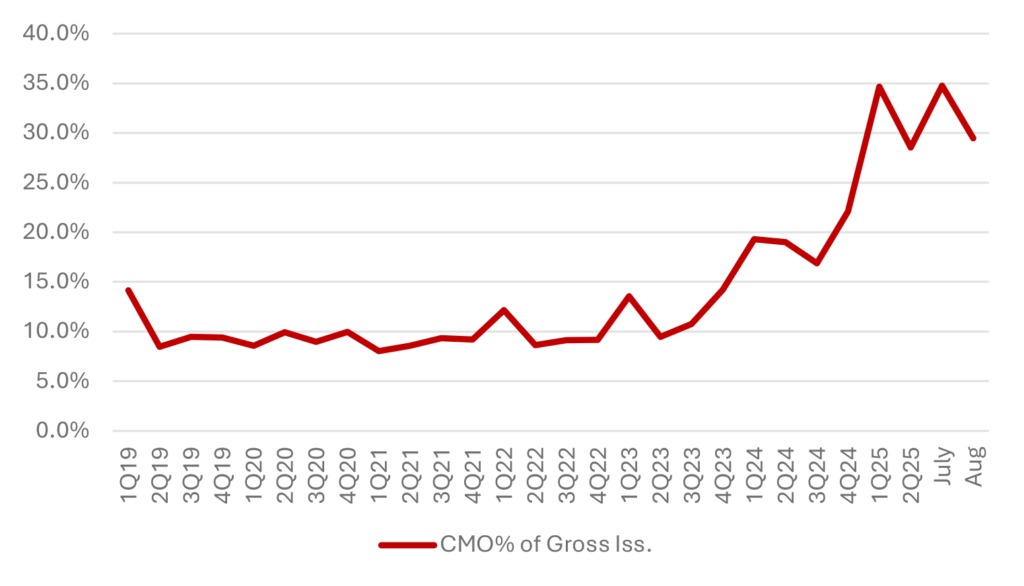
CMOs continue to take out a substantial amount of MBS supply. They accounted for more than one-third of total gross issuance in July and just shy of 30% last month. This is a stark departure from recent history where CMO issuance commonly accounted for less than 10% of monthly or quarterly supply, admittedly against the backdrop of elevated levels of gross issuance in 2020 and 2021 (Exhibit 1).
Exhibit 1: CMOs tale out roughly one third of gross supply in July and August
Source: Santander US Capital Markets, Inside Mortgage Finance
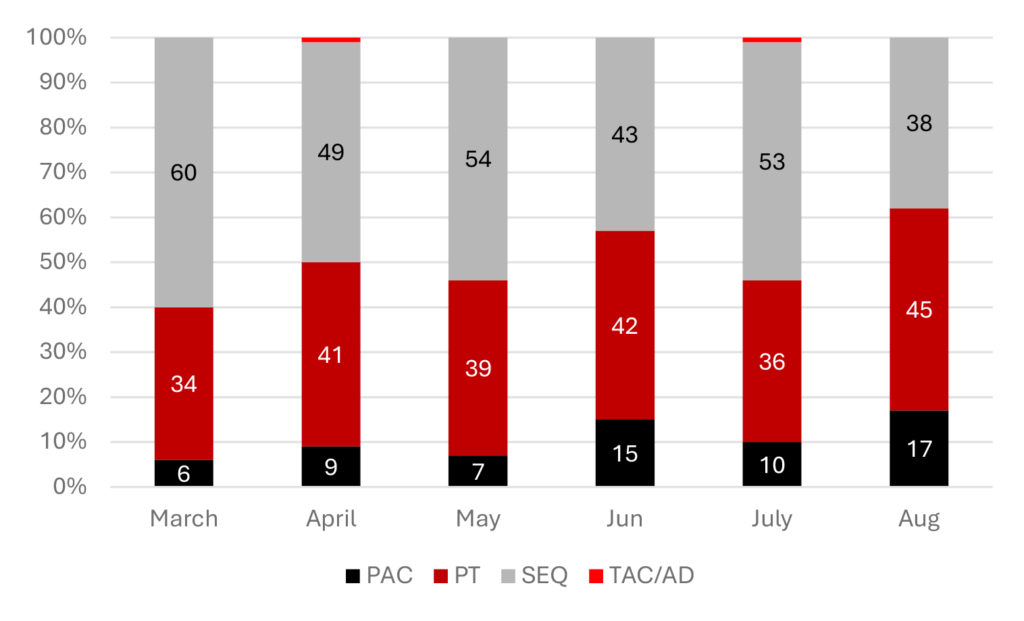
There were some notable changes to structures in August relative to earlier months. Despite the steady decline in volatility, more CMO buyers reached for the additional protections afforded by PAC structures. Anecdotally, demand for PACs has been driven by money managers, who are likely using them as surrogates for indexing purposes instead of 15-year MBS which remain both rich and in short supply. Sequential structures broadly fell out of favor last month, accounting for just 38% of bonds dealt after accounting for as much as 60% of total volumes earlier this year. The decline in sequential issuance suggests that despite market sentiment shifting towards a more hawkish tone and more aggressive Fed cutting cycle, that banks still favored floaters over locking in fixed-rate yields in the front end of the curve (Exhibit 2).
Exhibit 2: Breaking down CMO issuance by structure
Source: Santander US Capital Markets, Inside Mortgage Finance
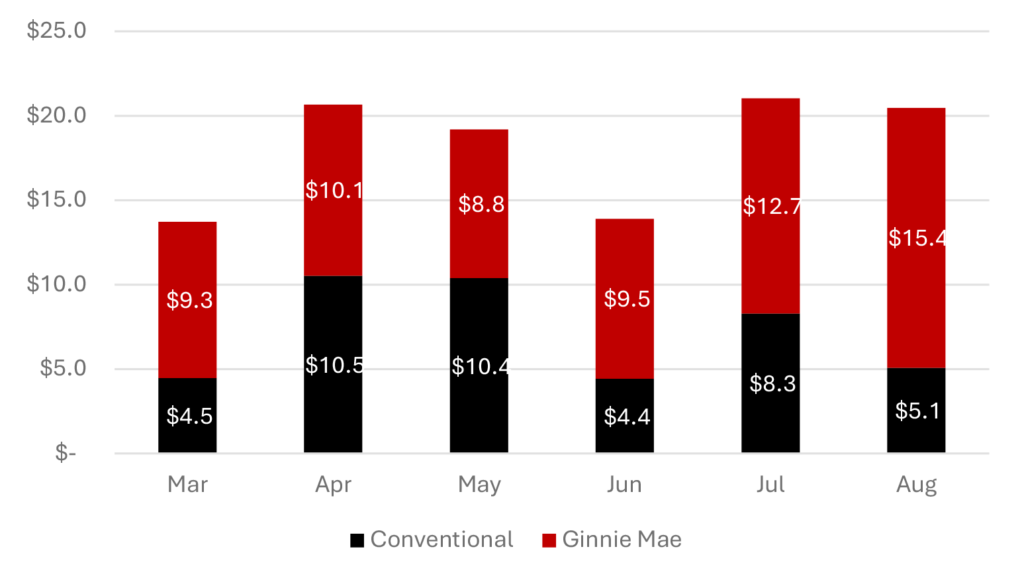
Floaters dominated the August CMO issuance cycle, accounting for over $20 billion of the nearly $33 billion dealt last month. While the mix of floater issuance was more balanced earlier this year, it has skewed heavily towards Ginnie Mae deals in recent months as $3 of Ginnie Mae floaters were created for every $1 of conventional last month. The surge in demand for Ginnie Mae floaters suggests banks may be more active buyers of MBS than in prior cycles as the Ginnie label carries limited value for asset managers and hedge funds who have also been active floater buyers (Exhibit 3).
Exhibit 3: Tracking floater supply by issuer
Source: Santander US Capital Markets, Inside Mortgage Finance
Expectations of more aggressive Fed cutting were expressed through a substantial migration down in floater cap last month. Floaters with 6.0% caps, which have generally made up 10% of total floater volume in recent months, made up one-third of last month’s floater issuance. To date, lower cap flows have been dominated by fast money buyers who view floaters as an attractive levered carry exposure with potential upside to spread tightening as the Fed cuts rates. Given this, their investments tend to be localized in lower cap strikes with wider spreads and subsequently greater spread duration that will have greater sensitivity to near-term Fed cuts.
Thoughts on bank demand for floaters going forward
Conventional wisdom has dictated that bank floater investment has, at least to some extent, been borne of elevated front end benchmark rates and little to no opportunity or economic cost associated with being invested in the shorter duration exposure. And that as front-end rates begin to fall, banks will begin to buy short-fixed rate bonds again. However, the potentially more likely path forward is that floaters will continue to be an integral part of banks’ investment portfolios and that they will add duration on the longer end of a steepening yield curve. The advantage to a more barbelled strategy is that it gives banks significantly more latitude to manage interest rate risk given higher levels of rate volatility.
Banks can add duration in positively convex instruments such as CMBS or longer duration last-cash flow CMOs and efficiently asset swap them back if they need to shorten the portfolio duration into a backup in rates. Conversely, if they buy open window, fixed rate CMOs, they have limited ability to hedge the extension risk of those assets into a backup. Owning a barbelled portfolio of floaters and long duration MBS gives depositories far more flexibility to manage duration than owning a homogeneous portfolio of shorter duration, more negatively convex MBS. Furthermore, the continued decline in rate volatility and steepening of the yield curve have served to tighten option-adjusted spreads on inverse IO, leaving floater spreads wide and further limiting the opportunity cost of being invested in the asset class. This technical does not appear to be abating anytime soon and banks appear poised to be able to continue to add floaters at attractive spreads.
This material is intended only for institutional investors and does not carry all of the independence and disclosure standards of retail debt research reports. In the preparation of this material, the author may have consulted or otherwise discussed the matters referenced herein with one or more of SCM’s trading desks, any of which may have accumulated or otherwise taken a position, long or short, in any of the financial instruments discussed in or related to this material. Further, SCM may act as a market maker or principal dealer and may have proprietary interests that differ or conflict with the recipient hereof, in connection with any financial instrument discussed in or related to this material.
This message, including any attachments or links contained herein, is subject to important disclaimers, conditions, and disclosures regarding Electronic Communications, which you can find at https://portfolio-strategy.apsec.com/sancap-disclaimers-and-disclosures.
Important Disclaimers
Copyright © 2026 Santander US Capital Markets LLC and its affiliates (“SCM”). All rights reserved. SCM is a member of FINRA and SIPC. This material is intended for limited distribution to institutions only and is not publicly available. Any unauthorized use or disclosure is prohibited.
In making this material available, SCM (i) is not providing any advice to the recipient, including, without limitation, any advice as to investment, legal, accounting, tax and financial matters, (ii) is not acting as an advisor or fiduciary in respect of the recipient, (iii) is not making any predictions or projections and (iv) intends that any recipient to which SCM has provided this material is an “institutional investor” (as defined under applicable law and regulation, including FINRA Rule 4512 and that this material will not be disseminated, in whole or part, to any third party by the recipient.
The author of this material is an economist, desk strategist or trader. In the preparation of this material, the author may have consulted or otherwise discussed the matters referenced herein with one or more of SCM’s trading desks, any of which may have accumulated or otherwise taken a position, long or short, in any of the financial instruments discussed in or related to this material. Further, SCM or any of its affiliates may act as a market maker or principal dealer and may have proprietary interests that differ or conflict with the recipient hereof, in connection with any financial instrument discussed in or related to this material.
This material (i) has been prepared for information purposes only and does not constitute a solicitation or an offer to buy or sell any securities, related investments or other financial instruments, (ii) is neither research, a “research report” as commonly understood under the securities laws and regulations promulgated thereunder nor the product of a research department, (iii) or parts thereof may have been obtained from various sources, the reliability of which has not been verified and cannot be guaranteed by SCM, (iv) should not be reproduced or disclosed to any other person, without SCM’s prior consent and (v) is not intended for distribution in any jurisdiction in which its distribution would be prohibited.
In connection with this material, SCM (i) makes no representation or warranties as to the appropriateness or reliance for use in any transaction or as to the permissibility or legality of any financial instrument in any jurisdiction, (ii) believes the information in this material to be reliable, has not independently verified such information and makes no representation, express or implied, with regard to the accuracy or completeness of such information, (iii) accepts no responsibility or liability as to any reliance placed, or investment decision made, on the basis of such information by the recipient and (iv) does not undertake, and disclaims any duty to undertake, to update or to revise the information contained in this material.
Unless otherwise stated, the views, opinions, forecasts, valuations, or estimates contained in this material are those solely of the author, as of the date of publication of this material, and are subject to change without notice. The recipient of this material should make an independent evaluation of this information and make such other investigations as the recipient considers necessary (including obtaining independent financial advice), before transacting in any financial market or instrument discussed in or related to this material.
Important disclaimers for clients in the EU and UK
This publication has been prepared by Trading Desk Strategists within the Sales and Trading functions of Santander US Capital Markets LLC (“SanCap”), the US registered broker-dealer of Santander Corporate & Investment Banking. This communication is distributed in the EEA by Banco Santander S.A., a credit institution registered in Spain and authorised and regulated by the Bank of Spain and the CNMV. Any EEA recipient of this communication that would like to affect any transaction in any security or issuer discussed herein should do so with Banco Santander S.A. or any of its affiliates (together “Santander”). This communication has been distributed in the UK by Banco Santander, S.A.’s London branch, authorised by the Bank of Spain and subject to regulatory oversight on certain matters by the Financial Conduct Authority (FCA) and the Prudential Regulation Authority (PRA).
The publication is intended for exclusive use for Professional Clients and Eligible Counterparties as defined by MiFID II and is not intended for use by retail customers or for any persons or entities in any jurisdictions or country where such distribution or use would be contrary to local law or regulation.
This material is not a product of Santander´s Research Team and does not constitute independent investment research. This is a marketing communication and may contain ¨investment recommendations¨ as defined by the Market Abuse Regulation 596/2014 ("MAR"). This publication has not been prepared in accordance with legal requirements designed to promote the independence of research and is not subject to any prohibition on dealing ahead of the dissemination of investment research. The author, date and time of the production of this publication are as indicated herein.
This publication does not constitute investment advice and may not be relied upon to form an investment decision, nor should it be construed as any offer to sell or issue or invitation to purchase, acquire or subscribe for any instruments referred herein. The publication has been prepared in good faith and based on information Santander considers reliable as of the date of publication, but Santander does not guarantee or represent, express or implied, that such information is accurate or complete. All estimates, forecasts and opinions are current as at the date of this publication and are subject to change without notice. Unless otherwise indicated, Santander does not intend to update this publication. The views and commentary in this publication may not be objective or independent of the interests of the Trading and Sales functions of Santander, who may be active participants in the markets, investments or strategies referred to herein and/or may receive compensation from investment banking and non-investment banking services from entities mentioned herein. Santander may trade as principal, make a market or hold positions in instruments (or related derivatives) and/or hold financial interest in entities discussed herein. Santander may provide market commentary or trading strategies to other clients or engage in transactions which may differ from views expressed herein. Santander may have acted upon the contents of this publication prior to you having received it.
This publication is intended for the exclusive use of the recipient and must not be reproduced, redistributed or transmitted, in whole or in part, without Santander’s consent. The recipient agrees to keep confidential at all times information contained herein.