By the Numbers
A hot July for CMO issuance
This material is a Marketing Communication and does not constitute Independent Investment Research.
Dealers underwrote an estimated $35 billion of agency CMOs in July, one of the highest 1-month volumes in the past 15 years. Near record breaking CMO issuance is somewhat surprising given relatively tepid bank demand for MBS broadly and CMOs specifically. Weaker bank demand for CMOs apparently is being offset by heightened demand from mutual funds and hedge funds, likely in the form of floaters that continue to offer attractive relative value both as a levered carry trade and hedge-adjusted basis compared to pass-throughs.
Framing current issuance
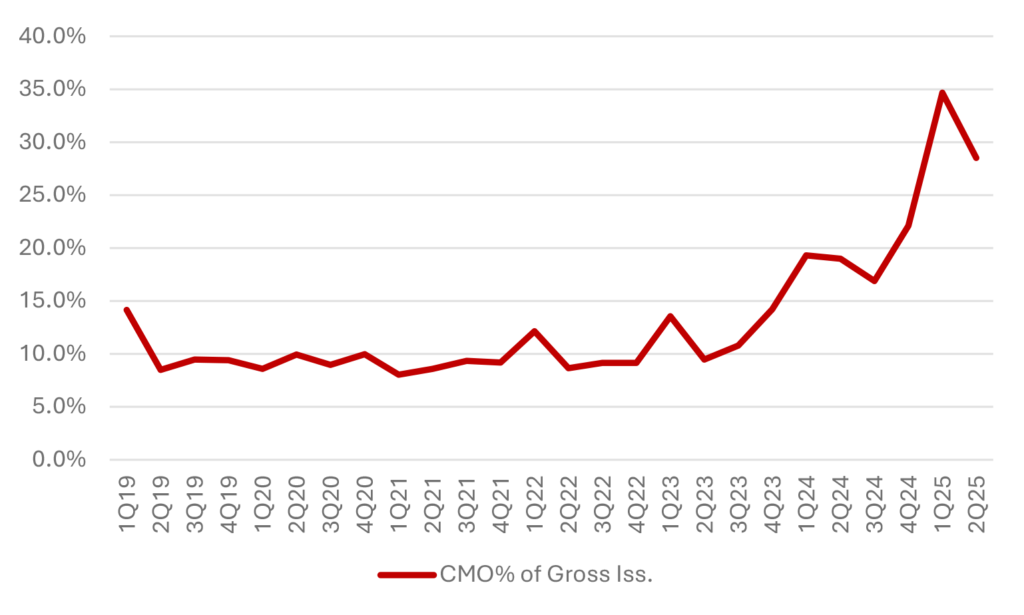
CMO issuance is attempting to keep pace with the late July mercury readings as this month is shaping up to be one of the highest on record. July represents more of a continuation and escalation of a trend than an aberration as the first half of this year has been marked by elevated CMO issuance. When viewed both as a percentage of gross MBS issuance and in absolute amounts, a lot of CMOs are being dealt. Desks across the street have underwritten over $185 billion of bonds through the first six months of this year. First quarter issuance was $100 billion and represented a whopping 34.7% of gross pass-through issuance, by far the highest CMO share of issuance in the past five years (Exhibit 1). Admittedly, the CMO share was against seasonally depressed gross MBS issuance of less than $300 billion.
Exhibit 1: CMOs make up a growing amount of overall MBS issuance
Source: Santander US Capital Markets, Inside Mortgage Finance, Fannie Mae, Freddie Mac, Ginnie Mae
Bank demand
Historically, elevated CMO demand has been marked by a growing appetite from depositories as CMOs have been a useful tool for banks to manage the duration gap between their assets and liabilities. In the wake of the failure of Silicon Valley Bank and other depositories, many banks changed how they allocated assets to the investment portfolio, increasing exposure to both floating-rate MBS along with more positively convex instruments like Treasuries and agency CMBS that can be efficiently swapped to a shorter duration.
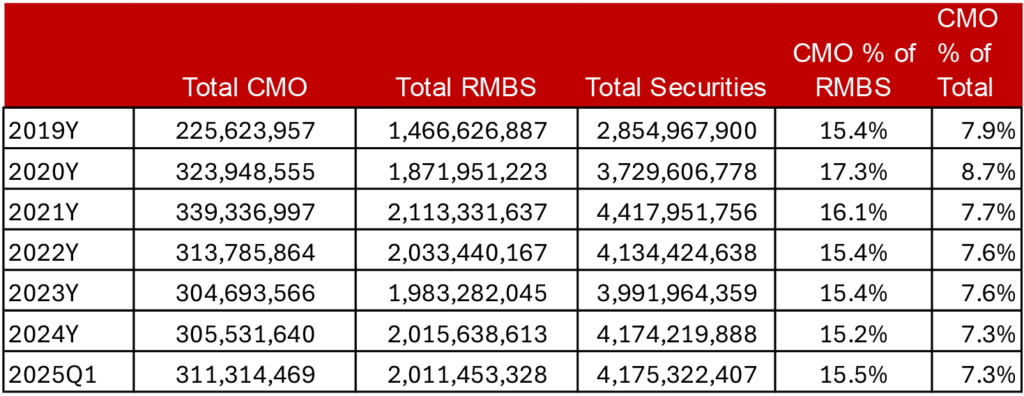
Measuring since the start of 2019, CMOs as a share of bank MBS holdings and total securities surged in 2020 as Covid-era monetary stimulus flooded bank balance sheets with deposits (Exhibit 2). These deposits, to a large degree, could not be offset by newly originated loans as lending standards tightened against a contracting economy, forcing banks increasingly into securities to defend their net interest margins.
Exhibit 2: CMO holdings surge then wane post COVID and SVB
Source: Santander US Capital Markets, S&P Capital IQ
CMOs subsequently have made up a smaller share of bank investment portfolios, holding fairly steady at roughly 15% of total MBS holdings and just over 7% of total securities. Admittedly, the bank holdings data is lagged, and we may have a clearer picture of more meaningful bank demand once the second quarter 2025 data is available. However, a meaningful uptick in bank demand for CMOs would go against a multiple-year trend of a weakened appetite for the product.
Money manager and hedge fund demand
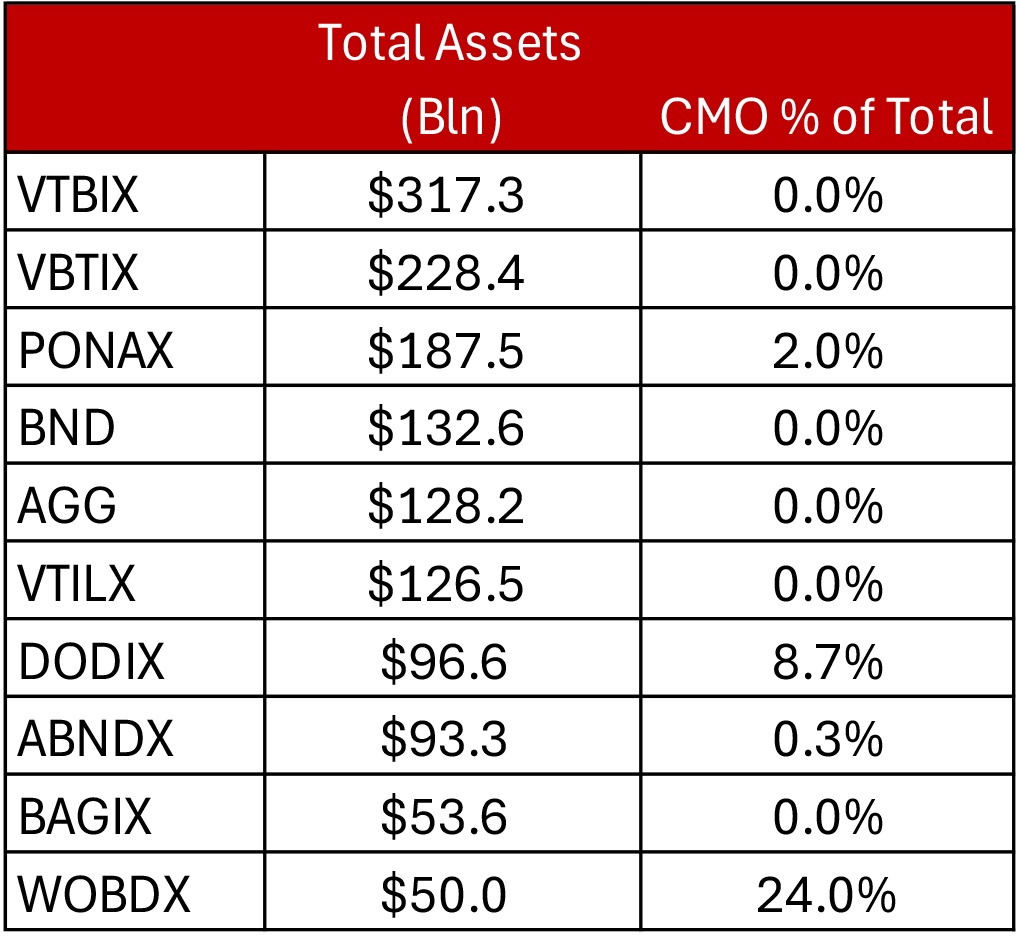
Quantifying demand from money managers and hedge funds can be somewhat more challenging. Money managers do report holdings at the CUSIP level but that reporting is delayed and tracking hedge fund purchases of MBS requires relying on Treasury data that tracks foreign purchases of US agency debt and MBS by foreign investors. Purchases of MBS by investors in the Caribbean serve as a reasonable proxy for hedge fund buying but leaves some ambiguity as to whether that demand is coming in pass-though or structured form. As of the end of March, the largest mutual funds benched to the US Aggregate Bond Index held very little in the way of CMOs, suggesting that money manager demand may be coming from either smaller or unconstrained bond funds rather than large index buyers (Exhibit 3). Hedge fund buying surged in May with funds adding more than $20 billion in net MBS exposure.
Exhibit 3: Only a few large mutual funds own CMOs
Source: Santander US Capital Markets, Bloomberg LP
Relative value driving hedge fund and money manager purchases
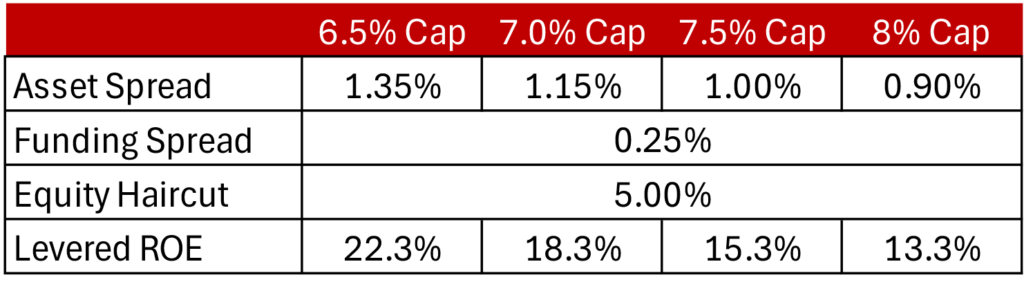
Elevated demand for CMOs from hedge funds and money managers looks to be primarily driven by attractive relative value. CMO floaters offer wide spreads, little interest rate duration and finance efficiently, making them a competitive levered carry vehicle for hedge funds. And strong inverse IO execution on the other side of the structure has left floater spreads relatively wide, creating the opportunity for funds to generate total return if spreads were to tighten on strip floaters with reasonably long spread duration. Depending on the cap, hedge funds can generate estimated levered returns of 13% to 22% (Exhibit 4). To date, the majority of hedge fund buying has been localized to lower caps with more spread duration that should show a more pronounced price response to Fed cuts than higher cap strikes.
Exhibit 4: Floaters offer attractive levered returns for hedge fund investors
Source: Santander US Capital Market
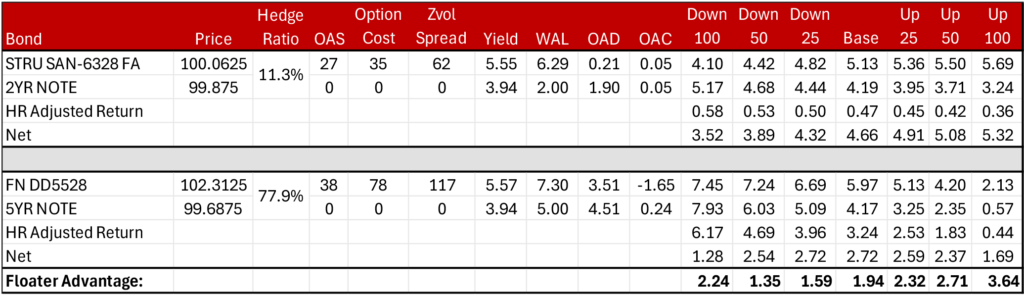
The value proposition for money managers is somewhat different but no less compelling as floaters currently offer a substantial hedge adjusted total return advantage over the underlying collateral. An example of this is a bond like STRU SAN-6328 FA, a 7.0% cap PAC floater backed by $300, 000 maximum loan balance 6.0% pools. Comparing the 7.0% cap floater to one of the underlying pools, FN DD5528, shows that while the fixed-rate pool offers slightly more Treasury OAS, the floater offers markedly better hedge-adjusted total returns, besting the pool by anywhere from 1.35% to 3.64% across modeled scenarios (Exhibit 5).
Exhibit 5: Floaters offer better hedge adjusted returns than underlying collateral
Source: Santander US Capital Markets, YieldBook
Note: 2yr and 5yr duration hedges are expressed as absolute returns. HR adjusted return expresses the hedge return in each scenario times the duration neutral hedge ratio. Net returns are calculated as the asset return less the HR adjusted return. Floater advantage is the hedged floater returns less the hedged fixed rate specified pool return.
This material is intended only for institutional investors and does not carry all of the independence and disclosure standards of retail debt research reports. In the preparation of this material, the author may have consulted or otherwise discussed the matters referenced herein with one or more of SCM’s trading desks, any of which may have accumulated or otherwise taken a position, long or short, in any of the financial instruments discussed in or related to this material. Further, SCM may act as a market maker or principal dealer and may have proprietary interests that differ or conflict with the recipient hereof, in connection with any financial instrument discussed in or related to this material.
This message, including any attachments or links contained herein, is subject to important disclaimers, conditions, and disclosures regarding Electronic Communications, which you can find at https://portfolio-strategy.apsec.com/sancap-disclaimers-and-disclosures.
Important Disclaimers
Copyright © 2026 Santander US Capital Markets LLC and its affiliates (“SCM”). All rights reserved. SCM is a member of FINRA and SIPC. This material is intended for limited distribution to institutions only and is not publicly available. Any unauthorized use or disclosure is prohibited.
In making this material available, SCM (i) is not providing any advice to the recipient, including, without limitation, any advice as to investment, legal, accounting, tax and financial matters, (ii) is not acting as an advisor or fiduciary in respect of the recipient, (iii) is not making any predictions or projections and (iv) intends that any recipient to which SCM has provided this material is an “institutional investor” (as defined under applicable law and regulation, including FINRA Rule 4512 and that this material will not be disseminated, in whole or part, to any third party by the recipient.
The author of this material is an economist, desk strategist or trader. In the preparation of this material, the author may have consulted or otherwise discussed the matters referenced herein with one or more of SCM’s trading desks, any of which may have accumulated or otherwise taken a position, long or short, in any of the financial instruments discussed in or related to this material. Further, SCM or any of its affiliates may act as a market maker or principal dealer and may have proprietary interests that differ or conflict with the recipient hereof, in connection with any financial instrument discussed in or related to this material.
This material (i) has been prepared for information purposes only and does not constitute a solicitation or an offer to buy or sell any securities, related investments or other financial instruments, (ii) is neither research, a “research report” as commonly understood under the securities laws and regulations promulgated thereunder nor the product of a research department, (iii) or parts thereof may have been obtained from various sources, the reliability of which has not been verified and cannot be guaranteed by SCM, (iv) should not be reproduced or disclosed to any other person, without SCM’s prior consent and (v) is not intended for distribution in any jurisdiction in which its distribution would be prohibited.
In connection with this material, SCM (i) makes no representation or warranties as to the appropriateness or reliance for use in any transaction or as to the permissibility or legality of any financial instrument in any jurisdiction, (ii) believes the information in this material to be reliable, has not independently verified such information and makes no representation, express or implied, with regard to the accuracy or completeness of such information, (iii) accepts no responsibility or liability as to any reliance placed, or investment decision made, on the basis of such information by the recipient and (iv) does not undertake, and disclaims any duty to undertake, to update or to revise the information contained in this material.
Unless otherwise stated, the views, opinions, forecasts, valuations, or estimates contained in this material are those solely of the author, as of the date of publication of this material, and are subject to change without notice. The recipient of this material should make an independent evaluation of this information and make such other investigations as the recipient considers necessary (including obtaining independent financial advice), before transacting in any financial market or instrument discussed in or related to this material.
Important disclaimers for clients in the EU and UK
This publication has been prepared by Trading Desk Strategists within the Sales and Trading functions of Santander US Capital Markets LLC (“SanCap”), the US registered broker-dealer of Santander Corporate & Investment Banking. This communication is distributed in the EEA by Banco Santander S.A., a credit institution registered in Spain and authorised and regulated by the Bank of Spain and the CNMV. Any EEA recipient of this communication that would like to affect any transaction in any security or issuer discussed herein should do so with Banco Santander S.A. or any of its affiliates (together “Santander”). This communication has been distributed in the UK by Banco Santander, S.A.’s London branch, authorised by the Bank of Spain and subject to regulatory oversight on certain matters by the Financial Conduct Authority (FCA) and the Prudential Regulation Authority (PRA).
The publication is intended for exclusive use for Professional Clients and Eligible Counterparties as defined by MiFID II and is not intended for use by retail customers or for any persons or entities in any jurisdictions or country where such distribution or use would be contrary to local law or regulation.
This material is not a product of Santander´s Research Team and does not constitute independent investment research. This is a marketing communication and may contain ¨investment recommendations¨ as defined by the Market Abuse Regulation 596/2014 ("MAR"). This publication has not been prepared in accordance with legal requirements designed to promote the independence of research and is not subject to any prohibition on dealing ahead of the dissemination of investment research. The author, date and time of the production of this publication are as indicated herein.
This publication does not constitute investment advice and may not be relied upon to form an investment decision, nor should it be construed as any offer to sell or issue or invitation to purchase, acquire or subscribe for any instruments referred herein. The publication has been prepared in good faith and based on information Santander considers reliable as of the date of publication, but Santander does not guarantee or represent, express or implied, that such information is accurate or complete. All estimates, forecasts and opinions are current as at the date of this publication and are subject to change without notice. Unless otherwise indicated, Santander does not intend to update this publication. The views and commentary in this publication may not be objective or independent of the interests of the Trading and Sales functions of Santander, who may be active participants in the markets, investments or strategies referred to herein and/or may receive compensation from investment banking and non-investment banking services from entities mentioned herein. Santander may trade as principal, make a market or hold positions in instruments (or related derivatives) and/or hold financial interest in entities discussed herein. Santander may provide market commentary or trading strategies to other clients or engage in transactions which may differ from views expressed herein. Santander may have acted upon the contents of this publication prior to you having received it.
This publication is intended for the exclusive use of the recipient and must not be reproduced, redistributed or transmitted, in whole or in part, without Santander’s consent. The recipient agrees to keep confidential at all times information contained herein.