By the Numbers
VA servicers have a large influence on refinancing
This material is a Marketing Communication and does not constitute Independent Investment Research.
Ginnie Mae speeds accelerated in January as lower mortgage rates allowed VA borrowers to refinance their mortgages. But most of the increase was driven by a handful of lenders. Seven VA lenders’ loans prepaid faster than typical, and those lenders pooled 75% of all streamlined refinances this year. The two fastest lenders accounted for nearly 30% of all new streamline refinances. As the multi issuer pools become more heavily concentrated in VA loans, investors may find opportunities in loans serviced by less aggressive VA lenders.
Seven VA lender’s loans prepaid faster than the typical VA loan over the last three months (Exhibit 1). Refinancing activity of VA loans jumped in January and stayed elevated in February and March in response to lower mortgage rates, but the refinance response was muted in FHA and conventional loans. VA speeds increased because VA borrowers were offered much lower rates to refinance than to buy a home and much lower rates than conventional and FHA borrowers. That behavior appears to have been concentrated in these lenders. The two fastest lenders were Village Capital and Freedom Mortgage, whose loans respectively prepaid 79.9% and 64.7% faster than typical VA loans, while the slowest lender’s loans prepaid nearly 65% slower than expected. The absolute speed differences are also large across lenders. For example, Village Capital’s loans prepaid 67.5 CPR while U.S. Bank’s prepaid 13.1 CPR.
Exhibit 1. Servicer prepayment comparison for higher coupon VA loans.
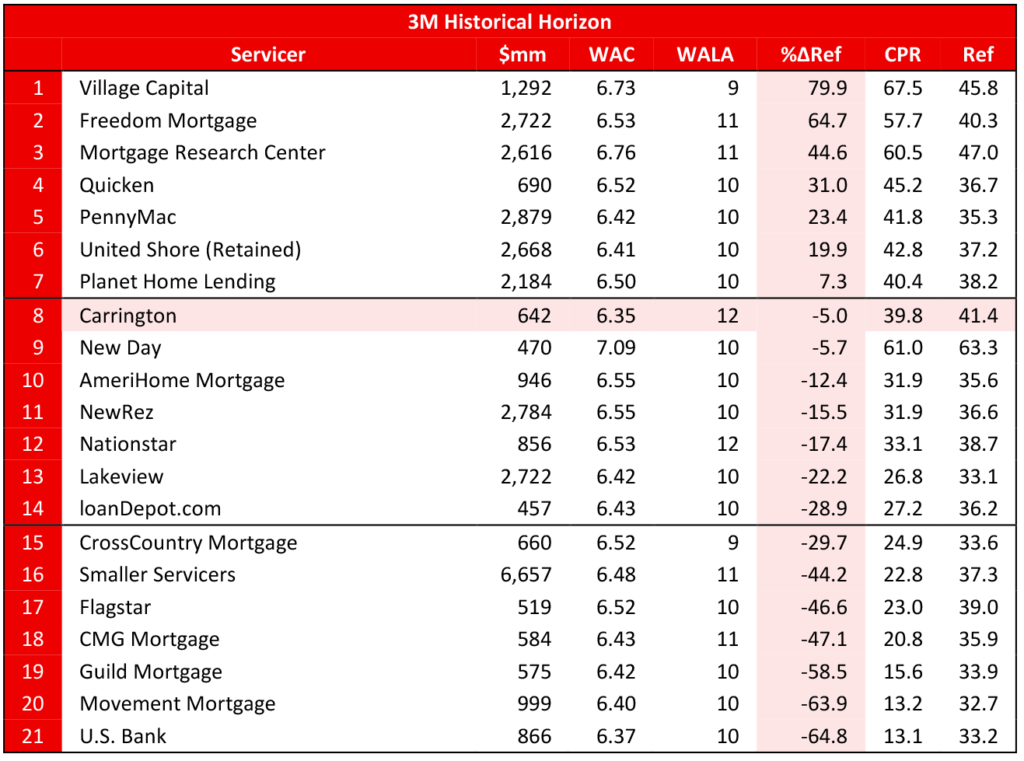
%ΔRef is the percent difference between the “CPR” (actual speed) and “Ref” (reference speed of typical VA loans with collateral characteristics similar to that servicer’s loans), calculated using SMM. Population is 30-year VA loans in 30-year TBA-deliverable pools with original loan size at least $300,000, loan age ≥6 months, and note rate at least 6%.
Source: Ginnie Mae, Santander US Capital Markets.
The reference speed is calculated as part of the Santander US Capital Markets Servicer Ranking report, but this table includes only a subset of VA loans that were more likely to refinance—30-year VA loans with original loan size at least $300,000, at least six months seasoned, and with a note rate at least 6%.
The seven fast lenders accounted for 75% of all VA streamlined refinance loans pooled over the last three months. But these same lenders accounted for only 49% of all purchase loans originated over that time, suggesting that the faster lenders are aggressively pursuing VA borrowers with offers to refinance. The two fastest lenders accounted for nearly 30% of streamlined refinances but only 13% of purchases. And the fastest lender—Village Capital—accounted for 13% of refinance volume but only 2% of purchase volume.
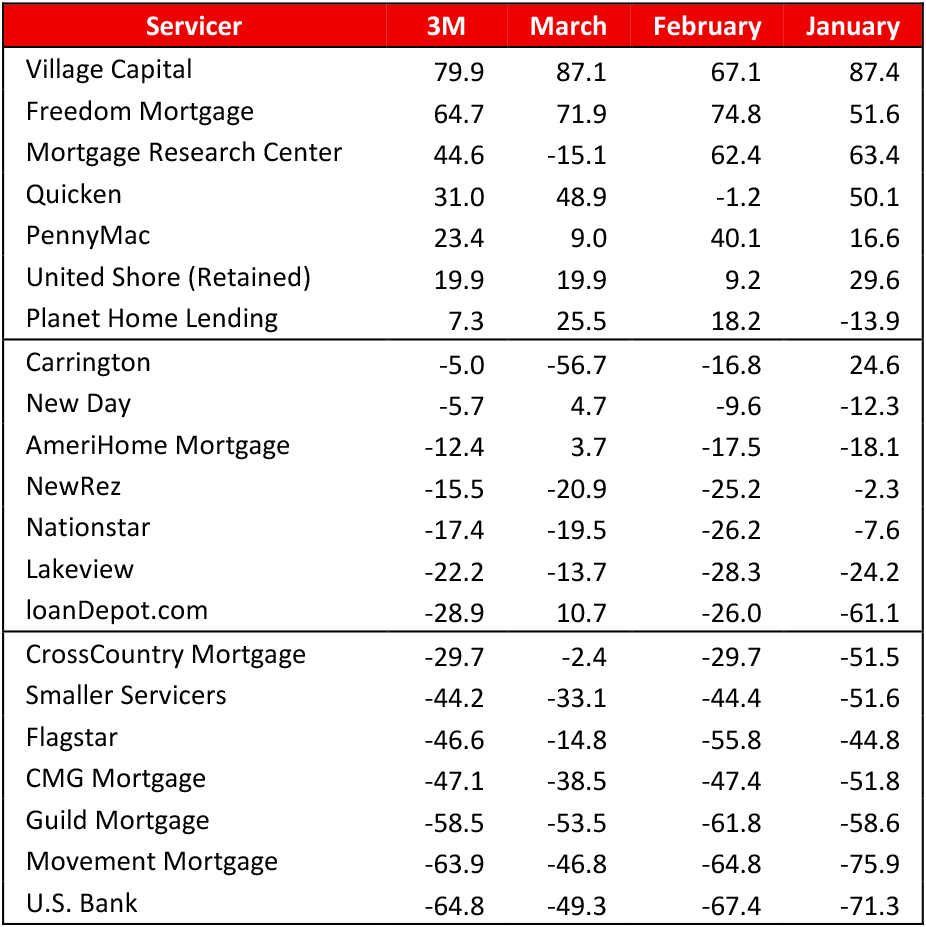
Servicer behavior was generally consistent across all three months, although there were some exceptions (Exhibit 2). Either Village Capital or Freedom Mortgage were the fastest servicer each month; Mortgage Research Center (Veterans United Home Loans) was also very fast in January and February but slowed markedly in March. Quicken’s loans also prepaid quickly, but only in January and March. Aggregate speeds tended to slow a bit in March since mortgage rates have increased, but the relative behavior across servicers didn’t change much.
Exhibit 2. Fast and slow VA servicers over the last 3 months (% faster/slower than the typical loan).
Source: Ginnie Mae, Santander US Capital Markets
Most of the slow lenders were similarly consistently slow. For example, U.S. Bank’s loans prepaid 49.3% slower than typical in March, 67.4% slower in February, and 71.3% slower in January. CMG, Guild, and Movement were similarly very slow in each of the three months. The group of smaller servicers was also quite slow, averaging 44.2% slower than typical over those months.
Ginnie Mae cautioned servicers last week that it is monitoring prepayment behavior and could take corrective action if needed. In 2018 Ginnie Mae temporarily prevented three lenders from delivering loans into multi-issuer pools due to fast speeds. In the meantime, the TBA is likely to deteriorate as more non-VA loans are pooled into custom pools that are not TBA deliverable. Pay-ups for custom pools should increase as this happens. Eventually if the TBA becomes primarily VA loans then some of the slower VA lenders’ loans might become a source of inexpensive prepayment protection.
This material is intended only for institutional investors and does not carry all of the independence and disclosure standards of retail debt research reports. In the preparation of this material, the author may have consulted or otherwise discussed the matters referenced herein with one or more of SCM’s trading desks, any of which may have accumulated or otherwise taken a position, long or short, in any of the financial instruments discussed in or related to this material. Further, SCM may act as a market maker or principal dealer and may have proprietary interests that differ or conflict with the recipient hereof, in connection with any financial instrument discussed in or related to this material.
This message, including any attachments or links contained herein, is subject to important disclaimers, conditions, and disclosures regarding Electronic Communications, which you can find at https://portfolio-strategy.apsec.com/sancap-disclaimers-and-disclosures.
Important Disclaimers
Copyright © 2026 Santander US Capital Markets LLC and its affiliates (“SCM”). All rights reserved. SCM is a member of FINRA and SIPC. This material is intended for limited distribution to institutions only and is not publicly available. Any unauthorized use or disclosure is prohibited.
In making this material available, SCM (i) is not providing any advice to the recipient, including, without limitation, any advice as to investment, legal, accounting, tax and financial matters, (ii) is not acting as an advisor or fiduciary in respect of the recipient, (iii) is not making any predictions or projections and (iv) intends that any recipient to which SCM has provided this material is an “institutional investor” (as defined under applicable law and regulation, including FINRA Rule 4512 and that this material will not be disseminated, in whole or part, to any third party by the recipient.
The author of this material is an economist, desk strategist or trader. In the preparation of this material, the author may have consulted or otherwise discussed the matters referenced herein with one or more of SCM’s trading desks, any of which may have accumulated or otherwise taken a position, long or short, in any of the financial instruments discussed in or related to this material. Further, SCM or any of its affiliates may act as a market maker or principal dealer and may have proprietary interests that differ or conflict with the recipient hereof, in connection with any financial instrument discussed in or related to this material.
This material (i) has been prepared for information purposes only and does not constitute a solicitation or an offer to buy or sell any securities, related investments or other financial instruments, (ii) is neither research, a “research report” as commonly understood under the securities laws and regulations promulgated thereunder nor the product of a research department, (iii) or parts thereof may have been obtained from various sources, the reliability of which has not been verified and cannot be guaranteed by SCM, (iv) should not be reproduced or disclosed to any other person, without SCM’s prior consent and (v) is not intended for distribution in any jurisdiction in which its distribution would be prohibited.
In connection with this material, SCM (i) makes no representation or warranties as to the appropriateness or reliance for use in any transaction or as to the permissibility or legality of any financial instrument in any jurisdiction, (ii) believes the information in this material to be reliable, has not independently verified such information and makes no representation, express or implied, with regard to the accuracy or completeness of such information, (iii) accepts no responsibility or liability as to any reliance placed, or investment decision made, on the basis of such information by the recipient and (iv) does not undertake, and disclaims any duty to undertake, to update or to revise the information contained in this material.
Unless otherwise stated, the views, opinions, forecasts, valuations, or estimates contained in this material are those solely of the author, as of the date of publication of this material, and are subject to change without notice. The recipient of this material should make an independent evaluation of this information and make such other investigations as the recipient considers necessary (including obtaining independent financial advice), before transacting in any financial market or instrument discussed in or related to this material.
Important disclaimers for clients in the EU and UK
This publication has been prepared by Trading Desk Strategists within the Sales and Trading functions of Santander US Capital Markets LLC (“SanCap”), the US registered broker-dealer of Santander Corporate & Investment Banking. This communication is distributed in the EEA by Banco Santander S.A., a credit institution registered in Spain and authorised and regulated by the Bank of Spain and the CNMV. Any EEA recipient of this communication that would like to affect any transaction in any security or issuer discussed herein should do so with Banco Santander S.A. or any of its affiliates (together “Santander”). This communication has been distributed in the UK by Banco Santander, S.A.’s London branch, authorised by the Bank of Spain and subject to regulatory oversight on certain matters by the Financial Conduct Authority (FCA) and the Prudential Regulation Authority (PRA).
The publication is intended for exclusive use for Professional Clients and Eligible Counterparties as defined by MiFID II and is not intended for use by retail customers or for any persons or entities in any jurisdictions or country where such distribution or use would be contrary to local law or regulation.
This material is not a product of Santander´s Research Team and does not constitute independent investment research. This is a marketing communication and may contain ¨investment recommendations¨ as defined by the Market Abuse Regulation 596/2014 ("MAR"). This publication has not been prepared in accordance with legal requirements designed to promote the independence of research and is not subject to any prohibition on dealing ahead of the dissemination of investment research. The author, date and time of the production of this publication are as indicated herein.
This publication does not constitute investment advice and may not be relied upon to form an investment decision, nor should it be construed as any offer to sell or issue or invitation to purchase, acquire or subscribe for any instruments referred herein. The publication has been prepared in good faith and based on information Santander considers reliable as of the date of publication, but Santander does not guarantee or represent, express or implied, that such information is accurate or complete. All estimates, forecasts and opinions are current as at the date of this publication and are subject to change without notice. Unless otherwise indicated, Santander does not intend to update this publication. The views and commentary in this publication may not be objective or independent of the interests of the Trading and Sales functions of Santander, who may be active participants in the markets, investments or strategies referred to herein and/or may receive compensation from investment banking and non-investment banking services from entities mentioned herein. Santander may trade as principal, make a market or hold positions in instruments (or related derivatives) and/or hold financial interest in entities discussed herein. Santander may provide market commentary or trading strategies to other clients or engage in transactions which may differ from views expressed herein. Santander may have acted upon the contents of this publication prior to you having received it.
This publication is intended for the exclusive use of the recipient and must not be reproduced, redistributed or transmitted, in whole or in part, without Santander’s consent. The recipient agrees to keep confidential at all times information contained herein.