By the Numbers
Modified loans improve Ginnie Mae convexity
This material is a Marketing Communication and does not constitute Independent Investment Research.
Ginnie Mae speeds surged in January and February, led by faster prepayments by VA borrowers. This has led investors to look for pools backed by only FHA loans to improve convexity. One category of FHA loan that may dial up convexity further are loans modified to cure a delinquency. These loans tend to re-default quickly and require further loss mitigation or proceed to liquidation, lifting buyout rates even for loans trading below par. Modified loans also responded less to the lower rates that drove refinances in January and February. FHA loans can be modified to 30- or 40-year terms. The latter go into “ET” pools ineligible for delivery into TBA while the 30-year loans can go in TBA-deliverable multi pools or non-deliverable custom pools. Issuance of ET pools has increased steadily and now approaches $1 billion a month.
Prepayment speeds of premium coupon pools jumped in January and February 2024 in response to lower mortgage rates (Exhibit 1). The chart shows green bars with the total prepayment speed for loans in multiple issuer pools that have never been modified. The red bars show the speeds for the modified loans in those multiple issuer pools, while the purple bars show the speeds for 40-year modified loans in ET pools. The non-modified loans prepaid less than 10 CPR in 5.5%s and below, roughly 30 CPR in the 6.0%s and over 50 CPR in the 6.5%s. Speeds on the modified loans topped the pace in non-modified in all coupons except for the very refinanceable 6.5%s, where non-modified loans far outpaced modified ones. Note that modified 30-year loans show the most muted refinance response of all.
Exhibit 1. Prepayment speeds in January and February 2024.
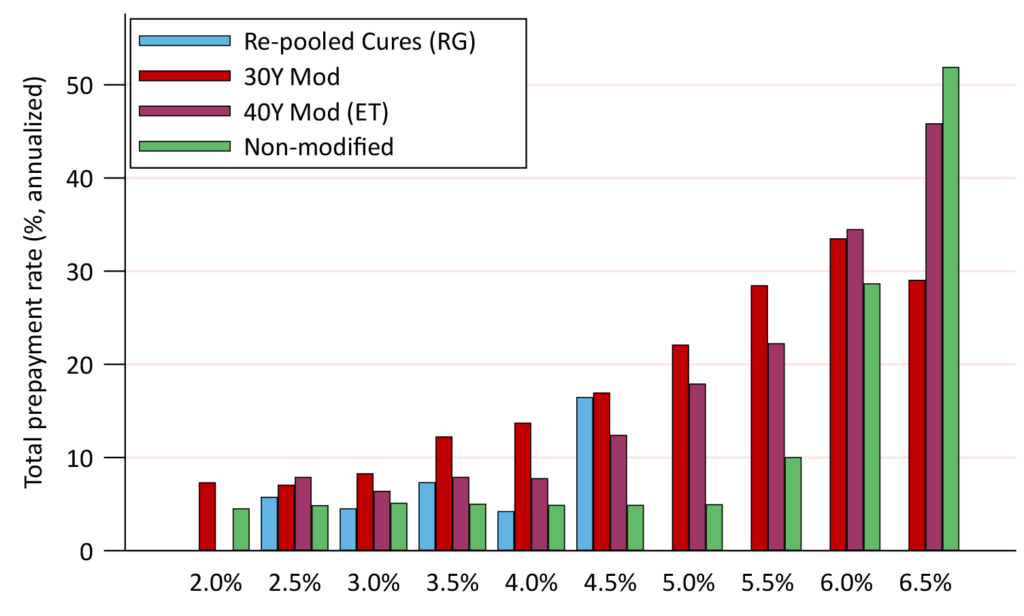
Prepayment speeds in January and February 2024. 30-year mods and the non-modified loans are in 30-year multiple issuer pools. Loans aged 6 to 36 months.
Source: Ginnie Mae, Santander US Capital Markets
The chart also shows the prepayment speeds for “RG” pools. These pools contained loans that became delinquent during Covid, were bought out by the servicer, cured without a modification, then re-pooled. The pools only exist in low coupons and speeds were generally a little slower than 30-year modified loans.
Voluntary prepayment speeds were slow in all coupons and loan types except for 6.0% and 6.5% non-modified loans (Exhibit 2). Borrowers with low coupons and borrowers with modified loans were unable to take advantage of lower mortgage rates.
Exhibit 2. Voluntary prepayment speeds in January and February.
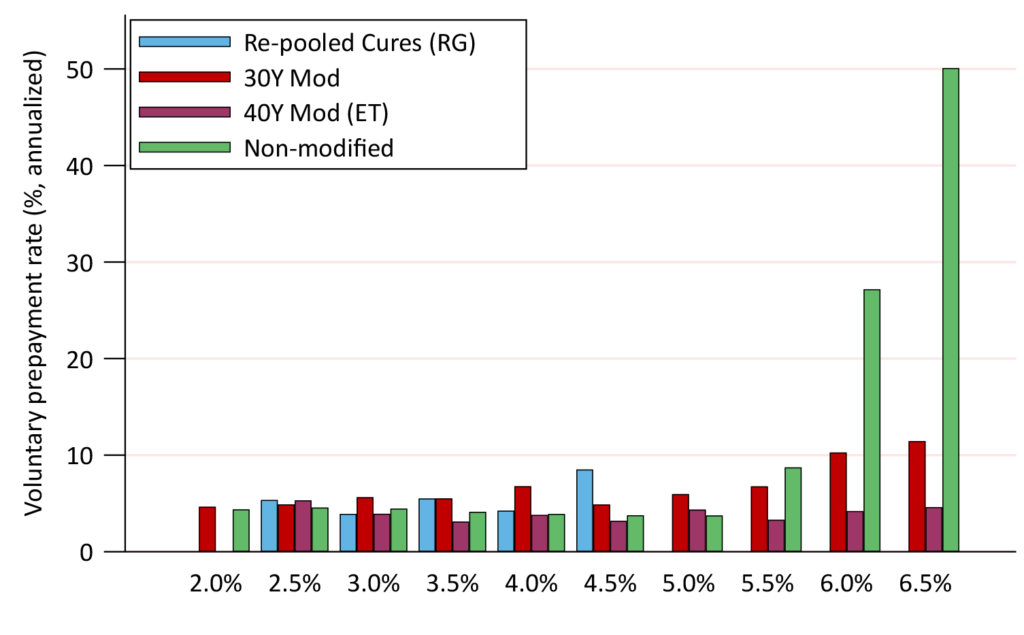
Voluntary repayment speeds in January and February 2024. 30-year mods and the non-modified loans are in 30-year multiple issuer pools. Loans aged 6 to 36 months.
Source: Ginnie Mae, Santander US Capital Markets
Fast prepayment speeds in the modified loans came from buyouts (Exhibit 3). Buyouts for the non-modified loans were less than 5 CPR in all coupons, while the buyout rates of 40-year loans topped 40 CPR in 6.5%s. Servicers must buyout loans that are modified, enter foreclosure or reach some other liquidation event, and this likely is the reason for most of the buyouts during those months. Servicers also have the option to buyout loans that are at least 90-days delinquent from Ginnie Mae pools. But that buyout is at par, so servicers will only exercise that option for loans trading above par. It is likely that all the buyouts in 5%s and below, and most of the buyouts in 5.5%s, were mandatory buyouts.
Exhibit 3. Prepayment speeds from buyouts in January and February.
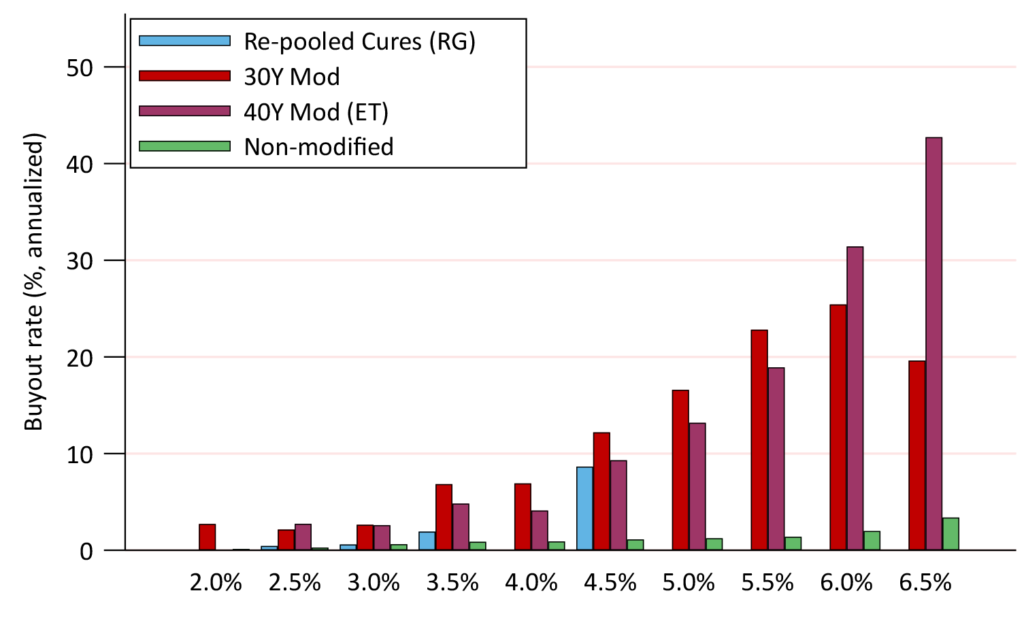
Buyout rates in January and February 2024. 30-year mods and the non-modified loans are in 30-year multiple issuer pools. Loans aged 6 to 36 months.
Source: Ginnie Mae, Santander US Capital Markets
Comparing buyout rates during 2023 to the buyout rates in 2024 shows there was little change from lower rates (Exhibit 4). This shows the buyout rates for 30-year modified loans and speeds in January and February were generally within a few CPR of the speeds in 2023. This lends support to the idea that most buyouts of delinquent modified loans are mandated, not optional.
Exhibit 4. Comparing buyout rates in 2023 to early 2024 for 30-year mods.
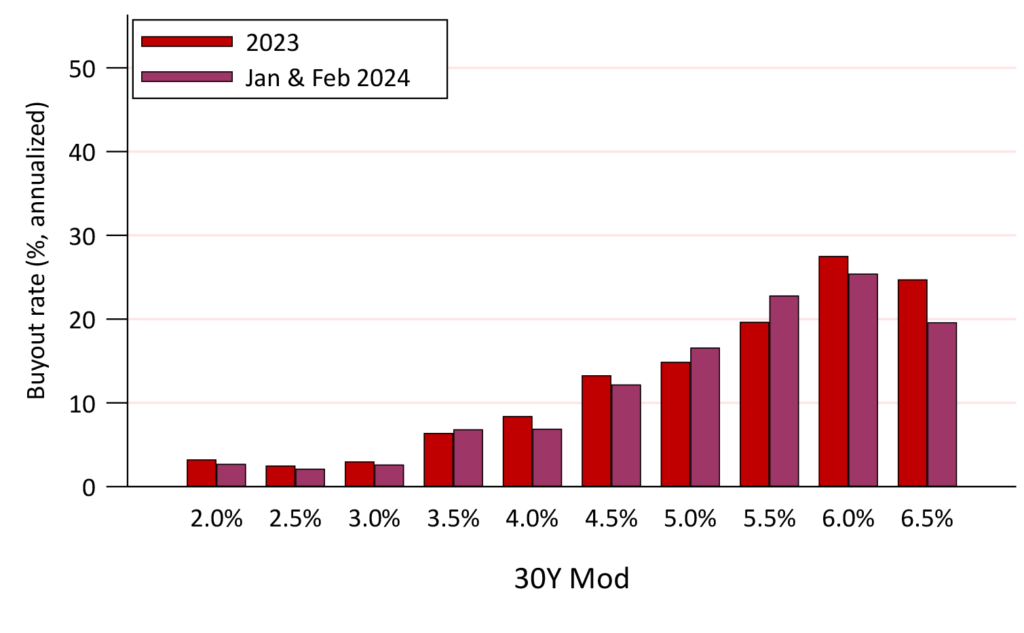
Transition rate of loans <90 days delinquent to ≥90 days delinquent.
Source: Ginnie Mae, Santander US Capital Markets
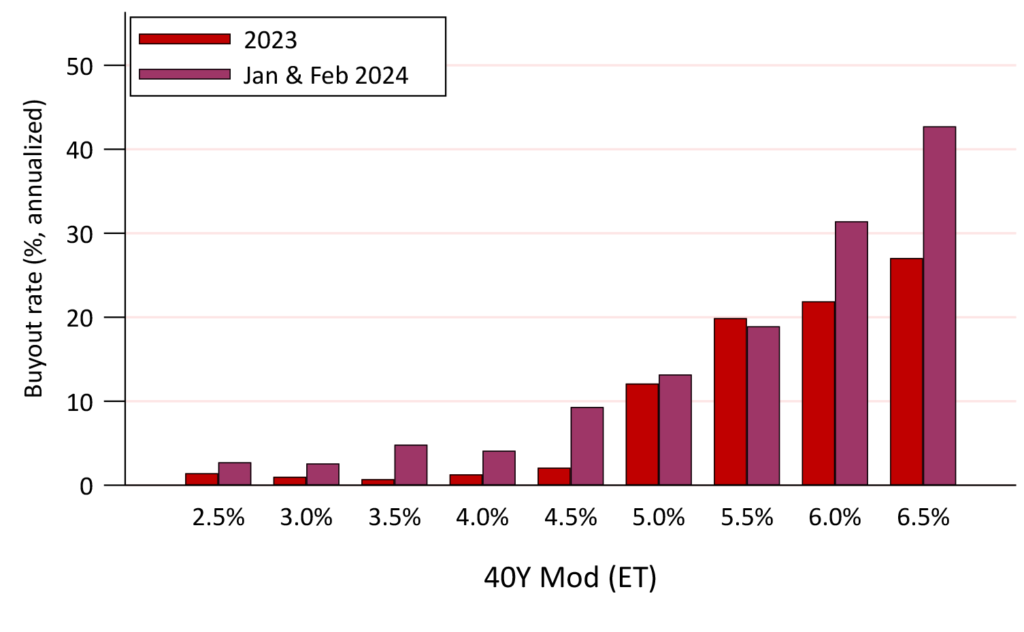
The loans modified to 40-year terms show a bit of a pickup in buyout rates in 6.0%s and 6.5%s (Exhibit 4). So, there may have been a pickup in optional buyouts in those coupons, but they were not most of the buyouts in those coupons. The 5.0% and 5.5% coupons had similar buyout rates in the two time periods.
Exhibit 5. Comparing buyout rates in 2023 to early 2024 for 40-year mods.
Source: Ginnie Mae, Santander US Capital Markets
Modified FHA loans tend to re-default quickly, which leads to higher buyout rates (Exhibit 6). Loans that received 40-year modifications have the highest re-default rates, exceeding 10% per month before the loans reach 6 months of seasoning. Loans with 30-year mods were a little slower, peaking at about 8.5% per month. For comparison the default rate of loans that have never been modified was less than 1% per month. High default rates mean the pools generally have many delinquent loans that are unable to refinance if rates fall and likely to be bought out regardless of interest rates—a recipe for good convexity.
Exhibit 6. Transition rate to 90 days delinquent for FHA loans.
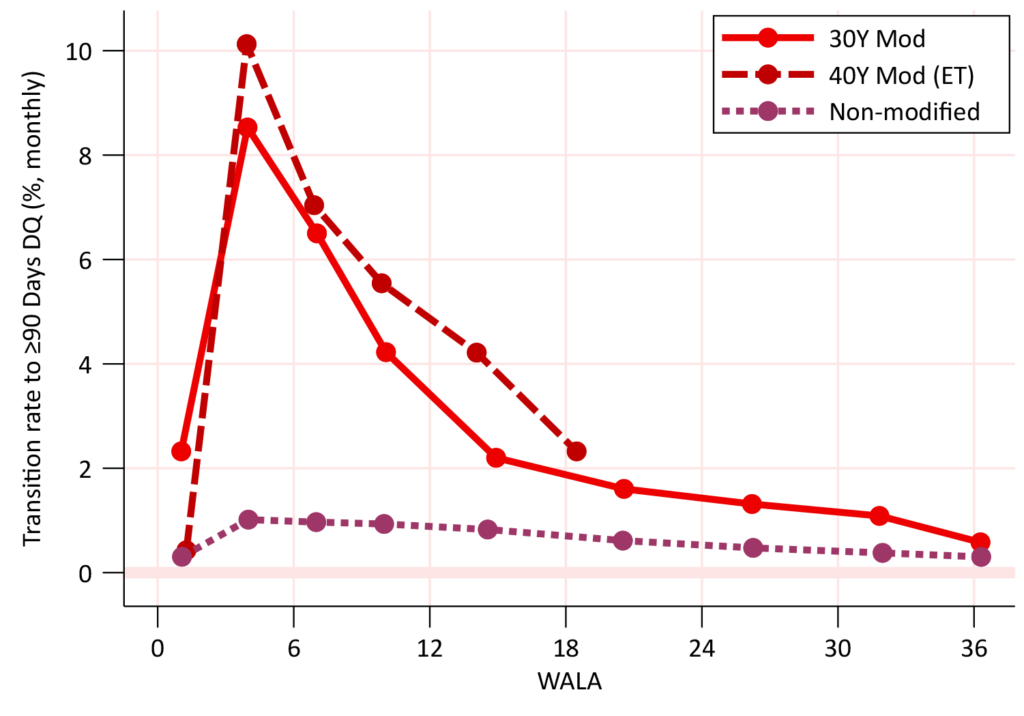
FHA loans originated in 2021 and later, less than 90 days delinquent. Performance from January 2023 to February 2024.
Source: Ginnie Mae, Santander US Capital Markets
Modified FHA loans are also less likely to cure without further loss mitigation (Exhibit 7). This shows the transition rate of loans at least 90 days delinquent back to current, most likely from receiving and FHA partial claim. The partial claim lets the borrower bring the loan current by creating a subordinate lien payable to the U.S. Department of Housing and Urban Development. This lien has no monthly payment, accrues no interest, and is only payable when the borrower moves, refinances into a non-FHA loan, or otherwise pays the loan in full. Delinquent loans that haven’t been modified are the most likely to cure, while 40-year modified loans are the least likely. Borrowers that have received a modification may be facing more financial distress than other borrowers and are less likely to benefit from a partial claim.
Exhibit 7. Transition rate from 90 days delinquent to current for FHA loans.
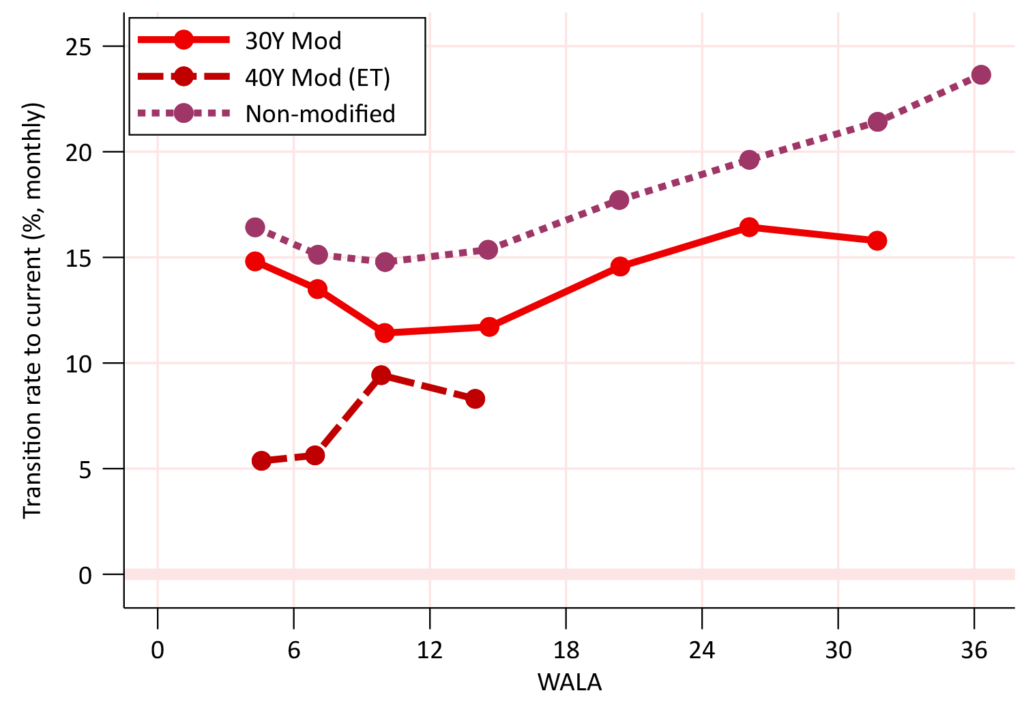
FHA loans originated in 2021 and later, at least 90 days delinquent. Performance from January 2023 to February 2024.
Source: Ginnie Mae, Santander US Capital Markets
The combination of fast transition rates into delinquency and low transition rates out of delinquency suggest that mandatory buyouts are likely to remain high on these loans. The FHA is implementing a new loss mitigation program that uses the partial claim funds to lower a borrower’s payment for three years, which could improve the cure rates on these loans. But it seems more likely that would benefit loans that have never been modified.
This material is intended only for institutional investors and does not carry all of the independence and disclosure standards of retail debt research reports. In the preparation of this material, the author may have consulted or otherwise discussed the matters referenced herein with one or more of SCM’s trading desks, any of which may have accumulated or otherwise taken a position, long or short, in any of the financial instruments discussed in or related to this material. Further, SCM may act as a market maker or principal dealer and may have proprietary interests that differ or conflict with the recipient hereof, in connection with any financial instrument discussed in or related to this material.
This message, including any attachments or links contained herein, is subject to important disclaimers, conditions, and disclosures regarding Electronic Communications, which you can find at https://portfolio-strategy.apsec.com/sancap-disclaimers-and-disclosures.
Important Disclaimers
Copyright © 2026 Santander US Capital Markets LLC and its affiliates (“SCM”). All rights reserved. SCM is a member of FINRA and SIPC. This material is intended for limited distribution to institutions only and is not publicly available. Any unauthorized use or disclosure is prohibited.
In making this material available, SCM (i) is not providing any advice to the recipient, including, without limitation, any advice as to investment, legal, accounting, tax and financial matters, (ii) is not acting as an advisor or fiduciary in respect of the recipient, (iii) is not making any predictions or projections and (iv) intends that any recipient to which SCM has provided this material is an “institutional investor” (as defined under applicable law and regulation, including FINRA Rule 4512 and that this material will not be disseminated, in whole or part, to any third party by the recipient.
The author of this material is an economist, desk strategist or trader. In the preparation of this material, the author may have consulted or otherwise discussed the matters referenced herein with one or more of SCM’s trading desks, any of which may have accumulated or otherwise taken a position, long or short, in any of the financial instruments discussed in or related to this material. Further, SCM or any of its affiliates may act as a market maker or principal dealer and may have proprietary interests that differ or conflict with the recipient hereof, in connection with any financial instrument discussed in or related to this material.
This material (i) has been prepared for information purposes only and does not constitute a solicitation or an offer to buy or sell any securities, related investments or other financial instruments, (ii) is neither research, a “research report” as commonly understood under the securities laws and regulations promulgated thereunder nor the product of a research department, (iii) or parts thereof may have been obtained from various sources, the reliability of which has not been verified and cannot be guaranteed by SCM, (iv) should not be reproduced or disclosed to any other person, without SCM’s prior consent and (v) is not intended for distribution in any jurisdiction in which its distribution would be prohibited.
In connection with this material, SCM (i) makes no representation or warranties as to the appropriateness or reliance for use in any transaction or as to the permissibility or legality of any financial instrument in any jurisdiction, (ii) believes the information in this material to be reliable, has not independently verified such information and makes no representation, express or implied, with regard to the accuracy or completeness of such information, (iii) accepts no responsibility or liability as to any reliance placed, or investment decision made, on the basis of such information by the recipient and (iv) does not undertake, and disclaims any duty to undertake, to update or to revise the information contained in this material.
Unless otherwise stated, the views, opinions, forecasts, valuations, or estimates contained in this material are those solely of the author, as of the date of publication of this material, and are subject to change without notice. The recipient of this material should make an independent evaluation of this information and make such other investigations as the recipient considers necessary (including obtaining independent financial advice), before transacting in any financial market or instrument discussed in or related to this material.
Important disclaimers for clients in the EU and UK
This publication has been prepared by Trading Desk Strategists within the Sales and Trading functions of Santander US Capital Markets LLC (“SanCap”), the US registered broker-dealer of Santander Corporate & Investment Banking. This communication is distributed in the EEA by Banco Santander S.A., a credit institution registered in Spain and authorised and regulated by the Bank of Spain and the CNMV. Any EEA recipient of this communication that would like to affect any transaction in any security or issuer discussed herein should do so with Banco Santander S.A. or any of its affiliates (together “Santander”). This communication has been distributed in the UK by Banco Santander, S.A.’s London branch, authorised by the Bank of Spain and subject to regulatory oversight on certain matters by the Financial Conduct Authority (FCA) and the Prudential Regulation Authority (PRA).
The publication is intended for exclusive use for Professional Clients and Eligible Counterparties as defined by MiFID II and is not intended for use by retail customers or for any persons or entities in any jurisdictions or country where such distribution or use would be contrary to local law or regulation.
This material is not a product of Santander´s Research Team and does not constitute independent investment research. This is a marketing communication and may contain ¨investment recommendations¨ as defined by the Market Abuse Regulation 596/2014 ("MAR"). This publication has not been prepared in accordance with legal requirements designed to promote the independence of research and is not subject to any prohibition on dealing ahead of the dissemination of investment research. The author, date and time of the production of this publication are as indicated herein.
This publication does not constitute investment advice and may not be relied upon to form an investment decision, nor should it be construed as any offer to sell or issue or invitation to purchase, acquire or subscribe for any instruments referred herein. The publication has been prepared in good faith and based on information Santander considers reliable as of the date of publication, but Santander does not guarantee or represent, express or implied, that such information is accurate or complete. All estimates, forecasts and opinions are current as at the date of this publication and are subject to change without notice. Unless otherwise indicated, Santander does not intend to update this publication. The views and commentary in this publication may not be objective or independent of the interests of the Trading and Sales functions of Santander, who may be active participants in the markets, investments or strategies referred to herein and/or may receive compensation from investment banking and non-investment banking services from entities mentioned herein. Santander may trade as principal, make a market or hold positions in instruments (or related derivatives) and/or hold financial interest in entities discussed herein. Santander may provide market commentary or trading strategies to other clients or engage in transactions which may differ from views expressed herein. Santander may have acted upon the contents of this publication prior to you having received it.
This publication is intended for the exclusive use of the recipient and must not be reproduced, redistributed or transmitted, in whole or in part, without Santander’s consent. The recipient agrees to keep confidential at all times information contained herein.